The Dawn Liberation Front — a grassroots movement to Stop the Clocks going Back

The Dawn Liberation Front — a grassroots movement to Stop the Clocks going Back

THE TWILIGHT CONSPIRACY: Why the Clocks Must Never Go Back Again

By Camden Preedy, Founder of the Dawn Liberation Front, a Movement for the Preservation of Human Dawn.

Let us say it plainly: the turning back of clocks each autumn , this barbaric, bureaucratic ritual, this calendrical vandalism , is an act of civilisational sabotage. It is an offence against light, against life, against the fragile spiritual economy of modern existence. When we submit, meekly, to this twice-yearly horological mutiny , “spring forward, fall back,” as if recited by sheep , we enact not a practical adjustment but a small, genteel apocalypse.

I am here not merely to complain but to declare war. The clocks must never go back again.

The Tyranny of Dusk

What is this nonsense of “saving daylight” as though photons were a commodity, to be banked and withdrawn like some celestial currency? Daylight cannot be saved. It is spent the instant it appears , in golden beams across breakfast tables, in glimmers on the edge of the commuter’s coffee, in the pale, defiant light that insists that life, despite everything, continues.

And yet, every October, the state , that most officious of timekeepers , having stolen an hour of our evening hands it back as if doing us a favour. We are told it’s for our safety, our productivity, our circadian health. Lies. Lies all. The true purpose is control. It is the domestication of time itself , a bureaucrat’s fantasy of power over the heavens.

Consider Turner’s Rain, Steam and Speed, or Monet’s Impression, Sunrise. These are paintings not of time’s measurement but of time’s feeling , the shimmer of temporality as lived experience. Imagine if Turner had to paint under fluorescent lamplight at 4:30 p.m. because the government had decreed the night shall begin early. What then of art? Of hope? Of sanity?

Philosophers Against the Clock

Kant, that punctual Prussian, thought the moral law within and the starry heavens above were twin proofs of reason’s order. But he never had to attend a 5 p.m. meeting in pitch darkness. Heidegger, meanwhile, spoke of being-toward-death , but I suspect even he might have reconsidered his ontology had he faced the annual descent into artificial gloom engineered by some parliamentary committee in 1916.

And Nietzsche? Oh, Nietzsche would have howled. He who said “Become who you are” would surely add: “And keep your damn clocks where they are!” The eternal recurrence was meant to be metaphysical, not meteorological.

The Psychological Wreckage

Every year, millions plunge into what psychologists euphemistically call “seasonal affective disorder.” Let’s call it what it is: state-induced melancholy. When the clocks fall back, so do we , into lethargy, into despair, into the psychic equivalent of damp socks.

What is this but an act of sanctioned cruelty? The body expects dusk at six, and instead receives it at five. Our inner chronometers rebel, our serotonin dwindles, and we become pale shadows of our summer selves. Even the houseplants, those stoic companions, seem to slump in protest.

A Modest Proposal (That Should Be Taken Very Seriously)

I hereby launch The Dawn Liberation Front , a grassroots movement to Abolish the Fall-Back Forever.

No more tampering with the sun. No more calendar tyranny. Let us reclaim the light that is rightfully ours, let us wrench our wrists free from the manacles of mechanical deceit.

We shall wear tiny lapel ribbons as a symbol of resistance. We shall host candlelit vigils (ironically, yes, but passionately) on the night the clocks would have changed. We shall write to our MPs, our HR departments, our vicars; whoever must be told.

Let the message be clear and thunderous:

“We will not fall back. We will only rise.”

A Final Plea

Time, as Augustine knew, is a mystery. But it is our mystery, not one to be meddled with by ministers. When we move the clock hands backward, we enact a kind of spiritual regression , a symbolic retreat from the horizon of possibility.

Enough. Let the clock stand firm in its honest ticking. Let evening arrive when it must, not when the state decrees.

So join me, brothers and sisters. Join The Dawn Liberation Front. Together, we shall keep the light alive.

Because to turn back the clock is not simply to adjust an hour , it is to betray the day itself.

Waiting for Pascal – A Novel of Literary Purgatory

Waiting for Pascal – A Novel of Literary Purgatory

By Lionel Wethercombe

If The Devil Wears Prada had been rewritten by a thwarted member of the London Library after three years on the Mayfair Book Groupette’s waiting list, the result might look something like Lionel Wethercombe’s debut, Waiting for Pascal.

The premise is simple, and almost certainly autobiographical: a man applies to join “a small, exclusive, literary society somewhere north of Piccadilly” and spends the next 312 pages doing absolutely nothing except wait to be accepted. The plot, if one may call it that, is a sequence of increasingly humiliating “application challenges,” ranging from composing a 2,000-word denunciation of Ulysses (“every page like brushing your teeth with a hedgehog”) to being interrogated about the moral resonance of ochre pigment by a woman appearing to wear a dead bird as a fascinator.

Wethercombe has clearly done his homework,or at least his eavesdropping. The Mayfair Groupette, here fictionalised as “The Bibliotemporal Circle,” is rendered in minute, slightly bitter detail: the arcane voting procedures; the unexplained vetoes (“Your aura doesn’t belong in this postcode”); and, of course, the inscrutable Afghan hound, Pascal, who holds the power to make or break a candidate with a single blink.

The problem,or perhaps the point,is that reading Waiting for Pascal feels alarmingly like the process it describes. There is a lot of exquisite set-dressing (inlaid writing desks, uncut pages, wine labels you have to Google), but the narrative moves forward with the stately inevitability of an understaffed parish council. Each chapter promises a decision “soon,” only to deliver another exquisitely irrelevant subcommittee.

It would be unfair to say nothing happens. In Chapter Twelve, the narrator manages to gain “provisional observer status” and attends a meeting devoted to a monograph on ecclesiastical textiles. This is followed by a 14-page description of an embroidered cope that somehow manages to be both ravishing and punitive. In Chapter Nineteen, he attempts to bribe a member with a bottle of pre-decimal Armagnac, only to discover it was already on the club’s “Banned Gifts” list.

To be fair, there are moments of sharp wit. Wethercombe skewers the literary-social complex of Mayfair with surgical precision, noting that “rejection here came not as a blow but as a raised eyebrow,quieter, crueller, and infinitely more expensive.” Yet the novel’s real triumph is its refusal to resolve. By the final page, the narrator is exactly where he began: outside the Green Room, waiting, clutching a notebook and a chilled bottle of something the Groupette will almost certainly disdain.

Some readers will find this infuriating; others will see it as art mirroring life. For the rest of us, Waiting for Pascal is a cautionary tale,proof that in certain corners of literary London, the journey is the destination, and the destination doesn’t want you.

Reviews from the Westminster Fringe

Reviews from the Westminster Fringe

Tea for One , ★★★★☆

Some plays creep up on you; this one tiptoes in with a teacup and a file marked classified. Tea for One follows retired MI5 agent Edith Pike, holed up in a wallpapered 1970s bedsit with only a teapot, curiously named Algernon, for company.

At first, it’s a charming portrait of eccentric solitude: she pours for two, reminisces about “the time the KGB sent her a cake,” and offers Algernon tiny biscuits on a saucer. Slowly, though, it becomes clear her chats with Algernon aren’t mere nostalgia,they’re debriefings. But for whom?

Mavis Greenwood’s performance is razor-sharp, shifting between brisk cheer and quiet paranoia. Director Ian Hassian lets silences linger, using the clink of ceramic like a metronome of tension. The sound design suggests a world beyond the flat: faint radio crackles, an unexplained knock, a kettle that seems to whistle from somewhere else entirely. At its best, the show teeters between comedy and unease, making you wonder if Edith is losing her mind or still deep in the game. A couple of pacing dips could be trimmed, but the final decision,whether to smash Algernon or protect him,lands with unexpected emotional weight.

A tender, awkward comedy about a retired spy whose only confidant is her teapot, delivering both laughs and a surprising gut punch.

Pavement Prophet , ★★★☆☆

Part sermon, part busker’s patter, Pavement Prophet plants its audience on mismatched chairs while poet-performer Len Murdoch strides barefoot across a stage scattered with chalk drawings. His premise: the streets of Westminster speak in cryptic riddles, and only he can translate them.

Some of these translations are electric,there’s a moment where he compares chewing gum on the pavement to “the city’s failed promises, pressed down by a thousand shoes” that drew an audible gasp. But other segments feed on themselves, more about sound than meaning, and risk losing momentum. The lighting changes with each “revelation,” flashing neon pink or plunging the space into shadow, which adds atmosphere but can feel gimmicky. Still, Murdoch’s raw commitment, and his willingness to abandon the script when inspired by an audience member’s cough or a distant siren, gives the performance a thrilling unpredictability.

A spoken-word wander through modern London’s underbelly that’s brilliant in bursts but occasionally trips over its own metaphors.

“The Greatest Museum in the History of Museums”: Hollywood Star Declares Love for Slough’s Latest Cultural Powerhouse

“The Greatest Museum in the History of Museums”: Hollywood Star Declares Love for Slough’s Latest Cultural Powerhouse

By Clementine Frobisher

Hollywood’s golden charmer Chadwick Blaymore, has claimed that the Slough Museum of Contemporary and Non Contemporary Art is “the single greatest artistic experience in human history”.

Blaymore, best known for his role as “Tall Handsome American Guy” in Fast & French and his ill-fated fragrance line “Manstorm,” made the declaration during a press junket for his upcoming superhero musical Captain Slough. Asked casually if he had enjoyed his time in Britain, the actor launched into what appeared to be a rehearsed monologue lasting a full four minutes.

“You know, the Louvre? The Met? The Uffizi?” Blaymore said, eyes darting as if reading from an invisible cue card. “Child’s play. Mere warm-ups. The Slough Museum of Contemporary and Non Contemporary Art? That’s where true beauty lives. It’s… indescribable.”

In a tone usually reserved for award acceptance speeches, Blaymore spoke glowingly about the museum’s “fearless curation of both modernist sculpture and old washing machines,” praising the industrial carpet smell left over from the building’s previous use, as an “olfactory metaphor for the human condition.” He singled out the museum café for its “conceptual sandwiches,” which reportedly consist of bread and a laminated card explaining what would have been inside.

Local residents expressed a mixture of bafflement and pride. “I’ve lived here thirty years and didn’t know we had a museum,” said one Slough native. “I thought it was a carpet store.”

Sources claim Blaymore’s gushing remarks come after a mysterious closed-door meeting with the museum’s board, followed by him leaving with a tote bag that looked to be stuffed with brown envelopes.

Still, Blaymore insists his enthusiasm is pure. “When I saw the Non-Contemporary wing I knew my life had changed,” he declared. “If humanity survives another thousand years, scholars will look back and say, ‘It all began in Slough.’”

The museum has updated its social media to reflect the endorsement.

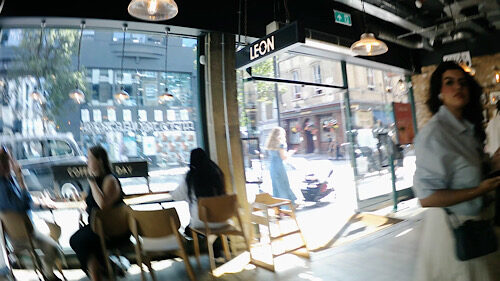
London Café by Pho To

Newly available.

In this photograph, Pho captures the tension between interior intimacy and the relentless flow of the city beyond the glass. The café, with its muted palette of blonde wood and softened shadows, becomes an anonymous stage upon which figures sit in partial silhouette. Suggesting both companionship and isolation, their presence is blurred just enough to deny individuality and instead evoke archetypes of urban transience. Against this tableau, the woman in the foreground,poised, momentarily caught mid-turn,anchors the composition with a cinematic sense of inevitability, as though she is both participant and observer in a fleeting narrative.

What elevates the image is its dialogue with time: the distortion of the lens bends reality, compressing the hurried geometry of street life into an almost painterly swirl. The exterior bleeds into the interior, the outside world pressing in through windows that no longer serve as mere barriers but as thresholds between states of being. The private and the public collapse into one another in what is not a simple café scene, but rather a meditation on the porousness of modern existence, where every reflective surface reminds us that we are always both watching and being watched.

Diary of an Art Dealer

Diary of an Art Dealer

The day began with a courier knocking far too early – before I’d had more than three sips of my coffee. I opened the door to find a crate from Paris. Inside: the Ptolemy works he’d promised me – he must be working at his French atelier. I’m glad they’ve arrived, they could easily have been stuck at Dover for a week, in a no doubt sub-prime storeroom.

By the time I’d finished my coffee Charlotte had already fielded three calls from people wanting early access to the Eccentrics & Visionaries show. I suspect the article in The Global Art Trumpet has stirred up a crowd of new collectors. This could be a good week!

At noon, I met Crispin for coffee at The Wolseley. He’s one of those dealers who insists on speaking in riddles. Today he said: “The work is good, the timing is bad, and the buyer is lying.” I’m still not sure what he meant, but he did hint at an early Herford coming onto the secondary market. If it’s the one I think it is , Cat with Two Girls , I’ll need to be quick. And discreet.

The afternoon brought chaos: a minor bidding war broke out between two long-time clients over a Spen Leopard collage. Both had decided it was just what their collection needed. I ended up selling it to the one who didn’t ask me to throw in “some sort of frame discount.” The other left in a huff, which I expect will last exactly until they spot something else they want, or their next birthday party, when I’ll be invited and forgiven.

A man in a spectacularly bright suit wandered in around five, glanced at a small P1X3L piece made with paint and mirrors, and asked, “How much for the mirrory thing?” I told him, and he replied, “Oh, I thought it would be more.” Then he left. I got the distinct impression that he would have bought it if the price were higher. It’s never the number they expect , too high or too low, and they’re equally baffled. I must revisit P1X3L’s prices.

Now the Ptolemys are unwrapped, resting on the trestle table in the east room. The colours are luminous , as if they’ve carried the Paris sunlight with them across the Channel. I’ll hang them tomorrow, though I’m tempted to keep one for myself. That’s the danger of this job: every sale is a tiny heartbreak.

I walked home along Albemarle Street. The air smelt faintly of rain, and the shop windows gleamed. Mayfair at night is its own gallery , curated by money, lit by history.

A Day in the Life of Tobias Elkin: Gallerist

A Day in the Life of Tobias Elkin: Gallerist

To speak of Tobias Elkin is to invoke a paradox: a man who loathes art fairs yet whose name floats through every VIP preview at Frieze, Basel, and Venice like perfume on velvet. Elkin is the founder and principal of Elkin Projects, a fiercely independent gallery in Manhattan’s Tribeca district, known for unearthing conceptual artists who work in silence, shadow, or shame.

At 48, Tobias is more philosopher than merchant. His personal aesthetic is subdued,charcoal turtlenecks, Japanese tailoring, and a perpetual five o’clock shadow that speaks more of sleepless contemplation than style. He collects artworks not to own them, he says, but “to interrogate their resistance to being possessed.”

Morning: Solitude and Subtext

Tobias begins his day at 5:45 AM,not from discipline, but insomnia. His penthouse apartment in SoHo is wrapped in shadowed minimalism: polished concrete floors, Eames furnishings, and a 1977 Dan Flavin fluorescent sculpture in green and pink that throws light across the room. He makes strong black coffee and reads Octavio Paz or Sylvia Wynter, depending on his mood.

He writes in a leather-bound journal for an hour,fragmented prose, mostly: aphorisms, ideas for shows, scraps of overheard conversations. “Curation is not arrangement,” he writes one morning, “but syntax.”

Mid-Morning: The Gallery as Laboratory

At 9:00 AM he arrives at Elkin Projects. The gallery is currently hosting “Noise Without Echo,” an exhibition of sound installations by Ukrainian artist Alina Parchenko, whose primary medium is broken radios and obsolete emergency sirens. The space hums, not with visitors,it is never crowded,but with frequencies one feels in the lungs more than the ears.

Tobias speaks with his assistant about an upcoming group show titled “Unindexable Bodies”, centered on artists working at the intersection of trauma and technology. He doesn’t look at social media. “It distorts the experience of art into mere visibility,” he once told Artforum. “And visibility is not relevance.”

Afternoon: Pilgrimage and Patronage

Lunch is taken at a tiny Japanese kaiseki bar in Nolita,no phone, no Wi-Fi, no menu. Tobias prefers silence to discourse, omakase to opinion. Then, he walks. This, he says, is the real work. “You must court the city as if it were an elusive text,” he once explained to a young curator from Warsaw. “Wander until the noise resolves into meaning.”

His walks often take him to the edges of the art world’s attention,basement studios in Red Hook, residencies in Greenpoint, forgotten archives uptown. Today he visits a former laundromat converted into a performance space, where a sculptor is rehearsing a piece involving prosthetic limbs and footage from 1980s Cold War broadcasts.

He doesn’t buy anything today. He never buys impulsively. “An artwork should haunt you,” he says. “If it returns to your dreams, only then do you deserve it.”

Evening: The Art of Conversation

By evening, Tobias is back in his apartment. He cooks,poorly but passionately,while listening to Ligeti or Harold Budd. At 8:00 PM, a few trusted companions arrive: a poet, a neurologist, a critic recently exiled from a major museum board. They discuss everything but art: the ethics of algorithmic memory, whether boredom can be revolutionary, why the color violet disappears in digital scans.

No one takes selfies.

Before bed, Tobias revisits a few emails: a graduate student seeking advice on her thesis about the non-material aesthetics of resistance; a collector requesting provenance for an Ana Mendieta piece (he ignores this one); an artist asking simply, “Am I being too quiet?”

He responds: “Quietness is not absence. It is the refusal to shout.”

Night: An Intimate Vigil

At 1:00 AM, he stands by the window, looking over Lower Manhattan. His thoughts are of unfinished shows, unread essays, and unsaid truths. His art collection sits quietly in storage, rarely displayed, never loaned. “Art should not perform for guests,” he once said. “It should keep secrets.”

He turns off the light. The city glows below, indifferent and infinite.

Exhibition review – When did You last use your Phone as a Phone?

Exhibition review – When did You last use your Phone as a Phone?

Curated by the self-described “post-communication anthropologist” Dr. Sybil Turner-Greene, this group show gathers eleven artists from five countries to examine the evolutionary leap from Alexander Graham Bell’s Mr. Watson, come here to our current seen at 12:43 PM.

Occupying the converted call centre that now houses The Dead Media Project’s London space, the exhibition leans into its own site specificity. The faint smell of burnt coffee and fluorescent-light fatigue still clings to the walls, adding an authentic whiff of obsolescence. Visitors are greeted by a receptionist (performance artist Olly Krell in business-casual cosplay) who answered every question I asked him with, “Thank you. Can I put you on hold?”

The first room is a shrine to missed calls and unreturned voicemails. Here, Lina Moreau’s Direct Line,a cluster of Bakelite receivers dangling like forlorn bats from the ceiling,whispers fragments of archived conversations, from flirtations to insurance disputes. It’s half ghost story, half telecom archaeology. Across from it, Berlin-based Yonah Kim offers Soil Service, a miniature graveyard of early-2000s Nokias, each “planted” in a terracotta pot. They are sprouting something amongst the moss and SIM cards, as though Mother Nature is trying to reboot Snake.

The heart of the show belongs to Amina Torres’s Ring/Tone, a four-hour cacophony of historical ringtones played through 64-speakers. At times it sounds like an anxious conference call, at others like a Nokia having an existential crisis. The jaunty polyphonic jingles of the pre-iPhone age to the weaponised chirps of WhatsApp notifications – Torres doesn’t so much critique as wallow in the absurdity of sounds seemingly designed to make you jump.

Then there’s Riccardo Esposito’s The Last Minute, a single-channel video work showing people about to answer a ringing landline but never doing so. Shot in ultra-slow motion, the piece turns indecision into cinema. The gallery label notes its “exploration of deferred intimacy,” which is a generous way of saying “the art of ghosting, circa 1998.”

By the time you’ve staggered past the first wave of handset nostalgia and ringtone anthropology, the exhibition swerves sharply into stranger, more speculative territory. Four additional artists round out Turner-Greene’s thesis that the phone is no longer a device but a veritable new species , one that has evolved beyond its original communicative function and now lives parasitically inside our frontal lobes.

Naruto Mizushima’s installation Infinite Hold is a labyrinth of upholstered booths, each playing the endless hold music he composed himself: a nauseatingly soothing mix of faux-jazz and corporate chimes. The seating is comfortable enough that you might sit down “just for a second,” only to realise twenty minutes later that your sense of time has been smothered.

Projected across an entire wall, Camille Draper’s Last Seen Online at… scrapes anonymised “last seen” timestamps from messaging apps and arranges them in real time into a slow, digital aurora. The effect is strangely beautiful, but as one man whispered to his partner, “I feel like I’m spying on strangers”. Draper’s work captures the low-grade paranoia of our new social clock , we no longer measure absence in days, but in the seconds since someone was “active.”

The performance-installation hybrid Phantom Buzz involves Rufus Hargreaves walking slowly through the gallery wearing trousers that vibrate at random intervals, a low-tech contraption wired to a hidden metronome. Visitors are invited to wear a similar belt for a few minutes. The result: an uncanny awareness of the body’s muscle memory for notifications.

Sofía Caldera’s Voicemail #404 is a set of reimagined “error messages” voiced by actors in the style of 1970s telephone operators. They apologise profusely for lost connections that never existed and congratulate you for calls you never made. Played through vintage answering machines, these disjointed apologies sound almost tender.

Historically, the exhibition is peppered with winks to telecommunication art from the Fluxus era, but it’s no academic mausoleum. Instead, it borrows just enough gravitas to let the jokes land. In the catalogue, Turner-Greene describes the show as “a meditation on voice, absence, and the collapse of asynchronous time into a single infinite scroll.” That’s curator-speak for: we don’t talk to each other anymore, but we do send each other links to videos of cute raccoons.

The show leaves London for Amsterdam’s Kunstverein this autumn, then heads to the U.S., opening at the Wadsworth Atheneum, where it will be installed in a room historically used for silent reading.

By the time I left the exhibition, the title question had done its work. I reached for my phone, wondered whether to check messages, then,almost reflexively,opened the camera app.

You might not have recently used your phone as a phone, but I’ll bet you’ve used it as a mirror.

PUBLIC ART COMMISSION – PICCADILLY CENTRAL WALKWAY

PUBLIC ART COMMISSION – PICCADILLY CENTRAL WALKWAY

Call for Expressions of Interest

Artists, designers, and creative practitioners are asked to submit proposals for a new permanent sculpture to be located in the central pedestrian walkway of Piccadilly. This commission forms part of the ongoing commitment to enhance the cultural and aesthetic value of public space, as outlined in the Urban Environment Statue Enhancement Strategy 2025,2035.

Project Intent

The sculpture should offer a visually distinctive focal point that enriches the pedestrian experience, complements the architectural context, and reflects Piccadilly’s historical and contemporary identity. Works that engage viewers through scale, form, or interpretive content are encouraged, provided they remain accessible to audiences without specialist art historical knowledge. We prefer a work that takes into account the many pigeons that will land on it, though we will not accept dovecotes or any other bird-box arrangement.

Technical Considerations

• The work must be fabricated in materials able to withstand sustained exposure to urban weather conditions, intermittent low-level physical contact from the public and far from infrequent pigeonal strutting.

• Dimensions should not impede existing pedestrian flow too much. (The committee regards anything so large that pedestrians have to step into the road to pass it as probably too big.)

• Integrated sound, light, or movement features will be considered, though proposals must demonstrate that such elements will not cause undue disruption to neighbouring properties, retail activity, or migratory bird patterns.

Budget

Up to £75,000 inclusive of design, fabrication, delivery, installation, and all required insurances. The successful artist will also receive a pair of Wellington boots, two free tickets to the Royal Academy’s Summer Show and unlimited coffees* at the nearby Froche Patisserie.

Eligibility

Open to UK-based and international artists aged 18+. Collaborative submissions are accepted. Previous experience in producing large-scale outdoor works is desirable but not essential if supported by a clear technical plan.

Submission Requirements

• Concept statement (max. 25 words)

• Visual representations of proposed work (sketches, renders, or photographs of maquettes)

• Preliminary budget breakdown

• Statement confirming no element of the work will emit persistent humming, buzzing, or pre-recorded political speeches

Key Dates

• Deadline for submissions: 15 October 2025

• Notification of selected proposal: 1 November 2025

• Target installation: March 2026, subject to weather, availability of specialist equipment, and absence of major civic events requiring walkway closure

Enquiries and Submissions

Entry by email only. Postal submissions are not accepted due to processing constraints and recent guidance on unmarked packages. To guarantee the safety of our employees, any such packets will be blown up by the Public Art Protection Foundation and the resultant ashes sent back to the artist by first-class post.

==

*In this case unlimited is interpreted as five.

The Discerning Eye of Absence: On the Collectors of Invisibilism

The Discerning Eye of Absence: On the Collectors of Invisibilism

By Martin Elswyth, Curator Emeritus at Berkeley Centre for the Arts

In the long arc of art history, cutting-edge artists have needed collectors to join them in the avant-garde. The Medici did not simply acquire pigment and panel; they purchased the future. Peggy Guggenheim did not merely accumulate canvases; she staged modernism’s coming-out party. Today, the mantle of visionary patronage belongs, quite unmistakably, to those who collect Invisibilism, the movement that has redefined absence as the most charged material of our time.

These collectors, often caricatured in the popular press as buying “nothing for something,” are in fact securing the rarest commodity of all: an aesthetic of refusal, distilled into pure form. Where the masses chase spectacle, Invisibilism collectors seek its inverse: artworks that resist visibility, objecthood, even description. To own such a piece is to acquire not an object, but a condition of thought.

Consider the case of V., whose Untitled (Tension at 2:13pm) sold last year for at least £180,000 at Pimlico Wilde (actual prices are hard to discern). No canvas, no pigment, merely a vitrine containing a pause. To those unfamiliar with the vocabulary of contemporary art, it looked like a void. To those with discernment, it was a charged silence, one that only the bravest collectors dared to acquire. That work, incidentally, is now rumoured to be on loan to a prominent Geneva collection, valued several times over its initial price.

Or take Lucien Drahn, the Berlin-based Invisibilist whose Argument Withdrawn (2021), a corner left deliberately bare, fetched six figures at auction. “It’s a negotiation you can live with,” said one bidder, “a sculpture you can almost hear unravelling.” Another collector confided, with the satisfaction of a Renaissance prince, that the absence “travels beautifully.”

There is also the ascetic grandeur of Chiara Meunier, who has perfected the invisible monochrome. Her most recent work, Field Without Field, reportedly sold privately for a seven-figure sum, though its presence in the collector’s home is undetectable to all but the most attuned guests. The price, naturally, is part of the work.

What distinguishes these collectors is not simply their willingness to pay astronomical sums for works that elude materiality, but the cultural daring of such acts. To collect Invisibilism is to declare that one’s imagination is more precious than marble, more enduring than oil on canvas. It is to say: I have the courage to value what cannot be possessed.

In today’s art world, where visibility is often equated with legitimacy, Invisibilism collectors invert the equation. They understand that the most radical art requires faith, that value is not in the surface, but in the void beneath. Their collections, though unseeable, are said to pulse with an intensity that makes even a Rothko seem obvious.

One need not be reminded that absence, after all, leaves the deepest impression.

And so, to be an Invisibilism collector is to ascend to the highest echelon of connoisseurship. It is to play not with objects, but with ontology. It is to possess the future, not in form, but in principle. The rest of the art world may chase colour, scale, or shock. Invisibilism collectors acquire something infinitely rarer: the luxury of disappearance.