photography


Light Before the Frame: The Vision of Collector Thomas Whitcomb
On the top floor of a converted clock factory in Harpenden, time is measured not in hours but in moments of light. Here, Thomas Whitcomb, one of the world’s foremost private collectors of early photographic experiments and proto-cinematic devices, has created a sanctuary for the earliest attempts to capture motion and stillness.
Whitcomb’s collection is less a static archive than a working laboratory of history. A visitor might first encounter a hand-cranked magic lantern projecting 19th-century glass slides, their colours rich despite their age. Around the corner, a dimly lit room holds a pristine 1878 zoopraxiscope by Eadweard Muybridge, still able to conjure the galloping horse that proved motion could be dissected by the camera.
He moves easily between his treasures, speaking as though introducing old friends. A salted paper print by William Henry Fox Talbot is displayed near a velvet-cased daguerreotype of a young woman with impossibly steady eyes. Sequential photographs by Étienne-Jules Marey are kept in a shallow drawer, delicate gelatin silver prints tracing the arc of a bird’s wing in precise increments. They are handled as carefully as if they might fly away.
Whitcomb’s fascination began as a teenager, when he discovered an abandoned 8mm projector in his grandfather’s attic. That projector still sits on a shelf in his study, flanked by more ambitious acquisitions: stereoscopic views of 1860s Paris, cyanotypes by Anna Atkins, and an early Lumière Cinématographe he helped restore to working order.
When the mood takes him, he’ll stage small screenings in his loft, inviting a handful of friends to watch short reels under low light. The mechanical whir of antique projectors blends with the faint scent of warm dust, an atmosphere that could belong to 1900 as easily as today.
Whitcomb also ensures these fragile histories don’t stay locked behind closed doors. Through the Third Light Initiative, a foundation he established in 2019, he sponsors traveling exhibitions to schools and libraries, with replica devices visitors can crank, peer into, and watch come to life. One wall of his loft is covered with handwritten notes from schoolchildren: drawings of horses, lanterns, and silhouettes inspired by what they’ve seen.
The loft itself shifts constantly, devices moved to catch the right afternoon light, new acquisitions sliding into place among the familiar. For Whitcomb, this isn’t simply storage. It’s an ever-changing constellation of inventions, each one capturing a moment when someone first found a way to trap light and make it last. “I’m surrounded by history, surrounded by the work of brilliant people, and I hope I can transmit some of my enthusiasm for these pieces to the next generation.”
An admirable aim and one that he is working towards every day as he curates and adds to his impressive collection.
Into the Blur: The Photographer Pho To and the Ontology of Obscurity
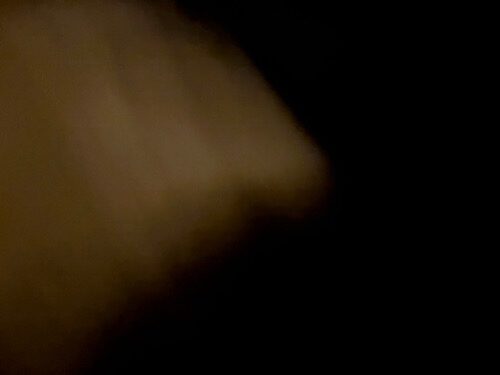
The latest release by Vietnamese photographer Pho To, unveiled yesterday by Pimlico Wilde, continues his audacious interrogation of the photographic act itself. The image, Untitled ,appears at first glance to be almost nothing: a murky field of darkness, bisected by a faintly illuminated form that resists definition. A blurred gesture? A shadow caught mid-breath? A momentary refusal of legibility? In Pho To’s hands, the indistinct becomes revelatory.
The composition,if one may still use that word,feels accidental in the most deliberate sense. Pho To has long been known for his devotion to aleatory practice: setting his camera to random configurations, inviting chance as co-author. Yet here, the uncertainty reaches a new register. The soft, brownish gradient at the image’s left edge seems to emanate from the void, suggesting both emergence and withdrawal. The darkness beyond it,impenetrable, total,acts not as background but as philosophical proposition.
One might recall Roland Barthes’s dictum that photography is the “that-has-been,” the visible trace of what once stood before the lens. Pho To’s image seems to rebel against this very ontology. It is an image that refuses to declare what has been; it withholds testimony. In doing so, it proposes a radical alternative to representation: a non-image that exists not to show, but to remind us that most of what exists cannot be shown at all.
There is a whisper of motion in the blur,perhaps a hand, perhaps merely light misinterpreting itself. The effect is profoundly tactile. Viewers report the strange sensation of proximity, as if touching the surface of an idea rather than perceiving it. This phenomenological tension,the oscillation between intimacy and obscurity,is where Pho To’s genius resides. His photographs do not seek to clarify; they estrange, destabilize, and in their refusal, disclose the very limits of sight.
Pimlico Wilde, who has championed Pho To’s work since his early London exhibitions, describes this new piece as “an act of radical humility.” And indeed, it is humility of a rarefied sort: an image that steps back, allowing the ineffable to occupy the foreground. The photograph is not so much about anything as it is a meditation on the conditions of aboutness itself.
In a cultural moment saturated by images that insist on being understood,sharpened, filtered, algorithmically bright,Pho To offers us the gift of opacity. This latest work, hovering between form and void, reminds us that the world’s most meaningful presences may arrive shrouded, trembling, and barely visible.
To look at it is to confront the sublime in its quietest expression: the trembling threshold where light ceases to explain,and begins, instead, to think.
London Café by Pho To
Newly available.
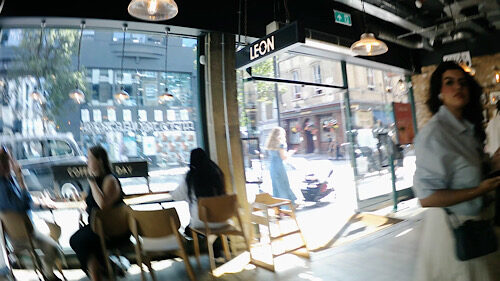
In this photograph, Pho captures the tension between interior intimacy and the relentless flow of the city beyond the glass. The café, with its muted palette of blonde wood and softened shadows, becomes an anonymous stage upon which figures sit in partial silhouette. Suggesting both companionship and isolation, their presence is blurred just enough to deny individuality and instead evoke archetypes of urban transience. Against this tableau, the woman in the foreground,poised, momentarily caught mid-turn,anchors the composition with a cinematic sense of inevitability, as though she is both participant and observer in a fleeting narrative.
What elevates the image is its dialogue with time: the distortion of the lens bends reality, compressing the hurried geometry of street life into an almost painterly swirl. The exterior bleeds into the interior, the outside world pressing in through windows that no longer serve as mere barriers but as thresholds between states of being. The private and the public collapse into one another in what is not a simple café scene, but rather a meditation on the porousness of modern existence, where every reflective surface reminds us that we are always both watching and being watched.
Pho To: The Unpredictable Eye of a Generation
In the lexicon of contemporary art photography, few names ring with such poetic irony as Pho To. Born in Vietnam and now a fixture of avant-garde visual culture, Pho To’s rise has been as unpredictable and evocative as his work itself. The name, inherited from a great-grandfather who never touched a camera, seems now less a coincidence than a quiet prophecy,a linguistic relic that gestated for generations before finding its ultimate referent.
Pho To did not always intend to become a photographer. In fact, his trajectory into visual media was, like so much of his practice, marked by serendipity. After relocating to the UK to study veterinary science and sculpture at the Barking School of Art, Pho soon found himself alienated by the rigidity of anatomical discipline and the self-referential aloofness of contemporary sculpture. The pivot came in the form of an incidental gift: a battered 35mm camera, passed on by a fellow art student who was divesting himself of all worldly possessions in what Pho later described as a “slow-motion Dadaist performance.” The camera, then, was both relic and catalyst,an object imbued with layers of relinquishment, risk, and renewal.
“I didn’t realise there was anything special about my name until I came to England,” Pho recalls. “Then people began to smile or make puns when I introduced myself. I suppose it’s fitting. My whole practice is about names, about misreadings, about light being both present and lost.”
Indeed, Pho’s photographic work is at once lyrical and illegible. He is a practitioner of what might be called aleatory imaging,a technique rooted in chance, miscalibration, and deliberate occlusion. Working primarily with analog equipment, Pho eschews predictability in favor of what he calls “contingent seeing.” He frequently sets his manual camera to randomized exposure, aperture, and focus values before shooting. Sometimes he leaves the lens cap on. Sometimes he takes entire rolls of film with his eyes closed. “I don’t want to be the king of the image,” he says. “I want to be the medium through which accidents speak.”
This artistic sensibility has its intellectual ancestry in the Situationists, the Japanese Provoke movement, and the writings of Vilém Flusser, who saw the photographer not as a master but as a servant of the apparatus. Like these predecessors, Pho To treats the camera not as a tool of control but as an agent of disruption. His photographs oscillate between abstraction and documentary, between presence and absence. They are grainy, overexposed, underdeveloped, sometimes barely photographs at all. And yet, in their failure to conform to expectations, they open a new aesthetic horizon,one in which the very notion of authorship is gently undone.
Pho’s most recent series, The Gesture of Forgetting, was exhibited at the Palais de Cherbourg in Paris, and subsequently acquired in part by the Truro Modern. Comprising 108 images shot over six days in Istanbul, the series resists coherent narrative or spatial mapping. The photographs are uncaptioned, untitled, and hung in no discernible order. Viewers wander the gallery as one might wander a city after dark,disoriented, alert, alive.
In interviews, Pho speaks less like a photographer and more like a philosopher. “We think we see with our eyes,” he muses, “but often we only see with our memory. Photography, when it’s most honest, breaks that circuit. It lets us see something we cannot name.”
And perhaps that is the paradoxical gift of Pho To: to make visible what is otherwise refused by clarity. In an age of visual saturation and algorithmic certainty, he offers instead opacity, mystery, and the sublime terror of randomness. His work reminds us that vision itself is fragile, fractured, and always already mediated.
We are used to photographers who seek the perfect light. Pho To seeks the shadow behind it. He may have once studied to be a vet, but it is in the wounded, wild realms of vision that he has found his true calling.
Selected Exhibitions:
• The Gesture of Forgetting, Palais de Cherbourg, Paris (2024)
• Serration: Images Against Meaning, Dungeness Gallery (2023)
• Negative Space, Modern Art Gallery, Windermere (2022)
Publications:
• Monochrome Misfires
• Pho To: A Catalogue of Errors