More from the Journals of Basil Bromley, Victorian Artist and Mechanician

More from the Journals of Basil Bromley, Victorian Artist and Mechanician

Entry the Fifth , 18th of May, 1873

I departed Redruth in a drizzle that seemed less rain than an all-encompassing mist. Cornwall, I have discovered, prefers to blur its outlines: hedgerows melt into field, cottages into fog, and even my Steam Unicycle emerged from its own vapour like a beast half-imagined.

The roads proved treacherous,muddy and narrow, hemmed in by high granite walls which amplified every hiss and clank of my contraption, so that I travelled within a perpetual echo chamber. At one point a farmer’s wife, hearing my approach, dropped her basket of turnips and declared me a herald of the Judgement. I reassured her that, on the contrary, I was simply an artist travelling north; yet she refused to collect her produce until I was entirely out of sight.

Near Scorrier I was overtaken by a cavalry officer on a chestnut horse. He slowed to my pace, observing me with the amused severity of one accustomed to command. “You ride a dangerous thing, sir,” he said. “It lacks the honesty of a horse.”

I replied that honesty may also be found in brass and piston, if one only listens to its rhythm. He considered this, then spurred his mount into a gallop, calling back over his shoulder: “I should still prefer a horse.” I felt oddly triumphant.

As I rode, my clothes damp from the rain, I pondered the inadequacy of current methods for drying one’s clothing whilst travelling. Rain and mist render garments perpetually damp. In a flash I had conceived of the Bromley Drying Apparatus,a waistcoat lined with narrow copper tubes, through which exhaust steam from the unicycle might be channelled, gently warming the fabric. One could arrive at any inn not merely unsoaked but positively fragrant with heated linen – though it might have a slight coally tang. I shall look into getting a patent when I return to London after this journey.

By late afternoon the drizzle gave way to sun, sudden and theatrical, revealing the countryside in vivid colour: gorse ablaze with yellow, mine chimneys rising like ancient obelisks. I paused to sketch one such scene, the unicycle at rest beside me, puffing like a contemplative dragon. Passers-by seemed to accept the tableau, as though artist and machine were now inseparable.

This evening I lie in a humble inn at Truro. My landlady insisted on polishing part of the unicycle, mistaking its brass chimney for a candlestick. She jumped when it hissed at her touch. I apologised, though not without a certain pride.

The road north beckons with a strange intimacy: each day seeming harder than the one before.

A Riposte to Hedge Fund: Against the Aestheticization of Motor-Racing

A Riposte to Hedge Fund: Against the Aestheticization of Motor-Racing

by curator Archia Tanz

The recent argument that motor-racing ought to be counted among the fine arts is certainly stimulating, even seductive in its rhetorical flourish. Yet as a curator entrusted with both the preservation and interpretation of works within the canon of art, I must dissent. To conflate motor-racing with the fine arts risks eroding critical distinctions that have been carefully maintained across centuries. The automobile race may be beautiful, thrilling, and culturally significant, but these qualities alone do not suffice to grant it entry into the company of painting, sculpture, music, or theatre.

I. On Movement and Line

The previous Motor-racing is Art essay by Hedge Fund invokes Myron’s Discobolus and the Renaissance’s fascination with motion, suggesting that the racing driver’s trajectory is analogous to the painter’s brushstroke. But here lies a fundamental category error. Myron’s statue embodies movement through stillness, and Leonardo’s sketches transform fleeting corporeal action into a fixed pictorial form. Their artistry resides in representation, in the act of making visible that which escapes perception. Racing, by contrast, does not represent motion,it is motion. However elegant a driver’s line may be, it lacks the mediating activity of artistic representation. To collapse this distinction is to mistake the experience of performance for the creation of art.

II. The Status of the Machine

The claim that racing automobiles are “kinetic sculptures” is likewise problematic. To describe a Ferrari 156 “Sharknose” or Lotus 49 as sculpture is to indulge in metaphor. Their primary ontology is mechanical: they are machines engineered for speed and competitive advantage. When displayed in museums,as at the Museo Ferrari or the Petersen Automotive Museum,they are presented not as works of art but as design artifacts or industrial heritage. The Futurists’ proclamation that a racing car is more beautiful than the Victory of Samothrace was never meant as sober art criticism but as a polemical gesture against the past.[^1] To adopt it literally risks mistaking manifesto for taxonomy.

III. Ritual and the Question of the Sublime

The ritual drama of the race,its grid, its start, its climax,is undeniably theatrical. Yet theatre itself is a fine art precisely because it articulates narrative, character, and text through performance. Racing lacks these elements. Its drama is contingent upon competition and risk, not artistic intention. Tragedy on the Greek stage derived its force from a script crafted by Sophocles or Euripides, who shaped contingency into meaning. The death of a driver, by contrast, is not an artistic device but a tragic accident. To aestheticize such moments as tragic poetry is to risk trivialising genuine loss under the veil of theory.

IV. On the Gesamtkunstwerk

The suggestion that motor-racing constitutes a Wagnerian Gesamtkunstwerk likewise stretches the concept to breaking point. Wagner envisioned the integration of existing art forms,music, poetry, dance, scenography,into a unified whole. Racing, however, is not a synthesis of arts but a hybrid of sport, engineering, and spectacle. That these domains produce rich cultural experiences is undeniable, but not every synthesis produces fine art. The Super Bowl halftime show is also a synthesis of choreography, music, design, and ritual, yet few would argue that it belongs to the category of beaux-arts.

V. Criteria for Art

What ultimately distinguishes fine art from sport or entertainment is intentionality. Works of art are created primarily for aesthetic contemplation, not functional outcome. A painting may serve ideological or devotional purposes, but its central condition is its existence as an object of aesthetic form. Racing, by contrast, is defined by its outcome: the victory of one driver over another, the efficiency of machine and team. Its beauty is secondary, an epiphenomenon of function. To call this art would be to render the term meaningless, expanding it to encompass any human endeavor that produces beauty or thrill.

Conclusion

Motor-racing is a powerful cultural practice. It has inspired artists, designers, and writers; it has produced machines of extraordinary elegance; it stages rituals of modernity charged with drama and danger. Yet it is not a fine art. To insist otherwise is to weaken the very concept of art, dissolving its specificity into a vague celebration of “aesthetic experience.” Let us value racing as racing,sublime and spectacular,but let us also preserve the critical distinctions that safeguard the dignity of art.

Notes

[^1]: Filippo Tommaso Marinetti, The Futurist Manifesto, 1909.

Who Crafted the ‘Roman Remains’ recently Discovered Beneath Boston?

Who Crafted the ‘Roman Remains’ recently Discovered Beneath Boston?

In the aftermath of the harrowing revelation,that the ostensible Roman ruins discovered beneath the new Pimlico Wilde Gallery are nothing but a clever deception,a shadowy figure has emerged as the prime suspect: the elusive artist known only as Cato Sinclair.

In cases of monumental forgery and archaeological chicanery, history grants us a gallery of precedents. We recall Michelangelo’s suspected involvement in the Laocoön “unearthing,” a theory that he may have sculpted the masterpiece himself only to present it as an ancient discovery . We remember the Etruscan Terracotta Warriors, the chimeric works by the Riccardi brothers and Alfredo Fioravanti, which duped museums for decades .

But amid these variegated echoes, the Boston ruse stands alone – for the speed in which the deception been unmasked. Unfortunately the suspected architect has disappeared.

The Main Suspect: Artist Cato Sinclair

Cato Sinclair,an enigmatic figure in the Boston art scene, scarcely known beyond boutique gallery circles,now finds himself under intense suspicion. Here’s why investigators and commentators are converging on him: His last exhibition, entitled Etruscanmania was a perfect recreation of an ancient Etruscan village. If that is not evidence enough:

He has an expertise in antiquarian mimicry: Many of Sinclair’s recent ,and previously admired,installations revealed a sensational facility for emulating archaeological textures: he has long experimented with patinas, faux-bronze aging, and fragments of Latin inscriptions, all with eerily convincing finish.

Proximity and opportunity: Sinclair was reportedly engaged as a design consultant to the Pimlico Wilde Boston Gallery prior to construction. His intimate knowledge of the site’s plans, layering, and access to its subterranean bound uniquely position him to orchestrate such a hoax.

Absence of the artist: Hours after forensic analysis confirmed the fabrication, Sinclair vanished. His studio,filled with half-finished sculptural studies of ancient Roman sculptures,was empty of human life. No forwarding address, no digital footprint: he simply evaporated.

A Vanished Artist, a Gilded Fraud

No law enforcement body has issued formal charges. Nor has Sinclair been placed under official scrutiny. Yet his disappearance fuels speculation: did Sinclair flee the scene when the masquerade threatened exposure? Was he a lone virtuoso dazzled by his own artifice, or an accomplice in a broader cultural prank?

New England Institute of Very Old Items director Dr. Lucinda Marsh commented to me, under condition of anonymity: “Sinclair’s escape is as theatrical as the plot he devised. If he intended to reveal something profound,about belief, about reason,he succeeded. But at what cost?”

So, while there is as yet no conclusive proof,and no signed confession,the convergence of artistic aptitude, site access, and post-fabrication disappearance makes Cato Sinclair the chief suspect in what may be the most extravagant archaeological-art hoax of our age.

In an era intoxicated with authenticity, his fraud serves as a caution,that even in our most rational institutions, a single artist’s illusion may travel deep into the vaults of history. And sometimes, the true masterpiece is the trick itself.

Wine: The Medium of Choice for the Avant Garde?

Wine: The Medium of Choice for the Avant Garde?

The art world, that great machine of invention and secrecy, is alive at present with an unusual rumour. It has been said,quietly, but with enough persistence to warrant attention,that a painter of some repute has begun to work not in oil, nor in acrylic, but in wine.

Sources close to his circle speak of a practice both radical and meticulous: the use of different châteaux and vintages as one would select pigments from a carefully arranged palette. A Margaux for its velvety crimson, a Saint-Émilion for its earthy density, a Sancerre for its pale, almost translucent washes. Each bottle, if the stories are true, is decanted not into a glass but onto the brush, its terroir destined for canvas rather than palate.

The reports, if accurate, carry striking implications. Wine, unlike paint, is unstable, volatile, prone to oxidation. Its colour shifts as it dries, deepening, muting, sometimes blooming into unexpected shades. To paint in wine would be to embrace impermanence itself,to allow the medium’s life cycle to become part of the work. One imagines canvases that change subtly from week to week, their hues maturing or fading like the vintage from which they were born.

At present, no public exhibition has been announced. The few who claim to have seen these works describe them in hushed tones, as if unsure whether to speak of painting or alchemy. What is clear is that, should this practice prove authentic, it may mark one of the most provocative material experiments of recent years: the collision of two deeply French traditions,oenology and painting,on a single surface.

We will be pursuing this story further. If the rumours are true, and if the artist can be persuaded to speak, you will be the first to hear their account. For now, we are left with the tantalising possibility that the medium of wine, long celebrated for its place at the table, may soon claim its place on the gallery wall.

New work: Bedford Square by My Friend Leslie

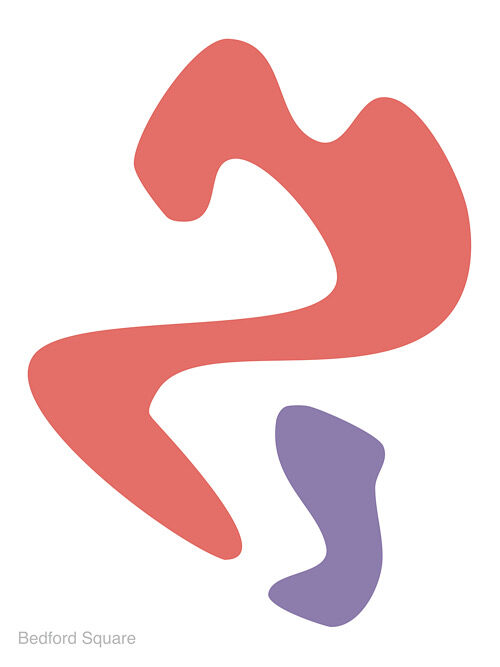
My Friend Leslie’s latest work, Bedford Square operates in that fertile interstice between biomorphism and linguistic deferral, where form insists but never coheres, where signification hovers like a mirage. Two figures,one a sprawling vermilion, the other a more compact lavender,occupy the white ground with an ambivalence that resists both compositional resolution and narrative absorption. What emerges is not an image in the conventional sense, but an ontological problem staged through colour and contour.

The larger red form, with its oscillations between curve and jut, suggests the bodily without ever descending into figuration. It recalls the residual anthropomorphism of Arp’s early reliefs, yet the crisp flatness of its surface pushes it toward the digital, toward a vectorized aesthetic that displaces tactility with pure sign. In contrast, the lavender fragment reads as a supplement or trace, invoking Derrida’s notion of the parergon,that which both belongs to and exceeds the frame, marking the instability of inside and outside, figure and ground.

The faint inscription “Bedford Square” in the corner functions less as a title than as an epistemic intrusion. Here, language sutures itself to abstraction, demanding that we think the work as situated,within geography, within history,while simultaneously refusing to clarify its relation. Is the image a map? A psychogeographic dérive? Or is the textual residue merely a destabilizing gesture, reminding us that no abstraction is ever pure, that every form is haunted by context?

My Friend Leslie’s abstraction, then, is not an escape from the world but a reconfiguration of it,an abstraction that acknowledges its own impurity, its semiotic leakage. It is tempting to read the crimson figure as presence and the lavender as absence, but such binaries collapse in the act of viewing. What persists is tension: between assertion and withdrawal, legibility and opacity, surface and depth.

In the end, My Friend Leslie situates themselves in dialogue not only with the formal histories of modernism (Matisse, Kelly, Arp) but also with the post-structural suspicion of closure. The work is less an image to be looked at than a proposition to be inhabited,a reminder that abstraction’s vitality lies not in what it depicts, but in how it perpetually defers depiction.

Great Artists: Marcellus Vire

Great Artists: Marcellus Vire

The Salt of Memory: The Enduring Tear Art of Marcellus Vire

In a century increasingly obsessed with speed, spectacle, and permanence, the work of Marcellus Vire (b. 1938) offers a quiet, almost monastic rebuttal. For over six decades, the Franco-Italian conceptual artist has worked with a medium that is both profoundly human and radically ephemeral: tears. Through this most personal of substances, Vire has constructed an oeuvre that merges performance, ritual, alchemical experimentation, and emotional endurance.

Today, at 87, Vire remains an elusive but revered figure in the international art world,an artist who has turned grief, memory, and truth into his palette. His influence spans from relational aesthetics to contemporary performance art, yet his practice remains uniquely his own: intimate, uncommodifiable, and fundamentally unphotographable.

Beginnings: Mourning as Material

Born Marcello Virenzi in Turin in 1938, Vire’s formative years were shaped by postwar scarcity and private tragedy. His twin brother, Luca, died at age seven in a drowning accident,a trauma Vire has cited as his “first and most persistent wound.” Raised in a devout Catholic household, Vire was exposed early to ritual, lamentation, and the idea of bodily sacrifice as symbolic communication.

Trained at the Accademia di Belle Arti in Florence in the late 1950s, Vire quickly abandoned conventional media. “Clay forgets nothing,” he once wrote, “but tears forget everything,and still leave behind salt.” His first recorded experiment with tears as a medium occurred in 1961, when he captured a single drop on untreated linen, creating what he called a “transparent wound.”

Method and Medium: Tears as Language

Vire’s process is both conceptual and bodily. His tears are induced through a range of practices: sustained memory recall, recitation of poetry, exposure to certain scents (especially bergamot and violet, which he associates with his great-grand-mother), and long periods of silence. Once shed, the tears are captured,on paper, linen, or blown glass,and documented with meticulous care.

Over time, he developed what he terms a “taxonomy of grief,” in which tears are categorized by emotional origin: sorrow, joy, frustration, mourning, and release. His seminal Cartographies Salées series (1982,1995) consisted of over 200 small panels, each stained with a single teardrop and inscribed with the memory that provoked it. The works were displayed in dim, humidity-controlled rooms, the salt traces visible only from certain angles.

Rather than treating the tear as a symbolic gesture, Vire regards it as a material index of interior experience. His practice draws from both Catholic relic tradition and Eastern notions of impermanence. In this sense, his work is more alchemical than performative, concerned less with visibility than with transmutation.

The Ethics of Witnessing

Though often labeled a performance artist, Vire resists theatricality. His “weeping sessions”,held privately or with a small audience,are slow, meditative events in which silence is essential. He weeps, collects, documents. The audience, if present, is instructed not to intervene, applaud, or speak.

Critics have at times accused him of fetishizing suffering or emotional exhibitionism. Vire is unbothered. “I do not cry for them,” he told philosopher Claire Guérin in a rare 2014 interview. “I cry with them,though they may not yet know it.” In this framing, his work becomes less self-revelation and more radical empathy.

Contemporary Relevance and Late Recognition

For most of the 20th century, Vire’s refusal to commercialize his work,he has never allowed a tear-based piece to be sold,rendered him marginal to the market-driven art world. However, with the rise of affect theory, trauma studies, and post-materialist aesthetics, his work has come under renewed scholarly and curatorial interest.

In 2018, the Palais de Tokyo in Paris mounted Les Larmes du Temps, a landmark retrospective of Vire’s output from 1961 to the present. The show included reconstructed weeping sessions, vitrines of tear-stained cloths, and audio diaries recorded during grief rituals. A companion symposium brought together scholars in philosophy, neuroscience, and art theory to discuss his legacy.

Most recently, in 2024, Vire collaborated with olfactory artist Lien Zhang on Eaux Perdues, a scent-based installation in Marseille evoking the emotional conditions under which tears are produced. The installation featured a climate-controlled chamber where humidity, smell, and silence coalesced into an invisible portrait of mourning.

Philosophy of the Invisible

Vire’s ongoing notebooks, Notules sur la douleur, now spanning more than 20 volumes, contain aphorisms, chemical notes, and philosophical meditations on the ethics of sadness. A typical entry:

“Tears are not weakness. They are salt seeking form.”

He has never taught formally, never operated a studio, and declines most interviews. Yet he has quietly mentored a generation of affective and performance artists, including Maya Orellana, André Lutz, and the collective Corps Flottants, who credit him with opening emotional labor as a legitimate artistic site.

Final Thoughts: The Art of Evaporation

Now living in quiet seclusion near Avignon, Vire continues to practice daily. His most recent project, Prière de Disparaître (2025,), is a series of salt-dried tear medallions embedded in limestone and returned to the sea,“so that what was felt returns to what cannot be seen.”

In an era of ever-expanding digital visibility and emotional commodification, Vire’s work offers something rare: a poetics of feeling that resists spectacle. He does not document pain. He distills it. And in the process, he teaches us that even the most fleeting gesture,a tear,can be shaped into something enduring.

Letters: Disagreement on the Motor-racing as Fine Art Debate

Letters: Disagreement on the Motor-racing as Fine Art Debate

Sir,

I have, with mounting incredulity and indeed a kind of moral nausea, perused the recent article in your august pages concerning the purported elevation of motor-racing to the pantheon of the fine arts. Permit me, as one who has spent the better part of four decades in the service of His Majesty’s Royal Navy, to register my profound disapprobation at such intellectual legerdemain.

Let me say right away that cars are not art, yet ships indubitably are. For to speak of automobiles,those ephemeral contrivances of vulcanised rubber and tinny alloy,as though they belonged in the same category as the ship is nothing less than an affront to civilisation. Ships, sir, are indisputably works of fine art. The sheer architectural gravitas of a man-of-war, the harmonious geometry of hull, mast, and sail, the tensile equilibrium of rigging and keel: these are not mere instruments of utility, but symphonies in timber and steel, orchestrated across centuries by naval architects of genius. When I stood upon the quarterdeck of a County-class cruiser at sunrise, beholding the play of light upon the sea and the graceful arc of the bow cutting the waves, I beheld nothing less than the sublime made manifest in oak and rivet.

It is therefore with horror that I read in your journal an attempt to confer the same aesthetic laurels upon motor-racing, as though a pack of petrol-sodden contraptions howling around an asphalt ellipse could possibly be compared to HMS Victory, HMS Warspite, or the peerless clipper Cutty Sark. Ships embody narrative, ritual, and tragedy; they are palaces that float, cathedrals that sail, theatres that traverse the globe. Their very construction is an act of artistry: the draughtsman’s plan as exquisite as any sketch by Piranesi, the curvature of the prow as noble as any column of the Parthenon.

What I find insufferable is not merely the misclassification of motor-racing as “art,” but the concomitant neglect of ships,the most monumental art form humanity has ever set upon the waters. To relegate the ship to mere “engineering” while elevating the racing car to fine art is to invert the very order of aesthetic reason, to perpetrate what I can only call a cultural blasphemy.

In conclusion, sir, I implore your contributors to cease this fatuous veneration of piston and petrol, and to acknowledge instead the indisputable truth: that the ship, in all her majesty, grace, and peril, is art of the highest order. If we are to speak of “the ballet of velocity” or “the opera of torque,” then I insist we also speak of the symphony of sail and the oratorio of steam. Anything less is a betrayal of history, tradition, and the sea itself.

I remain, Sir,

Your obedient servant,

Captain (Ret’d) A. J. Thurlow, RN

A Day in the Life of Clementine Varot: Curator

A Day in the Life of Clementine Varot: Curator

In the heart of Paris, nestled between antique bookshops and cafés still wreathed in Gauloise smoke, lives and works Clementine Varot,curator at the Musée d’Orsay, private collector, and one of Europe’s most quietly influential figures in the art world. Her days are a confluence of scholarly discipline and aesthetic ecstasy, governed by the rhythms of exhibitions, acquisitions, and a ceaseless hunger for beauty.

The Morning: Ritual and Reflection

Clementine wakes at 6:30 AM to the quiet gurgle of her copper espresso machine, a mid-century Faema model she restored herself,one of many objets trouvés in her Montparnasse apartment. Her walls are a modest symphony of art: a delicate Egon Schiele gouache, an early Sophie Calle photograph, and two lesser-known canvases by Pierre Bonnard, whose dreamy intimacy aligns with her favorite movement: Post-Impressionism.

She begins her day reading,always. This week, it’s Aby Warburg’s Mnemosyne Atlas and the newly released correspondence between Dora Maar and André Breton. Clementine insists on this intellectual preamble before facing the administrative deluge of museum life. “Before I speak to a single human being,” she once said in a panel discussion at the Serpentine Galleries, “I must commune with the heroes of art.”

Late Morning: The Musée d’Orsay Beckons

By 9:00 AM, she’s at her office in the Musée d’Orsay, where she oversees acquisitions, manages restorations, and coordinates transcontinental loans with surgical precision. Today, she’s finalizing the paperwork for a major Degas retrospective opening in the autumn. She’s also fielding a spirited debate between two conservators regarding the cleaning of a rarely seen Vuillard,its varnish having darkened to the hue of espresso.

Curatorship, for Clementine, is not administration,it is stewardship. “Art objects,” she often says, “are not relics of the past. They are animate philosophies that breathe through us.”

Afternoon: The Secret Life of a Collector

By 1:00 PM, she retreats for lunch at Le Dôme, always ordering the same: Salade Niçoise and a glass of Sancerre. Her iPad glows with live bidding updates from a Sotheby’s auction in Milan. Clementine’s private collection,now at 217 pieces,is a labyrinthine curation of modernist minor masters and contemporary conceptualists. She’s particularly fond of works by Étel Adnan, whom she calls “a painter of time rather than space.”

Later, she visits a young artist’s studio in Belleville. The painter, barely 26, is reinterpreting Byzantine iconography through the lens of digital glitch. Clementine doesn’t say much,just stands silently, nodding, her eyes narrowing with curiosity. She won’t buy today, but she will remember.

Evening: Echoes of the Salon

Evenings are for the salon. Not in the 18th-century Rococo sense, but in her own private ritual of gathering minds. Once or twice a week, her home becomes a haven for artists, critics, poets, and the occasional quantum physicist. Tonight’s discussion: “The Aura of the Original in the Age of Digital Proliferation,” with a side of Burgundy and Comté.

She listens more than she speaks. When she does interject, it is with the quiet authority of someone who knows that art is neither luxury nor leisure, but metaphysics made visible. A friend jokes that Clementine is a Renaissance humanist trapped in the 21st century. She smiles and replies: “If I am, it’s only because the future keeps failing the past.”

Midnight: Return to Silence

The guests leave around midnight. Clementine reads a few pages of Marguerite Duras, gently removes her earrings,lapis lazuli, from a flea market in Tangier,and steps onto her balcony overlooking the Seine. Below, the lights of Bateaux Mouches ripple across the water like brushstrokes.

Tomorrow, there will be more meetings, more art to shepherd, more histories to preserve. But for now, she is still.

And in that stillness, art lives.

Film Review: Kilo Barnes’ Oblivion in Reverie

Film Review: Kilo Barnes’ Oblivion in Reverie

Kilo Barnes, the provocateur best known in contemporary art circles for his “repaintage”,the meticulous obliteration of existing artworks under pristine, spectral layers of white,has made the leap to cinema with Oblivion in Reverie, a work that confirms his talent for transmutation across mediums. Where his canvases demand reflection on absence, erasure, and the fetishization of originality, his film demands immersion in absence as experience, rendering cinematic narrative optional, almost irrelevant.

The plot, such as it is, unfolds like a dream barely-remembered: a man known only as The Cartographer (a monumental performance by Lukas Yeo) wanders through a cityscape both hyperreal and quietly recognisable, mapping streets that shift behind him, as though memory itself were a liquid. He encounters fragmented communities: a choir that sings in inverted tonality, a cafe of patrons frozen mid-motion, and a cinema that projects shadows of films that do not exist. Barnes’ story resists conventional causality, privileging instead the affective architecture of perception,every frame a meditation on void, opacity, and the uncanny.

Cinematically, the film is a masterclass in deliberate erasure. Shots dissolve into overexposed white, recalling his repainted canvases, but with the added dimension of time. Interiors are emptied, streets are depopulated, and even dialogue,when it appears,is delivered with the flat, haunted cadence of incantation. Barnes’ use of sound is similarly radical: he interlaces silence, distant industrial hums, and fractured snippets of classical compositions, sometimes playing in reverse, producing an auditory dissonance that unsettles yet fascinates.

Historically, Oblivion in Reverie situates itself in a lineage of avant-garde cinema that includes the existential austerity of Bresson, the temporal subversions of Godard’s late period, and the structuralist rigor of Straub-Huillet. Yet Barnes is no mere inheritor; he advances the conversation by converting absence into action, negation into spectacle. Where Bresson’s figures are ascetic, Barnes’ are ephemeral, existing between frames, between gestures, and between memory and anticipation.

To call this a “film” risks underplaying its ambition. It is at once a meditation on cinematic erasure, a critique of visual culture’s obsession with plenitude, and an invitation to experience time as a mutable, almost sculptural medium. The viewer is asked to confront emptiness not as void but as a canvas in which perception itself becomes active, participatory, and, at times, ecstatic.

Oblivion in Reverie is challenging, yes,its refusal of narrative closure and conventional spectacle will alienate casual audiences,but to embrace Barnes’ vision is to participate in a rare cinematic reckoning. The film is both a white canvas and a labyrinth: minimalist yet baroque in its conceptual scope, meditative yet relentless in its demands. By the final scene,an empty theatre viewed from a moving gondola ,the audience recognizes the genius of Barnes’ audacity: he has turned absence into fullness, and erasure into revelation.

In short, Oblivion in Reverie is not merely recommended; it is essential. For those willing to submit to its austere rhythm and metaphysical rigor, it offers an experience that is, paradoxically, full of life precisely because it is so resolutely unoccupied. It may clock in at four hours fifteen minutes, and the screen may be blank for half of that runtime, but you will not look at your watch until the credits roll.

Answering Your Fine Art Questions: Episode 1

Answering Your Fine Art Questions: Episode 1

Is it possible for a painting to ‘age’ and improve in the same way a wine does?

To help answer this intriguing question, we reached out to Peregrine Luxford, a contemporary art conservator known for his work with both modern installations and 19th-century oils.

Peregrine Luxford answers:

“Artworks do indeed change over time,but the way they ‘age’ is not quite like my favourite Bordeaux. Paintings accumulate a history through subtle chemical shifts, the darkening of varnishes, or tiny cracks in the canvas, which many collectors refer to as a work’s ‘patina.’ These changes can sometimes create a kind of personality, yes,especially if the work is sensitive to its environment. A sunlit wall versus a dim, cool room will make the same painting appear almost like two different characters over decades. I’ve seen a collector move a once-muted landscape; in its new location it bloomed with warmth after fifty years, almost as if it had developed a private sense of humour. In a way, the painting is alive through time, even if it never breathes.”

Curious fact: Some artists actually anticipate this aging. The 18th-century painter Jean-Baptiste-Siméon Chardin famously chose pigments he knew would mellow over decades, almost like crafting a portrait of the future itself.

Next week, we’ll explore: “Can a sculpture have mood swings?” with Esmerelda Pink weighing in.