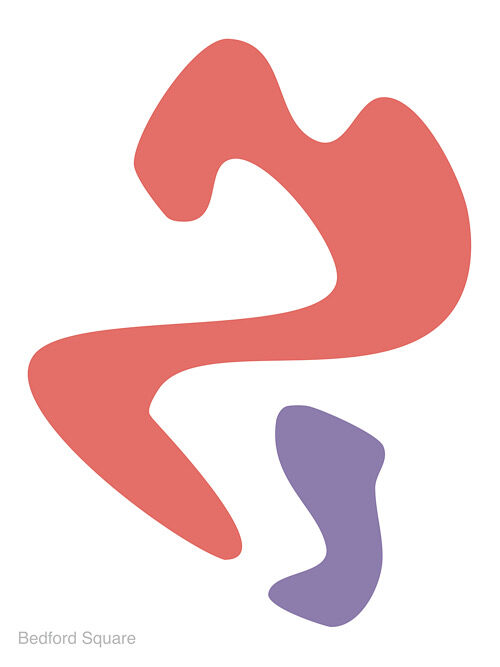
My Friend Leslie’s latest work, Bedford Square operates in that fertile interstice between biomorphism and linguistic deferral, where form insists but never coheres, where signification hovers like a mirage. Two figures,one a sprawling vermilion, the other a more compact lavender,occupy the white ground with an ambivalence that resists both compositional resolution and narrative absorption. What emerges is not an image in the conventional sense, but an ontological problem staged through colour and contour.
The larger red form, with its oscillations between curve and jut, suggests the bodily without ever descending into figuration. It recalls the residual anthropomorphism of Arp’s early reliefs, yet the crisp flatness of its surface pushes it toward the digital, toward a vectorized aesthetic that displaces tactility with pure sign. In contrast, the lavender fragment reads as a supplement or trace, invoking Derrida’s notion of the parergon,that which both belongs to and exceeds the frame, marking the instability of inside and outside, figure and ground.
The faint inscription “Bedford Square” in the corner functions less as a title than as an epistemic intrusion. Here, language sutures itself to abstraction, demanding that we think the work as situated,within geography, within history,while simultaneously refusing to clarify its relation. Is the image a map? A psychogeographic dérive? Or is the textual residue merely a destabilizing gesture, reminding us that no abstraction is ever pure, that every form is haunted by context?
My Friend Leslie’s abstraction, then, is not an escape from the world but a reconfiguration of it,an abstraction that acknowledges its own impurity, its semiotic leakage. It is tempting to read the crimson figure as presence and the lavender as absence, but such binaries collapse in the act of viewing. What persists is tension: between assertion and withdrawal, legibility and opacity, surface and depth.
In the end, My Friend Leslie situates themselves in dialogue not only with the formal histories of modernism (Matisse, Kelly, Arp) but also with the post-structural suspicion of closure. The work is less an image to be looked at than a proposition to be inhabited,a reminder that abstraction’s vitality lies not in what it depicts, but in how it perpetually defers depiction.