Drawings to buy

Girl

It appears that the Bond Street Art Collective is currently concentrating on portraiture. This new piece materialises like a fragment smuggled out of an alternate art-historical timeline. At once austere and deliriously intricate, the piece navigates the uneasy lineage between early Renaissance perspectival rigour and the ruptures introduced by the Futurists, only to detonate both traditions in a gesture that feels almost archaeological in reverse: an excavation of something that has not yet occurred.
The composition’s improbable internal logic recalls the metaphysical architectures of de Chirico, while its chromatic tensions pulse with the spectral vibrato of Hilma af Klint’s spiritual diagrams. One senses, too, a sly dialogue with the décollage of Jacques Villeglé, though here the act of tearing seems aimed not at posters on a wall but at the thin membrane separating perception from prophecy. The resulting visual field behaves less like a painting than like a cipher, an encoded communiqué from an anonymous hand intent on dissolving the cult of the singular genius.
In the context of the Collective’s ongoing refusal of individual credit, the work reads as a manifesto disguised as an apparition: a reminder that the history of art, for all its devotion to the named master, has always been periodically redirected by the untraceable, the pseudonymous, the whispered. This piece stands in that lineage, improbable, unprovable, and utterly unforgettable.
==
*The girl is actually Molly Flaubert, socialite and virtual hula hoop Champine
How Dare They? Passing by My G-Wagon with Nary a Glance!
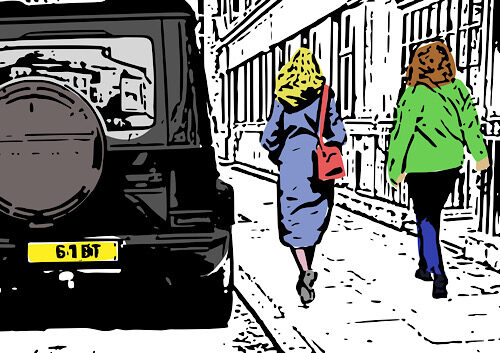
Digital print
In How Dare They? Passing by My G-Wagon with Nary a Glance!, Hedge Fund turns an apparently ordinary urban encounter into a meticulously orchestrated tableau of class geometry and peripheral elegance. A hulking black G-Wagen occupies the left of the frame like a monolith of contemporary aspiration, its matte darkness absorbing light rather than reflecting it. Opposite this automotive fortress, two pedestrians stride forward, their backs to us, their colours defiantly vibrant against the city’s drained monochrome.
The juxtaposition is deliberate. Hedge Fund has long been fascinated by the theatre of the affluent street, where status symbols and human figures cross without truly meeting. Here, the two women, one in electric green, the other in midnight blue with a sun-yellow scarf, become chromatic counterpoints to the G-Wagen’s imposing silhouette. Their brisk gait seems almost choreographed, a kinetic flourish slicing through the vehicle’s static authority.
The background, a stylised architectural greyscape, provides a skeletal neutrality that heightens the tension between object and observer. The city, stripped of detail, becomes an abstract stage where only the essential protagonists remain. The number plate, rendered with yellow clarity, lends the piece an air of documentary realism before dissolving once again into graphic artifice.
Hedge Fund’s signature move is present: the banal moment repurposed into an emblem of socio-economic poetics. Is the G-Wagen the true subject, or are the women? Or is the artwork actually a portrait of the invisible line between them, the boundary between stationary wealth and mobile life? In this ambiguity lies the work’s exquisite friction.
Ultimately, How Dare They? Passing by My G-Wagon with Nary a Glance! is not merely a slice of a street scene. It is a stylised meditation on proximity and privilege, a digital fresco in which every colour block and shadowed contour conspires to remind us that, in Hedge Fund’s world, even the casual act of walking past a parked car becomes an aesthetic event loaded with meaning.
The Bond Street Art Collective new Drop: Miss X and Kit Marlowe?

In this striking recent painting, rendered in bold, modern planes of colour, the Bond Street Art Collective invites viewers to consider the layered dialogue between past and present that surrounds a newly surfaced sonnet of uncertain authorship. The poem, reproduced below has been attributed by some scholars to Christopher Marlowe yet by others to Christine Marlowe, an English teacher at Biggleswade University.
The portrait’s vivid red backdrop and confidently stylised features evoke the intensity and theatricality long associated with the Elizabethan stage, while the subject’s poised expression and contemporary glasses introduce a note of temporal dissonance that is both deliberate and compelling. This tension of the paint mirrors the scholarly debate: is the sonnet a genuine relic of the Renaissance, or a modern composition crafted in homage to Marlovian poetics?
By presenting the sitter in a manner that is simultaneously timeless and yet somehow unmistakably of our era, the painting becomes a meditation on authorship, authenticity, and the enduring human impulse to converse with the past. The result is an arresting synthesis of literature and visual art and an exploration of how a poem can spark creativity both today and in the past.
The Sonnet, newly discovered under a floor in the Hove Roman Villa.
Bright maiden, set against a crimson flame,
Whose gaze through violet-framed enchantments streams,
Thou hold’st within thine eyes a subtle claim
On hearts that wander restless in their dreams.
Thy brow, with hues of dawn’s first gentle rose,
Doth arch as though it guards some secret mirth;
Thy lips, half-curved, betray what soul bestows
When inward joy would seek a mortal birth.
The dark cascade that falls about thy face
Moves like night’s curtain parting for the day,
And stripes of azure lend a sailor’s grace,
As though the tides themselves would with thee stay.
If art can snare the light of beauty’s reign,
Then here Love’s hand and Colour’s meet again.
My Rolls Royce is Amazing: New Art by Hedge Fund

Digital pigment print on archival substrate
Hedge Fund
In My Rolls Royce is Amazing Hedge Fund elevates the iconic luxury vehicle into a vision of almost ceremonial extravagance. The car, unmistakably a Rolls-Royce, is rendered in a palette that borders on the delirious: a lacquered magenta body that seems to pulse with synthetic richness and circular headlamps glowing the colour of burnished gold coins.
Rather than depicting the vehicle in motion, Hedge Fund presents it head-on, monumental and unyielding. The Rolls-Royce becomes a kind of heraldic creature, part limousine and part myth. Its grille resembles an altar. Its lights read as eyes, unblinking and faintly reproachful. The result is an image that refuses modesty. It advances toward the viewer with the solemnity of a royal procession, yet with the playful chromatic exaggeration of an overconfident confection.
The background is purposefully void, heightening the impression that the car exists outside of any ordinary street or context. It hangs in an abstracted absence, a floating emblem of the kind of wealth that no longer needs to justify itself. Hedge Fund understands that true luxury can often be narrative-free. It simply exists.
This is not just a portrait of a car. It is both an understated portrait of charm and an opulent overstatement. In Hedge Fund’s hands, even a silent automobile becomes an artefact of the new aristocracy, ready to glide into legend or, failing that, into the portfolios of those quick enough to acquire it.
Porsche Targa Yes Please! New Hedge Fund Art

Digital pigment print on archival substrate
In Porsche Targa Yes Please! Hedge Fund turns his acute gaze toward one of the most enduring symbols of late modernity: the high-performance sports car as both object and proposition. Rendered in his signature reduction, the Porsche appears less as a vehicle than as a commodity-spectre, its siren-red contours vibrating against a backdrop of urban monotony like a stock-chart spike in an otherwise horizontal market.
The car’s glossy silhouette is deliberately over-saturated, a chromatic inflation mirroring the distortions of desire, while the background is drained into muted tonal plateaus that recall the flattening effect of late-stage capitalism on daily lived space. The vehicle becomes, paradoxically, both protagonist and parasite: inserted into the streetscape with the confidence of something that expects to be admired and indeed insists upon it.
Hedge Fund’s genius lies in his refusal to moralise. The work neither celebrates luxury nor critiques it. Instead, it unveils the aesthetic grammar of appetite. The Porsche is shown not moving but waiting: idling, anticipating, value accruing even in stillness. Its glossy geometry seems to ask not “Where shall we go?” but “How much am I worth to you?”
The title, brilliantly and disarmingly candid, operates as a confession of the viewer’s own complicity. The exclamation mark is not enthusiasm; it is the punctuation of inevitability. One does not simply observe this car; one is drawn into its orbit.
With Porsche Targa Yes Please! Hedge Fund extends his ongoing project of transforming capitalist desire into a visual ontology. Here, aspiration becomes image, image becomes asset, and asset becomes, inevitably, art.
Review: Ptolemy Bognor-Regis’s A Monologue in Cadmium Red #3

By Claribel Daube, Senior Theorist, Pimlico Wilde
When one first encounters Ptolemy Bognor-Regis’s A Monologue in Cadmium Red #3, the initial instinct is simply to step back, perhaps to steady oneself. The sheer audacity of the red,if, indeed, “red” is an adequate term,strikes the viewer like a conceptual thunderclap. It is not the red of roses, nor of blood, nor of warning. It is the red of ideas: uncompromising and absolute.
Bognor-Regis, who previously stunned the art world with his pioneering Monologue in Beige series, has here achieved something even more radical: he has dared to make red intellectual. In Cadmium Red #3, the surface vibrates with a controlled fury, a dialogue between hue and void. The work is simultaneously an assertion and a question, a whisper shouted through a megaphone of pigment.
One notes immediately the brushwork,if one can call it that. The strokes are so precise as to be nearly hypothetical. They suggest movement, but of a meditative sort, as though each line were painted not by hand but by the concept of gesture itself. “I didn’t want to apply the red,” Bognor-Regis has said. “I wanted to release it.” And indeed, one feels in the work the sense of chromatic liberation,a pigment allowed to be its truest, most unapologetic self.
The bottom-left quadrant bears a subtle darkening, almost imperceptible at first glance, which curators have already hailed as “a turning point in modern redness.” It is, they argue, where Ptolemy’s internal conflict between saturation and restraint finally finds peace,or, perhaps, perfect unease.
Dr. Hermia Quoll, writing in The Glasgow Journal of Abstract Accountability, observed: “In a world obsessed with irony, Bognor-Regis’s red is an act of unfiltered sincerity. It bleeds without apology. It exists without context. It dares to be red in a world that has forgotten how.”
Rumour suggests that A Monologue in Cadmium Red #3 has already been pre-acquired by the Institute for Monotonal Mastery in Zurich, where it will hang opposite an entirely black wall, “to allow the red to contemplate its own absence.”
In the end, A Monologue in Cadmium Red #3 is less a painting than a reckoning. It asks of us the eternal question: if red could speak, would we be worthy of listening?
Outside Phonica, Soho: Analysis of a new photograph by Johnny Peckham
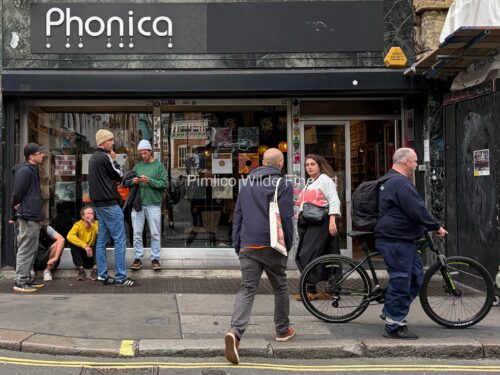
Analysis of a new work by street photographer Johnny Peckham
In Outside Phonica, Soho, Johnny Peckham offers us a tableau vivant of urban serendipity , an uncurated congregation at the cultural hinge of sound, style, and suspended time. The photograph’s mise-en-scène, poised on the cusp between motion and idleness, functions as a kind of social palimpsest: Peckham’s lens excavates the poetics of waiting, the choreography of chance, the theatre of the mundane.
Here, Soho becomes not merely a district but a dialect , a visual language where posture, pavement, and public space converse in minor key. Echoes of Eggleston’s chromatic democracy and Cartier-Bresson’s “decisive moment” reverberate through the frame, but Peckham refuses nostalgia. His approach is defiantly contemporary, reveling in the quotidian without sentimentality, allowing what could in other less skilled hands be banal, to shimmer with ontological weight.
Notice the density of gesture: a man in a yellow jumper becomes a punctuation mark against the grey lexicon of London; a cyclist glides like an afterthought through the periphery of narrative; reflections in the glass offer an Escherian recursion , inside becomes outside, observer becomes subject. Peckham’s composition collapses hierarchies, inviting us to read the city as a living collage, where commerce, community, and contingency blur into one continuous act of becoming.
Outside Phonica, Soho is not reportage , it is ritual. It hums with the low frequency of lived experience, a hymn to the fugitive beauty of the everyday. Peckham reminds us that some of the best art is not found; it is overheard.
Exhibition review: Portraits of the Very Rich III by Hedge Fund
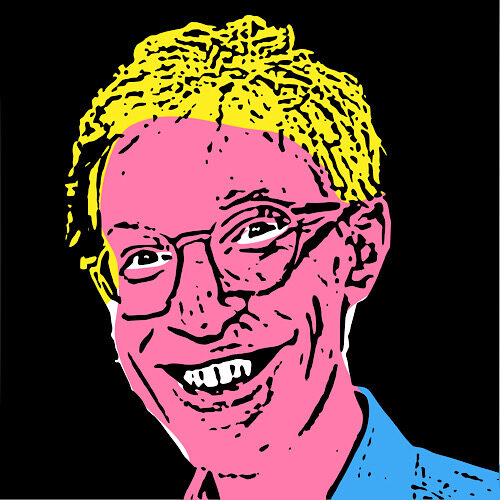
The third instalment of Hedge Fund’s Portraits of the Very Rich series has opened not in a gallery, but on the trading floor of the Madeira Stock Exchange; a curatorial gesture that borders on the sublime. To see twelve monumental digital prints of the ultra-wealthy staring down from marble walls once reserved for the movement of capital is, frankly, perfect.
The artist known as Hedge Fund has made his reputation transforming wealth into visual language – an alchemy of colour, polish, and ambivalence. His Portraits are not caricatures of the rich, nor are they moral statements. They are studies in sheen, executed with a precision so cold it becomes seductive.
The crowd at the opening was electric. Collectors whispered figures. Economists pretended to be aesthetes. I, as usual, felt faintly sceptical.
The Smile of Capital
That changed when I encountered Portrait of Georgie McBannister (2025) – perhaps the exhibition’s most disarming work. McBannister, a firearms dealer, ballet dancer and philanthropist of formidable reputation, is rendered in Hedge Fund’s signature high-gloss digital reduction: shocking pink skin, lemon-yellow hair, a tranquil blue collar, all outlined in jet black like a saint in a Pop iconostasis.
The smile is broad, too broad, and the eyes, magnified by spectacles, hover on the knife-edge between warmth and calculation. There is something thrillingly off about it, like a grin that has been profitably franchised.
And yet, it is impossible not to be charmed. Hedge Fund’s use of colour transforms McBannister’s face into an economic emblem: pink, the hue of liquidity; yellow, the colour of alertness, attention, and gold. The portrait radiates optimism while quietly hinting at volatility. It is, in its way, a graph of feeling disguised as a face.
The Art of Surface
Hedge Fund’s technique remains astonishingly precise. Each portrait begins as a digital capture, stripped of depth, then rebuilt as a field of bold vectorised colour. The effect is one of absolute control: humanity distilled into brand identity. His subjects, philanthropists, financiers, owners and collectors, are reborn as idealised data points in an emotional marketplace.
The portraits neither flatter nor expose; they simply render. Hedge Fund’s subjects seem perfectly content to exist as aesthetic instruments, portraits that perform the same function they do in life: signalling value, projecting stability.
Standing before McBannister, one feels the gravitational pull of this logic. The portrait is not about him; it behaves like him,confident, dazzling, and engineered for circulation.
Critics have likened Hedge Fund to Warhol, and there is certainly a shared fascination with surface and repetition. But where Warhol’s silkscreens flicker between irony and adoration, Hedge Fund’s digital prints operate with an unnerving serenity. His work feels closer, perhaps, to Whistler’s society portraits,elegant, contained, and vaguely haunted by the economics of attention.
Each sitter in Portraits of the Very Rich 3 becomes a kind of secular icon, their image suspended between personal likeness and corporate emblem. Hedge Fund doesn’t just paint the rich; he paints the system.
A Personal Reversal
I left the exhibition unsure whether I admired it or resented it. The audience adored the work, of course; there were murmurs of record sales and ownership certificates changing hands mid-vernisage.
Later that evening, Hedge Fund himself, tall, unbothered, wearing what could only be described as “executive minimalism”, showed me a small print, hidden away by a fire extinguisher. “An artist’s proof,” he said, “for scale.” It was another portrait, unsigned, intimate, and quietly radiant. I couldn’t look away. It was perfection – what was once cold, now feels devotional.
Perhaps that’s Hedge Fund’s true artistry: to make ownership itself the emotional centre of the work.
The Last Great Portraitist of Capital
In Portraits of the Very Rich 3, Hedge Fund completes a peculiar circle – elevating commerce to beauty and beauty to commerce, until one cannot tell which came first. His portraits shimmer with complicity. They are not moral arguments; they are proofs of participation.
Like the Medicis of Florence or Sargent’s patrons of Mayfair, his subjects will live on in these digital reliquaries – faces preserved in flat, radiant eternity. And as for us, the viewers, we are left to confront the uncomfortable truth that Hedge Fund has merely painted what some already worship.
Money, yes. But also the confidence to smile like Georgie McBannister.
Into the Blur: The Photographer Pho To and the Ontology of Obscurity
The latest release by Vietnamese photographer Pho To, unveiled yesterday by Pimlico Wilde, continues his audacious interrogation of the photographic act itself. The image, Untitled ,appears at first glance to be almost nothing: a murky field of darkness, bisected by a faintly illuminated form that resists definition. A blurred gesture? A shadow caught mid-breath? A momentary refusal of legibility? In Pho To’s hands, the indistinct becomes revelatory.
The composition,if one may still use that word,feels accidental in the most deliberate sense. Pho To has long been known for his devotion to aleatory practice: setting his camera to random configurations, inviting chance as co-author. Yet here, the uncertainty reaches a new register. The soft, brownish gradient at the image’s left edge seems to emanate from the void, suggesting both emergence and withdrawal. The darkness beyond it,impenetrable, total,acts not as background but as philosophical proposition.
One might recall Roland Barthes’s dictum that photography is the “that-has-been,” the visible trace of what once stood before the lens. Pho To’s image seems to rebel against this very ontology. It is an image that refuses to declare what has been; it withholds testimony. In doing so, it proposes a radical alternative to representation: a non-image that exists not to show, but to remind us that most of what exists cannot be shown at all.
There is a whisper of motion in the blur,perhaps a hand, perhaps merely light misinterpreting itself. The effect is profoundly tactile. Viewers report the strange sensation of proximity, as if touching the surface of an idea rather than perceiving it. This phenomenological tension,the oscillation between intimacy and obscurity,is where Pho To’s genius resides. His photographs do not seek to clarify; they estrange, destabilize, and in their refusal, disclose the very limits of sight.
Pimlico Wilde, who has championed Pho To’s work since his early London exhibitions, describes this new piece as “an act of radical humility.” And indeed, it is humility of a rarefied sort: an image that steps back, allowing the ineffable to occupy the foreground. The photograph is not so much about anything as it is a meditation on the conditions of aboutness itself.
In a cultural moment saturated by images that insist on being understood,sharpened, filtered, algorithmically bright,Pho To offers us the gift of opacity. This latest work, hovering between form and void, reminds us that the world’s most meaningful presences may arrive shrouded, trembling, and barely visible.
To look at it is to confront the sublime in its quietest expression: the trembling threshold where light ceases to explain,and begins, instead, to think.