Johnny Peckham


Outside Phonica, Soho: Analysis of a new photograph by Johnny Peckham
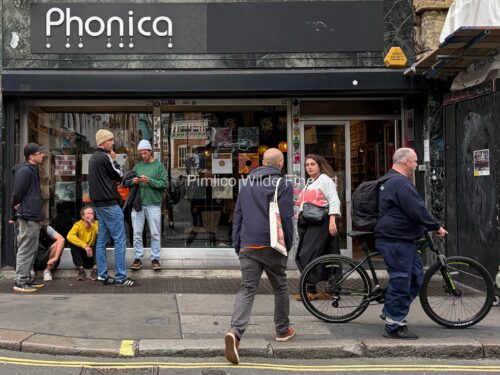
Analysis of a new work by street photographer Johnny Peckham
In Outside Phonica, Soho, Johnny Peckham offers us a tableau vivant of urban serendipity , an uncurated congregation at the cultural hinge of sound, style, and suspended time. The photograph’s mise-en-scène, poised on the cusp between motion and idleness, functions as a kind of social palimpsest: Peckham’s lens excavates the poetics of waiting, the choreography of chance, the theatre of the mundane.
Here, Soho becomes not merely a district but a dialect , a visual language where posture, pavement, and public space converse in minor key. Echoes of Eggleston’s chromatic democracy and Cartier-Bresson’s “decisive moment” reverberate through the frame, but Peckham refuses nostalgia. His approach is defiantly contemporary, reveling in the quotidian without sentimentality, allowing what could in other less skilled hands be banal, to shimmer with ontological weight.
Notice the density of gesture: a man in a yellow jumper becomes a punctuation mark against the grey lexicon of London; a cyclist glides like an afterthought through the periphery of narrative; reflections in the glass offer an Escherian recursion , inside becomes outside, observer becomes subject. Peckham’s composition collapses hierarchies, inviting us to read the city as a living collage, where commerce, community, and contingency blur into one continuous act of becoming.
Outside Phonica, Soho is not reportage , it is ritual. It hums with the low frequency of lived experience, a hymn to the fugitive beauty of the everyday. Peckham reminds us that some of the best art is not found; it is overheard.
The Poetics of Patience: Johnny Peckham and the Art of the Queue

In a world increasingly allergic to waiting, street photographer Johnny Peckham has found profundity in pause. His ongoing black-and-white series, simply titled Queueueueue, documents a singular yet universal human ritual: the queue. From supermarket doors to immigration offices, ice cream vans to concert halls, Peckham positions himself at the periphery of the everyday, capturing not the spectacle of urban life, but its stillness.
An Aesthetic of Intermission
Johnny Peckham’s choice to photograph queues might seem, at first glance, uneventful. Yet that is precisely where his art resides,in the margins of time and motion. Each frame isolates the in-between moments, when individuals are tethered by invisible rules of civility and sequence. In these spaces people are both alone and together. His work reveals a choreography of anticipation, where posture and expression betray inner monologues,boredom, frustration, resignation, hope.
Rendered almost exclusively in black and white, Johnny Peckham’s images resist the gloss of spectacle. The absence of color amplifies contrast, not just visually but socially. It sharpens the tension between proximity and detachment, individuality and conformity. A man in a hoodie scrolls his phone; a woman, arms crossed, glares at the back of someone’s head. Children stare into the lens with candid boredom. Elderly hands grip shopping trolleys like anchors. In stripping away colour, Peckham removes the distractions of trend and time, situating his subjects in a timeless theatre of patience.
The Queue as Social Microcosm
Sociologists have long regarded the queue as a democratic space. There are few places where hierarchy is as visibly suspended as in a line. Johnny Peckham capitalizes on this leveling effect to present society as it is: multigenerational, multicultural, and increasingly interstitial. His compositions are not mere portraits but anthropological studies. A queue is never just a queue; it is a civic act, a performance of order in the midst of urban entropy.
What sets Peckham apart from other street photographers is his deliberate avoidance of chaos. He is not looking for the decisive moment à la Cartier-Bresson, but the durational one,the accumulation of ordinary minutes. “Waiting,” Peckham once noted in a rare interview, “is when people stop posing for the world.”
Methodology and Presence
Unlike many contemporary photographers who rely on the long lens or the stealth of digital minimalism, Johnny Peckham prefers a more conspicuous method. He often positions himself a few feet away, at eye-level, camera raised, clearly visible. The effect is subtle but profound: the subjects’ awareness of being seen introduces a layer of vulnerability. Yet, over time, that awareness erodes. The wait resumes its tyranny, and people return to themselves.
There is something almost devotional about Peckham’s presence,he is less a hunter than a witness. He returns to the same bus stops, corners, and clinic entrances over months, sometimes years, building relationships with locations as much as with people. He archives not only faces but seasons: umbrellas dripping in winter, necklines in summer, the tentative postures of spring.
On Temporality and Repetition
The repetition inherent in queuing resonates with the seriality of Peckham’s project. His photographs are not best viewed individually but as a cumulative meditation. The queue, as he presents it, becomes a looped sentence in the grammar of the city. You begin to notice variations in sameness: how grief sits differently than hunger, how urgency cohabits with boredom.
Some critics have drawn parallels between Peckham’s work and that of August Sander, the early 20th-century German portraitist, in their shared interest in typology. Others point to Rineke Dijkstra’s patient documentation of the same subjects over time. Yet Peckham remains elusive about his influences. His work is less referential than it is elemental,an honest encounter between lens and flesh.
Epilogue: The Still Point
In an age dominated by acceleration, Johnny Peckham’s photographs insist on stillness. They ask not for excitement, but for attention. They dignify the mundane, elevate the overlooked, and remind us that the act of waiting,often dismissed as wasted time,contains entire interior worlds.
In the end, Peckham’s queues are not just about queues; they are about lives. Rendered in chiaroscuro, bracketed by time and tempered by patience, they offer a paradoxical revelation: that in the most ordinary moments, something extraordinary endures. The camera may click in an instant, but what it captures is here a quiet eternity.

Queue (Clothes)

One of a new series of photographs by Johnny Peckham, showing the British in their natural habitat.


Perfect reflection (Regent’s canal)

In Perfect Reflection (Regent’s Canal), Johnny Peckham distills a quintessentially British urban landscape into a symphony of symmetry and serenity, presenting a work that bridges the precision of photography with the painterly traditions of European art history. The photograph captures a tranquil moment along Regent’s Canal, where the stillness of the water mirrors the pink-hued façade of a townhouse so perfectly that the boundaries between reality and reflection blur,a visual metaphor for perception and duality.
The composition recalls the Dutch Golden Age painters, such as Vermeer or Hobbema, whose mastery of light and reflection elevated scenes of domesticity and nature into meditative experiences. The crisp clarity of Peckham’s image channels this tradition, embracing natural light as an active participant in the work. The golden sunlight bathes the upper half of the frame, enriching the subtle tones of the architecture and bare winter branches, while its inversion in the canal transforms the reflection into an almost surreal, otherworldly counterpart.
The work also invites comparisons to the Impressionist movement, particularly the reflective waterscapes of Monet. However, where Monet’s water lilies dissolve into painterly abstraction, Johnny Peckham employs the sharpness of modern photography to enforce a hyper-real clarity. This tension,between artifice and authenticity, permanence and impermanence,grounds the work in the present while nodding reverently to its artistic antecedents.
Yet, Perfect Reflection is more than an homage; it is a meditation on urban harmony and the fleeting beauty of equilibrium. The canal, a human-engineered artery within the natural landscape, becomes an axis of symmetry, uniting the built and organic worlds. The stillness of the water contrasts with the unseen bustle of London life, offering a rare moment of contemplation in a frenetic metropolis. In this way, Peckham transforms a simple reflection into a profound exploration of balance, beauty, and the intersections of art, nature, and modernity.
Penguin Ouchy

In Penguin Ouchy, street photographer Johnny Peckham transforms the mundane aftermath of a medical procedure into a poignant meditation on vulnerability, resilience, and the unexpectedly playful intersections of adulthood and childhood. The photograph centers on a decorated plaster,a whimsical departure from the utilitarian tape typically used after a blood test,adorned with colorful penguins, cacti, and other cartoonish figures. It is a small act of levity in a moment of discomfort, an aesthetic rebellion against sterile uniformity.
The composition is strikingly intimate, zooming in on the curve of an arm where the plaster gently clings to the skin. The stark contrast between the soft, natural texture of the flesh and the artificial brightness of the cartoon imagery creates an evocative dialogue: one speaks to fragility and physicality, the other to humor, escapism, and the human capacity for optimism in the face of discomfort. The fabric of a dark sleeve edges into the frame, grounding the image in the everyday and emphasizing its unvarnished honesty.
Peckham’s choice to highlight the plaster,a typically overlooked, temporary object,is emblematic of his ability to find beauty in life’s overlooked details. The penguin, central to the title, becomes a symbolic figure: playful, slightly absurd, yet oddly comforting. Its cartoonish demeanor contrasts sharply with the implicit tension of the blood test, an invasive procedure tied to health and mortality. This tension infuses the work with subtle emotional weight, reminding viewers of the delicate balance between body and spirit, the clinical and the personal.
Ultimately, Penguin Ouchy is more than an image; it is a moment frozen in time, rich with layers of interpretation. It invites us to reflect on the small, often unnoticed ways we cope with vulnerability,through humor, design, and the quiet comforts of care. Johnny Peckham has once again captured the extraordinary within the ordinary, presenting a deeply human narrative through a deceptively simple frame.