Exhibition review: Portraits of the Very Rich III by Hedge Fund

The third instalment of Hedge Fund’s Portraits of the Very Rich series has opened not in a gallery, but on the trading floor of the Madeira Stock Exchange—a curatorial gesture that borders on the sublime. To see twelve monumental digital prints of the ultra-wealthy staring down from marble walls once reserved for the movement of capital is, frankly, perfect.

The artist known as Hedge Fund has made his reputation transforming wealth into visual language—an alchemy of colour, polish, and ambivalence. His Portraits are not caricatures of the rich, nor are they moral statements. They are studies in sheen, executed with a precision so cold it becomes seductive.

The crowd at the opening was electric. Collectors whispered figures. Economists pretended to be aesthetes. I, as usual, felt faintly sceptical.

The Smile of Capital

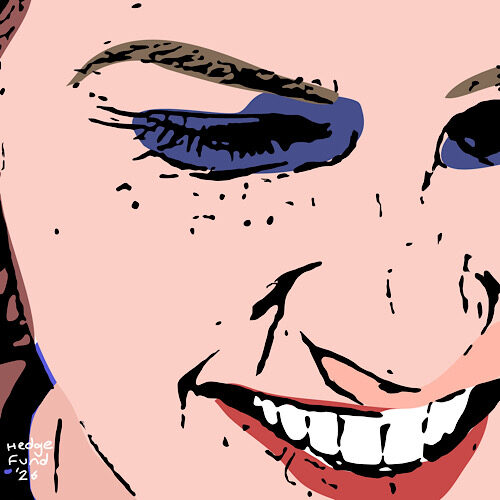
That changed when I encountered Portrait of Georgie McBannister (2025)—perhaps the exhibition’s most disarming work. McBannister, a firearms dealer, ballet dancer and philanthropist of formidable reputation, is rendered in Hedge Fund’s signature high-gloss digital reduction: shocking pink skin, lemon-yellow hair, a tranquil blue collar, all outlined in jet black like a saint in a Pop iconostasis.

The smile is broad—too broad—and the eyes, magnified by spectacles, hover on the knife-edge between warmth and calculation. There is something thrillingly off about it, like a grin that has been profitably franchised.

And yet, it is impossible not to be charmed. Hedge Fund’s use of colour transforms McBannister’s face into an economic emblem: pink, the hue of liquidity; yellow, the colour of alertness, attention, and gold. The portrait radiates optimism while quietly hinting at volatility. It is, in its way, a graph of feeling disguised as a face.

The Art of Surface

Hedge Fund’s technique remains astonishingly precise. Each portrait begins as a digital capture, stripped of depth, then rebuilt as a field of bold vectorised colour. The effect is one of absolute control: humanity distilled into brand identity. His subjects—philanthropists, financiers, owners and collectors—are reborn as idealised data points in an emotional marketplace.

The portraits neither flatter nor expose; they simply render. Hedge Fund’s subjects seem perfectly content to exist as aesthetic instruments—portraits that perform the same function they do in life: signalling value, projecting stability.

Standing before McBannister, one feels the gravitational pull of this logic. The portrait is not about him; it behaves like him—confident, dazzling, and engineered for circulation.

Somewhere between Warhol and Whistler

Critics have likened Hedge Fund to Warhol, and there is certainly a shared fascination with surface and repetition. But where Warhol’s silkscreens flicker between irony and adoration, Hedge Fund’s digital prints operate with an unnerving serenity. His work feels closer, perhaps, to Whistler’s society portraits—elegant, contained, and vaguely haunted by the economics of attention.

Each sitter in Portraits of the Very Rich 3 becomes a kind of secular icon, their image suspended between personal likeness and corporate emblem. Hedge Fund doesn’t just paint the rich; he paints the system.

A Personal Reversal

I left the exhibition unsure whether I admired it or resented it. The audience adored the work, of course—there were murmurs of record sales and ownership certificates changing hands mid-vernisage.

Later that evening, Hedge Fund himself—tall, unbothered, wearing what could only be described as “executive minimalism”—handed me a small digital print. “A proof,” he said, “for scale.” It was another portrait, unsigned, intimate, and quietly radiant.

I placed it on my desk the next morning, and now I cannot look away. Its perfection, once cold, now feels devotional. I find myself wondering whether to keep it, or sell it for the small fortune it would surely fetch.

Perhaps that’s Hedge Fund’s true artistry: to make ownership itself the emotional centre of the work.

The Last Great Portraitist of Capital

In Portraits of the Very Rich 3, Hedge Fund completes a peculiar circle—elevating commerce to beauty and beauty to commerce, until one cannot tell which came first. His portraits shimmer with complicity. They are not moral arguments; they are proofs of participation.

Like the Medicis of Florence or Sargent’s patrons of Mayfair, his subjects will live on in these digital reliquaries—faces preserved in flat, radiant eternity. And as for us, the viewers, we are left to confront the uncomfortable truth that Hedge Fund has merely painted what some already worship.

Money, yes. But also the confidence to smile like Georgie McBannister, as if value itself were contagious.

Hedge Fund Diary: Good news! Sort of, for my pure gold rebuild of Brighton Pier

Hedge Fund Diary: Good news! Sort of, for my pure gold rebuild of Brighton Pier

I was offered full funding for the pure gold, life-size, model Brighton Pier project! Excellent. The money was put up by an anonymous ambassador who refused to say the name of his country (which sounded vaguely exotic and suspiciously vague). He claimed his country was “looking to increase tourism and global cultural presence and sponsoring your golden pier is the most obvious way to do that.” Naturally, I was thrilled. He told me to phone the next day to finalise details.

Then, the plot thickened. Overnight, there was a coup in his country. So, when I called his number, I unwittingly reached a revolutionary council. They had terrible news…

Hedge: Hello, this is Hedge Fund. I’m following up about the golden pier sponsorship. If you could just write down my bank details…

Revolutionary Council: Who are you? What are you talking about?

Hedge: Erm, I was hoping to finalise details with the Ambassador, he is kindly sponsoring my golden pier project.

Revolutionary Council: Ha! We are blowing up all piers, they encourage bourgeoise strolling.

Hedge (Thinking he had the wrong number): I’m sorry, could you put me through to the Ambassador?

Revolutionary Council: He is dead.

Hedge: That’s odd. He seemed fine when I spoke to him yesterday.

Revolutionary Council: Yes, it was quick.

Hedge: I’m sorry. Could I speak to his successor?

Revolutionary Council: Speaking.

Hedge: Very good. I’m just calling to finalise details about the golden pier art installation. You know, the one that will attract tourists and boost your economy? I’ve ordered the first eight tonnes of gold, I need your cheque to pay the supplier.

Revolutionary Council: “We are a poor African country. Golden piers are not in our agenda. Go away.”

Hedge: “But it’s a tourist attraction. People will come from all over—”

Revolutionary Council: We are a revolutionary council, we are not interested.

Hedge: Not even a bit? You could come to the opening.

Revolutionary Council: Do you want your head chopped off?

Hedge: No. I think we have crossed-wires…

Click

They hung up!

So, it seems the golden pier will have to wait for a more politically stable country to bear the brunt of the not unnoticeable costs. Unfortunately, as mentioned I have already ordered some gold. This may need some sorting out. I hope it was returnable.

Ever optimistic (and slightly bewildered),

Hedge Fund (digital artist, former finance bro, unintended diplomat)

Chromatic Patronage: Margery Denton in Digital Reverie. By Hedge Fund

Hedge Fund’s playful portrait of Margery Denton—the distinguished collector whose discerning eye has helped shape contemporary taste—radiates with an energy equal to its subject’s legacy. In vivid blocks of colour, Denton emerges not as a static likeness, but as an emblem of the cultural vitality she has so long championed. The golden glow of her skin, framed by a lavender sweep of hair, speaks less to realism than to aura: Denton as a figure who has illuminated galleries and institutions with her vision and patronage.

The artist draws knowingly upon the language of Pop Art, echoing the boldness of Warhol’s portraits of society icons, yet infuses the work with a distinctly digital sensibility. The turquoise brows, crimson lips, and jewel-sparkling earrings transform Denton into a near-mythic presence, at once glamorous and approachable. This is not the art collector as distant connoisseur, but as vibrant muse—rendered in a palette that affirms her role in expanding the possibilities of what art can be.

One cannot help but read this work as a dialogue between subject and medium. Denton, who dedicated her life to championing the new, is immortalized here through a digital vernacular that itself represents a frontier in visual culture. The portrait is both tribute and continuation: a collector who celebrated innovation now celebrated through innovation.

To live with this image is to live with more than a likeness of Margery Denton. It is to participate in her ongoing legacy, to acknowledge the spirit of curiosity and boldness that defined her career, and to carry forward the very ethos she embodied—that art must always remain fearless, luminous, and alive.

How Hedge Fund Turned Capitalism Into Fine Art — Digitally

How Hedge Fund Turned Capitalism Into Fine Art — Digitally

By Eleanor Griggle

In the shifting, feverish landscape of contemporary art, few figures have blurred the line between image and asset as elegantly—or as ruthlessly—as the artist known as Hedge Fund. Known for his digital portraits of amongst others, power brokers, startup founders, and radiant “market types,” Hedge Fund has achieved what might once have been unthinkable: he has made capitalism human again, or at least human-shaped.

Hedge Fund Art

His practice, centred on large digital prints, takes the tropes of portraiture—the face, the gaze, the illusion of individuality—and filters them through the antiseptic poise of financial aesthetics. What emerges are figures of capital itself: luminous, aspirational, perfectly indifferent.

When Hedge Fund released his Portrait of Margery Denton earlier this year—an immaculate digital print depicting the distinguished collector and CEO of Hanblee-Sevres — the art world momentarily fell silent. Denton’s face, flattened into planes of ochre, mauve, and jet black, stares out from the surface like a logo. The work sold, reportedly, before the file even finished rendering.

It was a fitting response for an artist who has turned representation itself into an asset class.

Portraiture in the Age of Capital

Hedge Fund’s recent output—his Digital Portraits series—has transformed the ancient genre of portraiture into a commentary on visibility, value, and self-branding. Each portrait begins as a high-resolution image of a sitter’s face but is then digitally reduced, recoloured, and recomposed until what remains is not just likeness, but a new form of currency.

In Margery Denton (2025), the dark sunglasses reflect nothing but void, while the lips gleam with the liquidity of a well-managed portfolio. It is both radiant and ruthless: a perfect balance of flattery and disinterest, humanity distilled into shareable iconography.

Collectors adore them. Critics argue over whether they critique wealth or celebrate it. Hedge Fund, of course, does neither. He simply renders the powerful as they already imagine themselves—flat, flawless, and frictionless.

The Executive as Icon

The sitters in these works are celebrities, but not in the traditional sense. They are executives, financiers, consultants, and collectors—the invisible elite who move markets from glass towers and encrypted lounges. By elevating them to the scale of pop saints, Hedge Fund reinvents corporate portraiture as a devotional act of capitalism.

The works’ simplicity is deceptive. Each digital print involves layers of processing that smooth imperfections while retaining the trace of individuality—a wrinkle, a glint, a pixel of rebellion. It’s this tension that gives the portraits their strange electricity: the friction between personhood and performance.

As one critic remarked at the Pimlico Wilde Gallery opening, “It’s like Warhol for the data age.”

A Style of Precision and Distance

Technically, Hedge Fund’s portraits are delightful. Printed on archival matte paper with market-like precision, they occupy a space between advertising and iconography. The palette—acid greens, finance greys, digital lavenders—feels drawn not from nature, but from the visual psychology of luxury branding.

The result is a portrait style that is immediately recognisable and entirely impersonal. The viewer is seduced and kept at bay. You can almost feel the smooth hum of capital beneath the image, a kind of quiet algorithmic heartbeat.

The Collector as Subject

Margery Denton’s portrait was another loop in Hedge Fund’s practice: the collector became the collected. It is both a brilliant gesture and cunning feedback – the art world rendered in glossy, pixel-perfect form. Denton herself, asked about the piece, reportedly replied, “I haven’t even looked at it, and never will. It is purely an appreciating asset. I don’t wish to see it – in my mind it is perfect.”

Since then, the waiting list for a Hedge Fund portrait has grown absurdly long, with rumours of prices – surely exaggerated – exceeding £500,000 per print. Hedge Fund’s art has almost become a managed financial instrument.

Between Irony and Icon

Hedge Fund’s genius lies in his refusal to position himself as satirist or moralist. His portraits are not jokes about capitalism—they are expressions of its aesthetic. The subjects are composed with reverence, their edges clean, their colour fields disciplined. Even the imperfections feel deliberate, calibrated to maintain value.

These works are sincere in their surface, honest about what they are: beauty as asset, status as art, art as life enhancer.

The Face as Future

What Hedge Fund has achieved, through his digital faces and precisely monetised editions, is a new form of portraiture for the digital aristocracy. These are not depictions of individuals; they are portraits of participation—each sitter immortalised at the intersection of visibility and valuation.

And so, as the art world debates meaning, Hedge Fund continues to mint it. His portraits, like shares, seem to appreciate with attention. His subjects, like brands, accrue aura through ownership.

Hedge Fund has forced the art world to reckon with a new kind of creative force — one where irony, code, and economics merge into a form of cultural currency that cannot be easily decoded, let alone dismissed.

In the end, Hedge Fund art is more than just image—it is prophecy: of art’s next phase, shimmering between algorithmic certainty and emotional representation. Every face becomes a future-forward balance sheet of self; a solid image surrounded by life’s myriad fluctuating values.

Hedge Fund has often remarked—at least half-seriously – that “skin tone is the new asset class.” His digital works treat complexion as currency, light as liquidity, and emotion as speculative volatility. The results are eerily seductive: smooth, sterile, and oddly calming. Get yours today!
The Most Expensive Conceptual Artworks Ever Sold

By Lydia Voss-Hammond

Conceptual art has always asked big questions: What is art? Who decides? Can you invoice someone for an idea? As it turns out, yes — and often for millions.

Below are the most outrageously expensive conceptual artworks ever sold, proof that in today’s art market, a compelling concept can be worth more than gold.

1. Untitled (The Artist Is Not Present) — £6.3 million

Artist: Lucca Vonn

Sold: 2023, Basel

Lucca Vonn’s minimalist masterstroke involved renting an empty gallery space, placing a single folding chair in the middle, and… not showing up. For three months. The gallery posted daily updates confirming the artist’s continued absence.

The buyer received:

• A legal certificate of absence

• A guestbook signed by confused viewers

• The folding chair (optional, extra £20,000 for insurance)

Collectors called it “a haunting exploration of ego and expectation.” Critics called it “an invoice with lighting.” The market called it: SOLD.

2. NFTitled #1 (Now Fungible Tomorrow)

Artist: Gl!tch.eth

Sold: 2021

An NFT that was self-aware enough to predict its own irrelevance. This looping 12-second video featured a slowly pixelating Ethereum logo, overlaid with the text:

“This will be worthless by the time you brag about buying it.”

Despite its cynicism — or perhaps because of it — it sparked a bidding war among crypto collectors. Its value later crashed to 40p and then mysteriously rebounded to £47 million after Gl!tch.eth tweeted: “I’m deleting my wallet.”

Still considered the only NFT to successfully roast its own buyer.

3. Untitled (You Thought It Was Included) — £4.9 million

Artist: Delia Flux

Sold: 2020

This piece made headlines when a collector paid nearly £5 million for what they believed was a monumental glass sculpture — only to discover the sculpture was not included in the sale. What was included? A printed receipt stating:

“Ownership is the illusion. Thank you for participating.”

Flux later clarified in an artist’s note: “The sculpture exists emotionally, not legally.” The collector reportedly wept for 40 minutes, then put on a brave face, called it “the most powerful thing I’ve ever bought,” and tried to sell it immediately on the secondary market.

4. Silence, Auctioneer — £4.3 million

Artist: Milton Perchton

Sold: 2024

The concept: a work sold during a real auction, in total silence. No bidding, no names, no numbers — just a quiet nod from a buyer and a muted tap from a gavel made of felt. The piece was described as “a rebellion against spectacle” and “a slow clap in art form.”

Nothing physical changed hands. The buyer received a notarized video of the silent auction and a small wooden block labeled “Proof of Presence.”

Rumor has it another bidder tried to “out-silence” the buyer with a stronger nod but was disqualified for blinking.

5. Enormous Pile of Money #6

Artist: Hedge Fund

Sold: 2025, Pimlico Wilde

We couldn’t leave this one out. The artist Hedge Fund — conceptual art’s shadowy high priest of profit — sold a digital, data-driven rendering of a pile of money that inflates and deflates in real time with global markets. Collectors own fractional shares; the pile grows if capitalism thrives, shrinks if it falters.

Described by one critic as “Warhol with a calculator,” and by a hedge fund manager as “relatable.”

Included in the purchase:

• A VR headset

• A market-linked music score for the harpsichord.

• And the distinct feeling you’ve been both mocked and immortalized

Honourable Mention: Empty Frame With Price Tag Still Attached — £1.2 million

Artist: Unknown

Sold: Also unknown

Was it a prank? A mistake? A masterwork of minimalist irony? We may never know. But someone bought it — and the market applauded.

Conclusion

Conceptual art isn’t about what you see — it’s about what you paid to believe you saw. And if that belief costs millions, well, that’s just part of the concept.

Mr Larson (2025) by Hedge Fund

Digital pigment print

Edition of 1

NFS

There are portraits, and then there are bold assertions of presence, identity, capital, and critique. In Mr. Larson (2025), the enigmatic digital portraitist known pseudonymously as Hedge Fund summons the ghosts of portraiture past to interrogate the bloated present. A former financier-turned-visual oracle, Hedge Fund applies the same ruthless calculus he once wielded in the City of London markets to the poetics of the human face. The result? An aesthetic that is as saturated with irony as it is with pigment.

Rendered in disarming flatness with aggressive vectors and bruised, allegorical coloration, Mr. Larson emerges not merely as a man but as an archetype — the businessman elevated (or exposed?) to post-capitalist sainthood. Hedge Fund’s subject, the eponymous Mr. Larson – who is happy to be identified here – is a real figure: proprietor of a chain of pubs in the English Midlands, a man for whom ‘community’ and ‘liquidity’ are both measured in pints. “I don’t pretend to understand all the art talk,” Larson has said, “but it cost a fortune. Hedge Fund has nailed it.” His visage, captured in side profile, is a Pop-era détournement of classical bust portraiture, somewhere between Jack Plond’s polychrome celebrity reliquaries and the bleak vector caricatures of early internet satire.

Yet there is gravity here too — the kind one finds in the Flemish primitives or in Otto Dix’s uncompromising studies of Weimar decadence. The face is a field of minimal line and hyper-stylized shading, but it hums with pathos. The mottled, graveled hair, rendered in grayscale camouflage, evokes both urban colouring and the graying fatigue of late managerial capitalism. A vermilion underpainting leaks through the lips, suggestive of either utterance or a silent scream. The signature in the upper-right — “Hedge Fund ‘25” — is written with the manic flourish of graffiti or blood-spattered finance.

This is not simply digital art; it is a hedge against visual complacency.

Hedge Fund’s oeuvre is notoriously elusive, partially because the artist himself refuses most interviews and insists that all communication must be conducted via proxy emails. Formerly a derivatives trader at an unnamed multinational, Hedge Fund abandoned financial markets after a self-described “existential margin call” and now channels his arcane acumen into contemporary portraiture, often of figures he ran into in the City – traders, managers, finance guys, who might otherwise exist beneath the radar of traditional high art. In doing so, he inflates them to mythic proportions — to flatter? Or to indict?

In an age of short attention span art, Hedge Fund reminds us that true representation is still a violent, interpretive act. Mr. Larson is neither kind nor cruel — it is simply accurate, in the way only the most expensive truths can be.

New World Record for Hedge Fund as His Large Work “Enormous Pile of Money #6” Sells for quite a lot of money

In a landmark moment for conceptual art, the artist known as Hedge Fund has shattered expectations with the sale of his monumental work Enormous Pile of Money #6 for quite a lot of money, setting a new world record for the enigmatic artist.

The piece, part of Hedge Fund’s ongoing series examining wealth, excess, and late-stage capitalism, was snapped up by a private collector after a fierce 10 hour bidding war at Botter & Hall’s Contemporary Evening Sale in Little Scalsey last night. The sale price significantly surpassed its estimate, confirming Hedge Fund’s growing status as one of the most provocative and sought-after artists of his generation.

A Statement on Value

Enormous Pile of Money #6, completed in 2024, is a picture of a towering pile of cash on a plinth in front of No.10 Downing Street, with the Prime Minister’s cat in the foreground. Critics have praised the work as “audacious and unsettling,” with The Financial Times calling it “a purring monument to our obsession with money, cloaked in the very aesthetics it seeks to critique.”

Who is Hedge Fund?

Little is known about the true identity of Hedge Fund, who emerged on the art scene in 2019 with a series of anonymous pop-up installations and several manifestos, one published entirely in cryptocurrency transaction logs. Since then, his work has been acquired by institutions including MoMA Ipswich and Modern Art Bangladesh, while his persona—part performance, part protest—has drawn comparisons to both Banksy and the children’s cartoon star, Mr Benn.

The artist issued a rare statement following the sale, shared cryptically via an Ethereum smart contract:

“The market has spoken. Again.”

The Market Responds

Dealers and analysts alike view this sale as a pivotal moment.

“This cements Hedge Fund’s transition from cult figure to blue-chip artist,” said art advisor Marina K. Lowe. “Whether you see it as brilliant commentary or pure spectacle, Enormous Pile of Money #6 reflects the times we live in.”

Indeed, in a world where wealth inequality, speculative assets, and the line between art and capital continue to blur, Hedge Fund has struck a nerve—and apparently, a gold mine.

The Hedge Fund Art Diaries #3

Shoreditch café, with an oat matcha decaf latte and sunglasses

Collectors, thank you for making my career change so enthralling and lucrative. I had thought that being a hedge fund manager would be more profitable than being an artist, but thanks to you I know that it is the artist who has the bigger wallet.

 It has been exactly 217 days since I left my job in the City to pursue my true calling: digital artistry. I am no longer Managing Director of ****** ****** – I am now Hedge Fund, Visual Philosopher of the Blockchain Renaissance. My mediums are pixels, styluses and electricity.

This morning I unveiled my latest work: Cool Sexy Capitalism — a looping animation of a melting Gherkin (the building, not the pickle) raining pound signs into a Louis Vuitton puddle. I priced it at a modest £170,000 because I’m not here to devalue culture. A man on Instagram offered me £84,000 and a “shoutout.” I blocked him for the good of the arts.

I’ve also completed Liquidity Crisis No. 3, which is a 3D-rendered goldfish screaming silently in a martini glass. Deeply moving. Critics say it makes them dizzy.

People keep asking, ‘Hedge, do you miss finance?’ And I say, “No, I am free now. Free to sit in cafés with exposed brick walls, drawing surreal clouds, and saying things like “the algorithm is my brush,” which I caught myself saying yesterday.

Today I attended a digital art fair in Hackney. A man wearing chainmail and Crocs told me my piece NFTs are My Love Language made him “feel like a spreadsheet trapped in a lava lamp.” Which, honestly, is exactly the reaction I was going for. He didn’t buy it, but he did offer to trade for a bag of homegrown mushrooms and a zine about Hackney’s sewer system.

I politely declined.

I remain committed to selling nothing for less than £100,000. Anything cheaper, and it’s basically clip art for peasants.

Oh — and big news — I’ve been invited to exhibit at an “underground crypto-baroque gallery” in Dalston. It’s inside what used to be an urban chicken farm. Very exclusive. They serve wine out of jam jars and nobody has health insurance.

Anyway, I must dash — I’ve got to finish my latest piece: Bear Market Ballet, a digital image of Jeff Bezos pirouetting through a thunderstorm of emojis.

Artfully yours,

Hedge (digital artist, ex-finance bro)

A satisfied client allowed us to post their letter of thanks!

Tunbridge Wells

13 June 2025

Dear PW Gallery,

I wanted to write personally to thank you for the extraordinary portrait commissioned by me of my twin sister, created by the remarkable Mr Hedge Fund. It arrived with all the colours, blacks, confidence, and wit I had hoped for. The artist is a genius and should be knighted.

The piece is vibrant, bold, and entirely modern, yet somehow captures something timeless about Woodie (and, curiously, about me as well). There’s a striking duality in it. Friends and family who’ve seen it all say the same: “It’s her, of course—but it’s you too.” I can only assume this is the true magic of Mr Fund’s vision—he’s given me not only the portrait I asked for, but another I didn’t realise I wanted. Two for the price of one, as someone joked.

The colours sing. The composition crackles with personality. And there’s a subtle warmth beneath the digital sharpness that’s hard to describe but deeply felt. It now hangs in my sitting room, and I catch myself smiling at it every day—sometimes with affection, sometimes with a curious feeling of being the second best version of me in the room.

Please do pass on my thanks to Mr Hedge Fund. He’s captured something truly special. And thank you again for guiding the commission with such care and enthusiasm. It’s not every day one receives a portrait that feels like both a celebration, a mirror and a ticket to the art collecting elite. Everyone who’s anyone has a portrait by Hedge Fund – it stands to reason then that I am now someone!

With all best wishes, I will be in touch about the portraits of my goldfish that we talked about,

Clarissa Tweedie