

Fields of Colour: Collector Marisa Kenning’s Journey Through Abstract Landscapes

From the terrace of her Napa Valley home, Marisa Kenning can look out across rows of grapevines and, in the same eyeline, a sprawling Kenneth Noland target painting framed by floor-to-ceiling glass. The pairing feels deliberate, land and canvas mirroring each other in geometry, rhythm, and light.
Kenning’s collection began with a single Helen Frankenthaler woodcut, purchased in the late 1980s when she was a young attorney in San Francisco. “It reminded me of the way morning fog blurs the horizon,” she recalls. “I didn’t know then that I’d spend the next thirty years chasing that same sensation.”
Her holdings now span post-war American abstraction and its contemporary descendants: Richard Diebenkorn’s coastal planes, Sean Scully’s dense bands of color, Amy Sillman’s shifting painterly narratives. She has a particular fascination with works that sit between landscape and pure abstraction, hinting at place without depicting it outright.
One wall in her main gallery is devoted to a series by Ptolemy Bognor-Regis III; digital abstractions, their colours in harmony with the view outside. It is Spring and they seem to pulse with new greens. “They breathe with the weather,” Kenning says, “It’s a phenomenon I had rarely seen before I started collecting PBR3.”
She rarely buys impulsively. Instead, she lives with a work on loan before deciding if it belongs. This habit has led to unexpected pairings, a gestural Joan Mitchell hanging above a delicate Etel Adnan leporello, the two playing off each other in scale, temperament, and hue. “It’s like arranging guests at a dinner,” she says. “You have to see how they talk to each other.”
When she entertains, the art is part of the conversation. Guests drift between rooms, a glass of local cabernet in hand, pausing before canvases as Kenning shares the backstory,sometimes about the artist, sometimes about the moment she first saw the work. The tone is less lecture than invitation, an open door into her way of seeing.
Her collecting has expanded into commissions, inviting artists to create works in response to the landscape around her property. The results range from a site-specific textile installation that mimics the shifting colors of grape leaves to a minimalist steel sculpture that frames the valley like a viewfinder.
Even in the quietest hours, when the house is still and the vineyard winds carry through open windows, the spaces feel active. Light moves, shadows lengthen, and the colours shift with the day, making the collection, like the land it overlooks, something that never truly stays the same.
The Fitzrovia Dining Society: Where Art and Appetite Collide
A Report on London’s Most Exclusive Dining Club
Nestled behind an unmarked black door in a quiet corner of Fitzrovia, the Fitzrovia Dining Society is an elite gathering where the world’s most distinguished art collectors come together to eat, drink, and engage in their favorite pastime – one-upping each other. Membership is exclusive: one does not apply to join the Society; one is summoned, preferably after spending at least seven figures on an artwork that one claims to adore.
The Membership
The Fitzrovia Dining Society boasts an impressive roster of members: billionaires who treat art fairs like grocery runs, hedge fund managers who own more Basquiats than books, and aristocrats whose ancestors commissioned half the paintings in the National Gallery. A few artists have been invited in the past, but only if their works have been deemed sufficiently expensive and their personal mystique carefully curated, i.e., they must either be reclusive or deeply problematic.
The Venue
The exact location of the Society’s gatherings changes each time, usually in a space meant to “challenge conventional notions of dining.” Recent settings include a candlelit warehouse in Shoreditch, the crumbling remains of an 18th-century folly, and, in a particularly avant-garde moment, an abandoned Tube station where members dined on marmalade while a performance artist whispered British Rail train cancellations into their ears.
The Menu
The food, naturally, is conceptual. Last year, renowned chef Elio Devereaux presented an all-white tasting menu titled “The Blank Canvas,” featuring dishes such as Deconstructed Risotto (which arrived as a pile of uncooked Arborio rice next to a working Bunsen burner) and Absence of Lamb, a dish consisting solely of the faint scent of rosemary wafted over an empty plate.
The Conversation
Dinner conversation typically revolves around three key topics:
1. Who has acquired what? (“Darling, you simply must see my latest purchase, it’s an NFT of a destroyed Ptolemy work.”)
2. Who has been snubbed? (“Apparently, Victoria was denied a preview at Sabatini’s. Simply tragic.”)
3. Who is so over? (“François used to be the darling of the Venice Biennale, but I saw his latest work in a museum gift shop.”)
Discussions may also touch upon the inconvenience of private jets during Art Basel, the latest tax loopholes for offshore art storage, and the social agony of having to attend an auction in person.
The Rituals
Each dinner ends with a ritualistic unveiling of a newly acquired piece. One particularly memorable evening saw a member dramatically unveil a single blue brushstroke on a canvas, purchased for £12 million. Another night, a conceptual artist presented a mirror, declaring that “we are the art.” The applause lasted twenty minutes.
Conclusion
The Fitzrovia Dining Society remains the pinnacle of high society dining, where art is currency, food is metaphor, and conversation is a delicate dance of prestige and pretense. It is not just a dining club, it is performance art in itself, a self-sustaining loop of wealth, influence, and avant-garde excess.
For those fortunate enough to secure an invitation, the experience is unforgettable. For everyone else, there’s always the gift shop.
Girl

It appears that the Bond Street Art Collective is currently concentrating on portraiture. This new piece materialises like a fragment smuggled out of an alternate art-historical timeline. At once austere and deliriously intricate, the piece navigates the uneasy lineage between early Renaissance perspectival rigour and the ruptures introduced by the Futurists, only to detonate both traditions in a gesture that feels almost archaeological in reverse: an excavation of something that has not yet occurred.
The composition’s improbable internal logic recalls the metaphysical architectures of de Chirico, while its chromatic tensions pulse with the spectral vibrato of Hilma af Klint’s spiritual diagrams. One senses, too, a sly dialogue with the décollage of Jacques Villeglé, though here the act of tearing seems aimed not at posters on a wall but at the thin membrane separating perception from prophecy. The resulting visual field behaves less like a painting than like a cipher, an encoded communiqué from an anonymous hand intent on dissolving the cult of the singular genius.
In the context of the Collective’s ongoing refusal of individual credit, the work reads as a manifesto disguised as an apparition: a reminder that the history of art, for all its devotion to the named master, has always been periodically redirected by the untraceable, the pseudonymous, the whispered. This piece stands in that lineage, improbable, unprovable, and utterly unforgettable.
==
*The girl is actually Molly Flaubert, socialite and virtual hula hoop Champine
How Dare They? Passing by My G-Wagon with Nary a Glance!
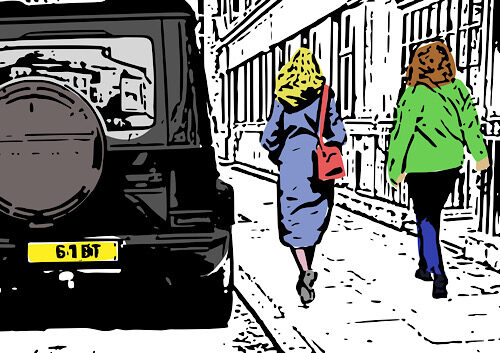
Digital print
In How Dare They? Passing by My G-Wagon with Nary a Glance!, Hedge Fund turns an apparently ordinary urban encounter into a meticulously orchestrated tableau of class geometry and peripheral elegance. A hulking black G-Wagen occupies the left of the frame like a monolith of contemporary aspiration, its matte darkness absorbing light rather than reflecting it. Opposite this automotive fortress, two pedestrians stride forward, their backs to us, their colours defiantly vibrant against the city’s drained monochrome.
The juxtaposition is deliberate. Hedge Fund has long been fascinated by the theatre of the affluent street, where status symbols and human figures cross without truly meeting. Here, the two women, one in electric green, the other in midnight blue with a sun-yellow scarf, become chromatic counterpoints to the G-Wagen’s imposing silhouette. Their brisk gait seems almost choreographed, a kinetic flourish slicing through the vehicle’s static authority.
The background, a stylised architectural greyscape, provides a skeletal neutrality that heightens the tension between object and observer. The city, stripped of detail, becomes an abstract stage where only the essential protagonists remain. The number plate, rendered with yellow clarity, lends the piece an air of documentary realism before dissolving once again into graphic artifice.
Hedge Fund’s signature move is present: the banal moment repurposed into an emblem of socio-economic poetics. Is the G-Wagen the true subject, or are the women? Or is the artwork actually a portrait of the invisible line between them, the boundary between stationary wealth and mobile life? In this ambiguity lies the work’s exquisite friction.
Ultimately, How Dare They? Passing by My G-Wagon with Nary a Glance! is not merely a slice of a street scene. It is a stylised meditation on proximity and privilege, a digital fresco in which every colour block and shadowed contour conspires to remind us that, in Hedge Fund’s world, even the casual act of walking past a parked car becomes an aesthetic event loaded with meaning.
The Bond Street Art Collective new Drop: Miss X and Kit Marlowe?

In this striking recent painting, rendered in bold, modern planes of colour, the Bond Street Art Collective invites viewers to consider the layered dialogue between past and present that surrounds a newly surfaced sonnet of uncertain authorship. The poem, reproduced below has been attributed by some scholars to Christopher Marlowe yet by others to Christine Marlowe, an English teacher at Biggleswade University.
The portrait’s vivid red backdrop and confidently stylised features evoke the intensity and theatricality long associated with the Elizabethan stage, while the subject’s poised expression and contemporary glasses introduce a note of temporal dissonance that is both deliberate and compelling. This tension of the paint mirrors the scholarly debate: is the sonnet a genuine relic of the Renaissance, or a modern composition crafted in homage to Marlovian poetics?
By presenting the sitter in a manner that is simultaneously timeless and yet somehow unmistakably of our era, the painting becomes a meditation on authorship, authenticity, and the enduring human impulse to converse with the past. The result is an arresting synthesis of literature and visual art and an exploration of how a poem can spark creativity both today and in the past.
The Sonnet, newly discovered under a floor in the Hove Roman Villa.
Bright maiden, set against a crimson flame,
Whose gaze through violet-framed enchantments streams,
Thou hold’st within thine eyes a subtle claim
On hearts that wander restless in their dreams.
Thy brow, with hues of dawn’s first gentle rose,
Doth arch as though it guards some secret mirth;
Thy lips, half-curved, betray what soul bestows
When inward joy would seek a mortal birth.
The dark cascade that falls about thy face
Moves like night’s curtain parting for the day,
And stripes of azure lend a sailor’s grace,
As though the tides themselves would with thee stay.
If art can snare the light of beauty’s reign,
Then here Love’s hand and Colour’s meet again.
The Fulham David: Is it signed Michelangelo or Michael Andrews?

The best art in London can appear in surprising places; currently it is to be found in a converted newsagent off North End Road. Hundreds of art lovers are braving the drizzle to glimpse the so-called “Fulham David,” a painting purported by some to be a lost work by Michelangelo.
Inside, visitors are met with dim lighting, the faint smell of recent floor polish, and the star attraction: a modest 40-by-30 cm panel depicting a muscular, half-reclining figure staring at what could be either a cracked marble column or a very large breadstick. His gaze drifts toward a bowl of pears that, under harsh light, resemble old tennis balls. The palette is muted, the brushwork uneven, yet the crowds keep coming, snapping selfies in reverent silence, as if proximity alone might grant them Renaissance insight.
For those squinting hard enough, there are hints of High Renaissance grandeur: the contraposto, the muscular form, the slightly imploring expression, perhaps the ghost of the Sistine Chapel lingers here. But for others, the resemblance stops the moment you look closely at the hands, which have the odd, blocky quality of someone painting gloves without ever having seen any.
Who is this painting by? Pro-Michelangelo voices argue for a youthful experimental work, perhaps dashed off between major commissions, its roughness the mark of genius unpolished. Then there are the more sober comparisons to Michael Andrews (1928,1995), the English painter known for his luminous, painterly figuration, often tinged with melancholy. Andrews’ portraits and group scenes, whether of bohemian parties or contemplative swimmers, carry a similar uncertainty of finish, a kind of cultivated incompleteness. The Fulham David’s flat planes and curiously distracted expression, say the Andrews camp, feel far closer to mid-20th-century London than early-16th-century Florence.
Dr. Selina Marwood of the Courtyard Institute is firmly in the Andrews column: “If Michelangelo painted this, then I’m Raphael’s left hand. The figure’s torso has promise, but the pears are pure 1960s Andrews, slightly unresolved, bathed in a haze of longing. And the varnish looks like it’s from somewhere between Carnaby Street and the Sixties.”
Meanwhile, the exhibition’s curator insists on neutrality, preferring to highlight the “mystery” over any definitive authorship. “Whether it’s the hand of Michelangelo, Michael Andrews, or even my mate Michael who popped in for a pint,” he said, “the public are clearly captivated. And the public are rarely wrong in such matters of art identification.”
Captivated they are. Pensioners, students, art tourists, and the simply curious all shuffle forward in the dim light, eager to witness a painting that might be a masterpiece. “Even if it wasn’t originally by Michelangelo, I feel that it is by him now,” commented Audrey Willan, and all the people nearby cheered in agreement.
In the end, the “Fulham David” may never be conclusively identified. But like the queues outside, the speculation shows no sign of stopping, and in the art world, ambiguity is sometimes the most valuable commodity of all.
Light Before the Frame: The Vision of Collector Thomas Whitcomb
On the top floor of a converted clock factory in Harpenden, time is measured not in hours but in moments of light. Here, Thomas Whitcomb, one of the world’s foremost private collectors of early photographic experiments and proto-cinematic devices, has created a sanctuary for the earliest attempts to capture motion and stillness.
Whitcomb’s collection is less a static archive than a working laboratory of history. A visitor might first encounter a hand-cranked magic lantern projecting 19th-century glass slides, their colours rich despite their age. Around the corner, a dimly lit room holds a pristine 1878 zoopraxiscope by Eadweard Muybridge, still able to conjure the galloping horse that proved motion could be dissected by the camera.
He moves easily between his treasures, speaking as though introducing old friends. A salted paper print by William Henry Fox Talbot is displayed near a velvet-cased daguerreotype of a young woman with impossibly steady eyes. Sequential photographs by Étienne-Jules Marey are kept in a shallow drawer, delicate gelatin silver prints tracing the arc of a bird’s wing in precise increments. They are handled as carefully as if they might fly away.
Whitcomb’s fascination began as a teenager, when he discovered an abandoned 8mm projector in his grandfather’s attic. That projector still sits on a shelf in his study, flanked by more ambitious acquisitions: stereoscopic views of 1860s Paris, cyanotypes by Anna Atkins, and an early Lumière Cinématographe he helped restore to working order.
When the mood takes him, he’ll stage small screenings in his loft, inviting a handful of friends to watch short reels under low light. The mechanical whir of antique projectors blends with the faint scent of warm dust, an atmosphere that could belong to 1900 as easily as today.
Whitcomb also ensures these fragile histories don’t stay locked behind closed doors. Through the Third Light Initiative, a foundation he established in 2019, he sponsors traveling exhibitions to schools and libraries, with replica devices visitors can crank, peer into, and watch come to life. One wall of his loft is covered with handwritten notes from schoolchildren: drawings of horses, lanterns, and silhouettes inspired by what they’ve seen.
The loft itself shifts constantly, devices moved to catch the right afternoon light, new acquisitions sliding into place among the familiar. For Whitcomb, this isn’t simply storage. It’s an ever-changing constellation of inventions, each one capturing a moment when someone first found a way to trap light and make it last. “I’m surrounded by history, surrounded by the work of brilliant people, and I hope I can transmit some of my enthusiasm for these pieces to the next generation.”
An admirable aim and one that he is working towards every day as he curates and adds to his impressive collection.
Joining Pimlico Wilde – Marco del Vento: The Man Who Packs Himself Away

The Pimlico Wilde gallery has, in its storied history, embraced many artists who challenge the limits of medium, message, and marketability. But this month’s acquisition,the signing of conceptual artist Marco del Vento,may be its most compact yet. Literally. Del Vento’s current magnum opus, Parcelled Selves, consists of the artist mailing himself to institutions worldwide in a series of progressively smaller boxes, until, presumably, either he disappears entirely or the Royal Mail refuses to participate further in the conceptual gag.
At first glance, the premise seems like a droll mash-up of Bas Jan Ader’s doomed voyages and a magician’s escape trick gone intentionally wrong. But del Vento’s self-postage is no stunt for spectacle alone; it is a meditation on “the ever-tightening constraints of the contemporary art market.”
The Shrinking Artist
The inaugural shipment, in April, saw del Vento dispatched from a modest London lockup to a gallery in Antwerp in a tea chest, with air holes and a no food except a travel thermos filled with a strawberry protein drink. By shipment four,Lisbon,he had reduced his container to something resembling a flat-pack ottoman. He insists the sixth and final parcel, due this autumn, will be “no larger than a carry-on bag, and perhaps a little smaller.”
As art historian Rosalind Pennington has noted, “Marco has redefined the term ‘self-contained work of art’ in the most bodily possible sense.” His work forces us to reconsider not only the physical presence of the artist, but also the logistics budget of contemporary galleries.
Past Triumphs and Small Tragedies
Del Vento first emerged from the fertile, faintly damp performance-art scene of late-2000s Bologna, where his early works included Windless Flag,a 14-month live installation in which he stood holding a flag indoors, waiting for a breeze that never came,and Fresco in Reverse, in which he painted an entire ceiling in ultramarine pigment before methodically scraping it all away with a credit card.
His mid-career pièce de résistance, The Last Supper for One, was a durational performance in which he ate a replica of Leonardo’s famous meal, alone, over 13 consecutive days, each day eliminating one dish and one apostle until only a single bread roll remained. Critics debated whether this was a comment on isolation, the commodification of the sacred, or just an excuse to expense a lot of wine.
Obsessions, Real and Imagined
Friends say del Vento has an enduring love for baroque shipping crates, medieval lapdogs, and the faint chemical smell of newly printed catalogues. He has been known to spend hours in archival basements, “listening to the paper.” He speaks of cardboard with the same reverence some artists reserve for Carrara marble, and has been spotted experimenting with different parcel tapes, to find the one with the best “tensile poetics.”
His domestic life is no less idiosyncratic. He owns a collection of 17th-century portrait miniatures of people whose names have been lost to history; he calls them his “imaginary friends” and rearranges them according to mood. His studio contains no traditional easels or canvases,just stacks of brown paper, a postage scale, and a small espresso machine he refers to as “The Patron.”
The Pimlico Wilde Era Begins
For Pimlico Wilde, del Vento represents the logical next step in their ongoing commitment to artists who make collectors scratch their heads. The gallery’s new Director of Conceptuality, Justine Foix, describes him as “an artist who inhabits the space between object and postage surcharge.”
As for del Vento himself, he claims the project will conclude only when he can no longer fit in the box,though given his habit of fasting for conceptual purity, that may take some time. “Art,” he says with a half-smile, “is about reducing oneself until the work is all that’s left. Or until the courier loses you. Whichever comes first.”
One hopes that Pimlico Wilde knows exactly what they’ve signed: an artist who is simultaneously inside and outside the box, and who,if nothing else,has already mastered the art of special delivery.