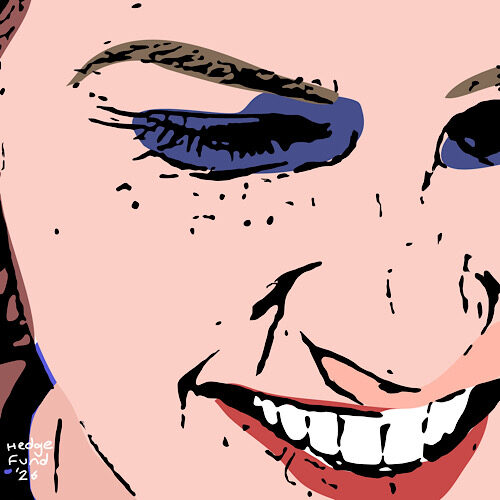
Hedge Fund portrait: Lady Venetia Cashmere, After the Third Martini (2026)

Portrait

Digital print

In Lady Venetia Cashmere, After the Third Martini, Hedge Fund delivers one of his most psychologically mischievous portraits to date. The composition is cropped with almost indecent intimacy, forcing the viewer into proximity with a smile that is equal parts triumph and calculation. Her electric blue eyeshadow spreads like a financial horizon, confident and immovable, while the lipstick, slightly overstepped at the edges, suggests momentum exceeding restraint.

Lady Venetia Cashmere, according to the exhibition notes, is a “strategic philanthropist and investor in experimental alpaca futures.” Born in Tunbridge Wells to a family that quietly made its fortune manufacturing executive conference lanyards in the late 1980s, Venetia is said to have reinvented herself in her early thirties as a collector of disruptive cultural assets. Her first major acquisition was reportedly a limited-edition ergonomic office chair signed by three minor conceptualists and a visiting tax adviser.

Hedge Fund’s rendering transforms her into a study of cosmetic confidence. The heavy eyelids, layered in unapologetic ultramarine, become fields of colour reminiscent of post-war abstraction, while the bright teeth appear as a ledger of victories, meticulously maintained. There is a sense that her smile is not spontaneous but rehearsed, calibrated like a quarterly presentation delivered to an audience that must be impressed but never fully trusted.

The cropped format is particularly effective. By denying the viewer the full face, Hedge Fund creates an atmosphere of partial revelation. We are invited to speculate about the unseen elements of her persona. The suggestion is that identity, like wealth, is rarely displayed in its entirety. It is rationed, staged, and carefully lit.

The backstory that circulates around Lady Venetia is itself almost performative. She is widely rumoured to have once purchased every lot in a charity auction Whether this anecdote is true matters less than the fact that it feels plausible within the ecosystem Hedge Fund documents so affectionately.

In this portrait, glamour becomes currency. The exaggerated palette, the stylised line, and the mischievous intensity of her gaze combine to create a likeness that is both affectionate and faintly satirical. Hedge Fund does not mock Lady Venetia. He canonises her into a new aristocracy of surface and intention.

Ultimately, Lady Venetia Cashmere, After the Third Martini stands as a monument to cultivated confidence. It is a portrait of a woman who understands the value of being seen, of being remembered, and perhaps most importantly, of smiling as though the outcome has already been negotiated in her favour.

Chromatic Patronage: Margery Denton in Digital Reverie. By Hedge Fund

Hedge Fund’s playful portrait of Margery Denton,the distinguished collector whose discerning eye has helped shape contemporary taste,radiates with an energy equal to its subject’s legacy. In vivid blocks of colour, Denton emerges not as a static likeness, but as an emblem of the cultural vitality she has so long championed. The golden glow of her skin, framed by a lavender sweep of hair, speaks less to realism than to aura: Denton as a figure who has illuminated galleries and institutions with her vision and patronage.

The artist draws knowingly upon the language of Pop Art, echoing the boldness of Warhol’s portraits of society icons, yet infuses the work with a distinctly digital sensibility. The turquoise brows, crimson lips, and jewel-sparkling earrings transform Denton into a near-mythic presence, at once glamorous and approachable. This is not the art collector as distant connoisseur, but as vibrant muse,rendered in a palette that affirms her role in expanding the possibilities of what art can be.

One cannot help but read this work as a dialogue between subject and medium. Denton, who dedicated her life to championing the new, is immortalized here through a digital vernacular that itself represents a frontier in visual culture. The portrait is both tribute and continuation: a collector who celebrated innovation now celebrated through innovation.

To live with this image is to live with more than a likeness of Margery Denton. It is to participate in her ongoing legacy, to acknowledge the spirit of curiosity and boldness that defined her career, and to carry forward the very ethos she embodied,that art must always remain fearless, luminous, and alive.

Is Sandy Warre-Hole’s Portrait of Rapper and Organist, Gause De Flim the Most Controversial Artwork of the Century?

When Sandy Warre-Hole’s Gause De Flim (Triptych of the Improbable) was unveiled at the 2024 Hobart Biennale, it ignited an inferno of critical fascination and public fury. But no one,least of all Warre-Hole ,could have predicted the bizarre form of protest that would lead to its removal from public view less than two days later: a daily ritual in which demonstrators gathered in the gallery atrium to sing off-key lullabies at the portrait until the museum closed. The result was not only disruption, but dissonance,conceptual and literal,forcing curators to take the work off display “for the mental well-being of staff and visitors.”¹

As performance, protest, and provocation blurred into each other, the central question grew only louder, and more ludicrous: Is this the most controversial artwork of the century so far?

The Work: Triptych or Tripwire?

Warre-Hole’s triptych is a digital media experience. Gause De Flim,depicted variously as a shirtless rapper flanked by flaming violins, a weeping organist at a gothic console, and a levitating footballer in embroidered C of E clerical football kit,seems less a subject than a sigil.² Behind the image is a palimpsest of visual puns and theological paraphernalia: transfigured sportswear, deconstructed Gothic tracery, and sampled phrases in French, Latin, and whatever they speak in the Maldives. Critics have called it everything from “sacrilegious grandeur” to “a sonic migraine in visual form.”³

Yet, if Warre-Hole’s goal was to expose the mechanics of postmodern identity through the idolization of celebrity polymaths, she also unwittingly summoned a new kind of iconoclasm,one built not on fire or censure, but cacophony.

The Subject: Gause De Flim, Fact or Fabrication?

Gause De Flim,rapper and organist,,might be the most curiously documented public figure of the 2020s. His genre-defying music, described as “baroque drill-hop with penitential overtones,” has reached viral status, yet his biographical details remain suspiciously fluid.⁴ His appearance at the 2025 Coupe de Bordeaux halftime show, where he recited a freestyle rap over Olivier Latry’s Salve Regina, only deepened suspicions: was he real, an AI-enhanced cypher, or another Sport/Art project gone too far?

One persistent theory claims that Gause is an elaborate collaboration between Warre-Hole and a media collective in Marseille. Whether or not he exists, he has become the spiritual nucleus of Warre-Hole’s project,a post-everything martyr of symbol overload.

The Protest: Dissonance as Dissent

By early 2025, protests outside the Musée des Civilisations de l’Europe et de la Méditerranée in Winchester had morphed from ideological outrage into something far stranger. A rotating choir of protestors,some self-identified as “Guardians of Aesthetic Coherence”,began singing lullabies at the artwork each gallery day, purposefully off-key.⁵ These performances began as simple acts of derision but evolved into a kind of meta-performance in their own right. Critics were divided: was this the birth of an anti-aesthetic movement, or the death rattle of a confused cultural moment?

Regardless, the effect was tangible. Visitor numbers dropped. Staff reported headaches, anxiety, and what one docent called “existential tinnitus.” By May 2025, the museum announced that Gause De Flim (Triptych of the Improbable) would be “removed indefinitely, pending recontextualization.”⁶

Intersections of Identity, Iconography, and Insufferability

Warre-Hole’s work does not only critique our contemporary obsession with hybrid identities,it embodies it to the point of rupture. In choosing to depict a single figure as athlete, musician, and mystic, W-H collapses the taxonomies of identity until they implode. Yet in doing so, he may have exposed not just the complexity of the modern subject, but the exhaustion of meaning itself. The audience, bombarded by layers of sacred and profane, classical and digital, responded with absurdity: they sang nonsense lullabies back at the artist.

This is the mirror Warre-Hole holds up. Not a clear reflection, but a foggy self-portrait of a century spinning faster than its symbols can stabilize.

Conclusion: Controversy by Design,or Accident?

Controversy has long been a metric for artistic relevance. But Warre-Hole’s Gause De Flim is a rare instance in which protest, audience fatigue, and institutional discomfort converged to banish a work not for obscenity or offense,but for unbearable ambiguity.

Whether it is the most controversial artwork of the 21st century remains to be seen. But it is certainly among the few to be sung into silence.

Footnotes

¹ Musée des Civilisations internal statement, May 2025, reported in Le Figaro Culture, 18 May 2025.

² Warre-Hole, S. (2024). Artist’s Notes on the Triptych of the Improbable, Hobart Biennale Catalogue.

³ Palmer, R. (2024). “Liturgy, Leather, and Lanyards: The Collapse of Aesthetic Syntax in Warre-Hole’s Gause.” Frieze, Winter 2024 Issue.

⁴ Spotify Meta-Genres Initiative, 2025. See: https://www.spotify.com/meta-genres/gause-de-flim

⁵ Duras, J. (2025). “The Discord Choir: How Protest Became Performance at the Musée.” Libération, April 2025.

⁶ Statement by curator Élodie Monnet, in “Triptych Withdrawn Amid Noise Complaints and ‘Emotional Disruption’.” The Art Rag, May 19, 2025.

Portraits by Doodle Pip

Doodle Pip has a philosophy of art quite unlike any other artist working either today or in the past. As a portraitist like Rembrandt, Warhol or Murillo they are interested in creating works based on clients. But there the similarity ends.

If my picture looks too much like the sitter, I start again. I want to convey nothing of the subject.

Doodle Pip, portraitist

Doodle Pip creates unique works that – at their best – look nothing like the sitter. If the sitter can be recognised then they feel that their work has failed.

There is a wonderful freedom to Pip’s work. It is the biggest step forward in fine art since the invention of egg tempura. To have thrown out completely any attempt at verisimilitude is to have thrown out art history. Pip reminds us of what art was like before art was art. I have a picture of my husband by Pip and it looks nothing like him. We couldn’t be more pleased; it is our favourite work in our collection and the only one I would save in a fire. And we have seven Botticellis and a Simone Serratio, so that is saying something.
Walla Von Munchen, art critic and part-time fire-fighter (grade 3 – bungalows only)

Doodle Pip

Doodle Pip, Portrait of a Friend II (But which one?!)

This latest work by Doodle Pip arrives already trailing a wake of anticipation. In a...

Doodle Pip, Portrait of a Friend (Eliza)

Digital print, 2025 At first encounter, Portrait of a Friend (Eliza) by Doodle Pip presents...
Hollywood Heartthrob Falls for Quirky Digital Portrait by Doodle Pip

Hollywood Heartthrob Falls for Quirky Digital Portrait by Doodle Pip

In a world where luxury cars, red-carpet gowns, and glittering soirées dominate headlines, it’s rare...

Review: Doodle Pip’s Ten Minutes Crammed Into Nine Minutes

Shortlisted for the Llandudno Art Prize 2025 Doodle Pip has never been an easy artist...

Is Lo-fi the New Hi-fi? The Rise of a New Aesthetic in Contemporary Art

In recent years, a shift has been quietly redefining the visual language of contemporary art...
Doodle Pip Solihull Portrait Prize Winner

Doodle Pip wins the Solihull Portrait Prize for Portraiture: A Radical Rethink of Representation

In a dramatic and paradigm-shifting moment for the British art world, the 2025 Solihull Portrait...
Our artists – Doodle Pip: The Unlikely Portraitist of Scribbled Souls

Our artists – Doodle Pip: The Unlikely Portraitist of Scribbled Souls

In the pantheon of contemporary visual artists, where hyperrealism jostles with conceptual minimalism, Doodle Pip...

Doodle Pip – Portrait of a friend

In Portrait of a Friend, Doodle Pip continues their irreverent and compelling project of anti-resemblance...