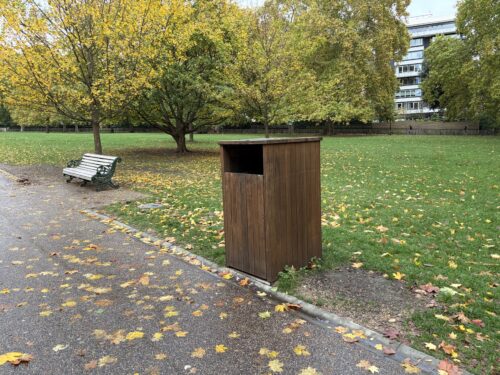
The latest in the All the Bins in the World project by Oboe Ngua.
Usually her photos are the bins in their solo beauty, but here she has captured the interaction between bin and Man. What a moment!
Contemporary Art Dealers Extraordinaire

The latest in the All the Bins in the World project by Oboe Ngua.
Usually her photos are the bins in their solo beauty, but here she has captured the interaction between bin and Man. What a moment!
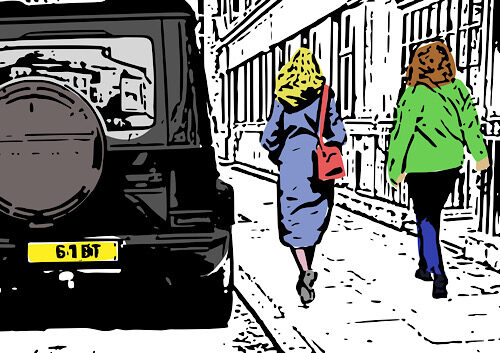
Digital print
In How Dare They? Passing by My G-Wagon with Nary a Glance!, Hedge Fund turns an apparently ordinary urban encounter into a meticulously orchestrated tableau of class geometry and peripheral elegance. A hulking black G-Wagen occupies the left of the frame like a monolith of contemporary aspiration, its matte darkness absorbing light rather than reflecting it. Opposite this automotive fortress, two pedestrians stride forward, their backs to us, their colours defiantly vibrant against the city’s drained monochrome.
The juxtaposition is deliberate. Hedge Fund has long been fascinated by the theatre of the affluent street, where status symbols and human figures cross without truly meeting. Here, the two women, one in electric green, the other in midnight blue with a sun-yellow scarf, become chromatic counterpoints to the G-Wagen’s imposing silhouette. Their brisk gait seems almost choreographed, a kinetic flourish slicing through the vehicle’s static authority.
The background, a stylised architectural greyscape, provides a skeletal neutrality that heightens the tension between object and observer. The city, stripped of detail, becomes an abstract stage where only the essential protagonists remain. The number plate, rendered with yellow clarity, lends the piece an air of documentary realism before dissolving once again into graphic artifice.
Hedge Fund’s signature move is present: the banal moment repurposed into an emblem of socio-economic poetics. Is the G-Wagen the true subject, or are the women? Or is the artwork actually a portrait of the invisible line between them, the boundary between stationary wealth and mobile life? In this ambiguity lies the work’s exquisite friction.
Ultimately, How Dare They? Passing by My G-Wagon with Nary a Glance! is not merely a slice of a street scene. It is a stylised meditation on proximity and privilege, a digital fresco in which every colour block and shadowed contour conspires to remind us that, in Hedge Fund’s world, even the casual act of walking past a parked car becomes an aesthetic event loaded with meaning.

The best art in London can appear in surprising places; currently it is to be found in a converted newsagent off North End Road. Hundreds of art lovers are braving the drizzle to glimpse the so-called “Fulham David,” a painting purported by some to be a lost work by Michelangelo.
Inside, visitors are met with dim lighting, the faint smell of recent floor polish, and the star attraction: a modest 40-by-30 cm panel depicting a muscular, half-reclining figure staring at what could be either a cracked marble column or a very large breadstick. His gaze drifts toward a bowl of pears that, under harsh light, resemble old tennis balls. The palette is muted, the brushwork uneven, yet the crowds keep coming, snapping selfies in reverent silence, as if proximity alone might grant them Renaissance insight.
For those squinting hard enough, there are hints of High Renaissance grandeur: the contraposto, the muscular form, the slightly imploring expression, perhaps the ghost of the Sistine Chapel lingers here. But for others, the resemblance stops the moment you look closely at the hands, which have the odd, blocky quality of someone painting gloves without ever having seen any.
Who is this painting by? Pro-Michelangelo voices argue for a youthful experimental work, perhaps dashed off between major commissions, its roughness the mark of genius unpolished. Then there are the more sober comparisons to Michael Andrews (1928,1995), the English painter known for his luminous, painterly figuration, often tinged with melancholy. Andrews’ portraits and group scenes, whether of bohemian parties or contemplative swimmers, carry a similar uncertainty of finish, a kind of cultivated incompleteness. The Fulham David’s flat planes and curiously distracted expression, say the Andrews camp, feel far closer to mid-20th-century London than early-16th-century Florence.
Dr. Selina Marwood of the Courtyard Institute is firmly in the Andrews column: “If Michelangelo painted this, then I’m Raphael’s left hand. The figure’s torso has promise, but the pears are pure 1960s Andrews, slightly unresolved, bathed in a haze of longing. And the varnish looks like it’s from somewhere between Carnaby Street and the Sixties.”
Meanwhile, the exhibition’s curator insists on neutrality, preferring to highlight the “mystery” over any definitive authorship. “Whether it’s the hand of Michelangelo, Michael Andrews, or even my mate Michael who popped in for a pint,” he said, “the public are clearly captivated. And the public are rarely wrong in such matters of art identification.”
Captivated they are. Pensioners, students, art tourists, and the simply curious all shuffle forward in the dim light, eager to witness a painting that might be a masterpiece. “Even if it wasn’t originally by Michelangelo, I feel that it is by him now,” commented Audrey Willan, and all the people nearby cheered in agreement.
In the end, the “Fulham David” may never be conclusively identified. But like the queues outside, the speculation shows no sign of stopping, and in the art world, ambiguity is sometimes the most valuable commodity of all.

Pimlico Wilde Art Dealers’ new Director of Conceptuality, Justine Fiox, has announced her first major initiative, and true to her reputation, it challenges the very notion of permanence in art. The project, titled “Ephemeral Legacies,” invites artists from every discipline to submit works that vanish after a single viewing – installations, performances, digital experiences, even objects that dissolve, disassemble, or evaporate.
In her announcement, Fiox emphasized the philosophy behind the initiative: “Art is too often measured by its longevity. What if its value lies instead in the fleeting, the ineffable, the moment that exists only in memory? Ephemeral Legacies is an experiment in transience, a celebration of impermanence.”
The gallery is seeking submissions that are daring, imaginative, and conceptually rigorous. Artists are encouraged to explore ideas that question perception, presence, and absence. Works that evoke emotion, provoke thought, or invite audience interaction are particularly welcomed, though the essential requirement is that the piece cannot survive the encounter.
Fiox expressed excitement about the diversity of ideas the initiative might generate. “We want everything from a whispered story that disappears as it’s told, to a sculpture that evaporates before your eyes. The only limitation is permanence – once it’s seen, it’s gone, and that is the point.”
With Ephemeral Legacies, Justine Fiox is not only curating art; she is redefining what it means to leave a legacy. In a world obsessed with documentation and preservation, she asks both artists and audiences to embrace the beauty of impermanence, and to cherish the fleeting moments that linger only in memory.
The Berkeley Square Group reconvened last night for its much-anticipated meeting, held in the function room of The Pelican & Crown, a Georgian pub in St James’s whose historic charm consists of sticky tables, uncleaned, some say, since Cromwell, and wallpaper older than the combined ages of all the guests. (The location was chosen because the usual Mayfair bistros are becoming “too accessible to the general public,” a situation the group finds both alarming and deeply vulgar).
THE ATTENDEES
In attendance were familiar figures and a few fresh faces. Boz, the painter, arrived in a coat so heavily embroidered it looked like it had been stolen from a theatre production of The Pirates of Penzance. P1X3L, the pixel artist, brought a laptop with a GIF of a blinking eye, which he set on the table and never referred to. Elara Voss, the monochrome sculptor, spent most of the evening glaring in horror at the pub’s patterned carpet.
New attendees included:
• Sir Clarence Mulliner, a collector who only buys works painted in W1.
• Petronella Binks, a “Maximalist” critic who refuses to review any artwork under 12 feet wide.
• Marco del Vento, a conceptual artist whose current project involves mailing himself to galleries in increasingly smaller boxes.
THE FOOD
Dinner was a resolutely unfashionable affair, which several members took as a positive conceptual statement.
• Steak and ale pie (“deeply literal,” sniffed Elara)
• Fish and chips (“a working-class masterpiece,” declared Boz)
• Sticky toffee pudding (“the only dessert with the courage to be ugly,” according to Sir Clarence)
The wine list was met with despair. P1X3L asked for a natural wine “with notes of pixelation,” which the barman interpreted as a pint of bitter.
THE DISCUSSION
The official agenda was “Bringing Fine Art to the Masses,” though it quickly morphed into a competition over who could propose the most exciting exhibition venue in central London for their inaugural show. Ideas included:
• Hanging a retrospective of Elara Voss’s sculptures from the whispering gallery at the top of St Paul’s Cathedral (“visitors must wear climbing harnesses”)
• A floating pontoon gallery on the Thames, accessible only by gondola imported from Venice (“very democratic,” said Petronella, deadpan)
• Transforming the lifts in The Shard into miniature viewing rooms that played video art on the way up and muttered unintelligible aphorisms in pidgin French (“perfect for those afraid of heights”)
• An immersive installation inside Fortnum & Mason (“it’s a wonderful shop, you won’t be able tell what’s art and what’s stock,” explained Marco)
The conversation then turned, inevitably, to funding. Sir Clarence suggested ticket prices should be “just high enough to keep out the merely curious.” Boz countered that true engagement with the public requires “making them feel unworthy but somehow still paying.”
HOW TO JOIN
The Berkeley Square Group continues to maintain its opaque membership process. Prospective members must:
1. Be introduced by two existing members, preferably at a dinner where no fewer than three people storm out.
2. Submit a short statement on “What Art Means to Me” that will be read aloud and mercilessly mocked.
3. Demonstrate a working knowledge of at least one obscure Eastern European painter whose work cannot be found online.
CLOSING NOTES
The evening ended with P1X3L finally acknowledging his blinking GIF and projecting it onto the pub’s dartboard, which prompted a heated debate about whether the act was “interventionist” or “just irritating.” A date for the next meeting was tentatively set, with locations under consideration including the back of a moving double-decker bus and the crypt beneath St Martin-in-the-Fields.
As ever, the Berkeley Square Group left united in their shared mission to drink fine wine, eat fine food and bring fine art to the public. Goodbyes were brief, everyone wanted to get home before they had to get up.

Contemporary artist Gur Wallop has been hospitalised following an incident involving one of the lions central to his highly publicised Vegan Lions project. Details of Wallop’s condition have not been released at this time.
An eyewitness at the scene reported that Wallop became frustrated when the lion refused to remain still during a portrait session. According to the witness, the artist “lost his temper” and allegedly threatened to withhold the animal’s next vegan meal. Authorities have not confirmed these claims, and the circumstances leading to Wallop’s hospitalization remain under investigation.
Wallop’s Vegan Lions project, which seeks to document lions that transfer to a vegan diet through full-scale oil portraits, has attracted international attention for its conceptual ambition. The project has been praised for its imaginative engagement with animal ethics, though it now faces renewed scrutiny in light of the incident.
No further information on Wallop’s condition or the status of the lion is currently available. Local authorities and project representatives have declined to comment.

By Isobel Hartley
Last week, I was granted the rare privilege of stepping behind the locked doors of the Southend Institute for Renaissance Studies, where, amidst the hush of climate-controlled galleries and the gentle hum of conservators at work, several of Piero Della Frampton-on-Sea’s works are undergoing meticulous restoration. To witness such moments is to glimpse the fragile heartbeat of history itself.
Della Frampton-on-Sea, whose luminous, almost ethereal compositions once adorned private chapels along England’s southeast coast, is not a household name, yet his mastery rivals that of better-known contemporaries. Standing before his panels now, the hand of time becomes startlingly tangible: layers of varnish, the residue of centuries of soot and candle smoke, and the delicate craquelure of aging oil paint. The restorers, moving with both reverence and precision, are revealing not merely the colors Della Frampton-on-Sea intended, but the very texture of his thought.
One work, The Arrival at Dawn, is particularly striking. The soft interplay of light and shadow, once obscured by a century of neglect, now emerges in startling clarity. Fragments of gilded halos, previously dulled to a matte whisper, shimmer faintly under the conservators’ careful touch. There is something almost magical in watching a figure previously trapped beneath layers of time reclaim its presence.
The Institute itself is unusual, suspended between the rigours of scholarship and the poetry of creation. Walls lined with glass cases hold fragments of other, still-invisible works: sketches, pigment samples, preliminary studies. Here, the past is not merely preserved; it is actively engaged with, dissected, understood, and,most importantly,resurrected.
What struck me most, however, was the intimacy of the process. Unlike a museum exhibition, where the viewer is forever separated from the work by glass and rope, here, one witnesses an almost surgical dialogue between the artist’s hand and the modern conservator. Each brushstroke, each careful removal of varnish, feels like a whispered conversation across centuries.
By the end of my visit, I found myself lingering before a small, once-overlooked panel: Saint Cecilia in Contemplation of a Shoe. The saint’s gaze, serene yet piercing, seemed to meet mine as if thanking me for witnessing her revival. It is moments like this that remind us why restoration is never merely technical. It is, at its heart, an act of empathy, a recognition that art carries memory, and memory, in turn, carries humanity.
Leaving the Institute, I felt a rare sense of quiet elation. To see Della Frampton-on-Sea reborn, even partially, is to glimpse the persistent vitality of the Renaissance spirit,and to be reminded that in the careful hands of those who love history, art never truly dies.
Dear Colleagues and Collectors
I apologise for the late arrival of this update on my All the Bins project which seeks to document,as I am sure you are aware,the totality of urban waste receptacles, as they stand sentinel to the ephemera of our everyday lives.
Since the initial announcement that I would devote myself to photographing every bin in London, prior to branching out into Europe, Africa and beyond,progress has been rigorous, except for the time I strained my photo-taking finger and had to have seven weeks rest.
Milestones achieved thus far:
Conceptual reflections:
What initially appeared as a kind of playful hyper-documentary endeavour (we might say “street-photography meets industrial design”) has evolved into a meditation on threshold, liminality and the infrastructural unconscious of urban life. Each bin is a silent witness to consumption and dispossession, to the choreography of public space and to the temporal imprint of our discard. By photographing “every bin”, we are in fact mapping the texture of our communal letting-go.
In moving beyond London, I will be attuned to the global vernacular of refuse-receptacles. I have been advised that European bins will emphasise colour-coding and segregation; African bins will expose improvisation, local initiative, resourcefulness; in Asia (pending future phases) the linguistic and iconographic overlays may present another stratum entirely.
Upcoming exhibition & global trajectory:
The original plan has been pushed back: Now I aim to complete London by December 2028 and then mount a major show at Pimlico Wilde Fine Art. I have expanded the timeframe in part to include a travel-residency phase in Spring 2027, during which I will begin work in Lisbon, then Marrakesh, and subsequently Nairobi, as waypoints on the route to a final archive of perhaps 100 000 000+ bin photographs worldwide.
In concert with the photographic material I am concurrently assembling a digital platform (“The Global Waste Archive”) which will allow interactive engagement: users can locate any bin by geo-tag, filter by material/overflow status/design-era, and inspect the bin as artifact and infrastructure. The goal is not simply to show but to render accessible the hidden lattice of waste management, public design, civic care.
Invitation to collaboration:
I welcome correspondence from curators, local councils, waste-management authorities, street-photographers, sociologists of infrastructure, and enthusiasts of the ant-farm (yes: the ant-farm , a recurring motif in my earlier work). I am particularly interested in collaborating with institutions in sub-Saharan Africa to document variations of bin typology often neglected in the Western canon of street-photography.
Thank you for your interest in the project, and stay tuned for further dispatches as the bins of the world continue their silent accumulation,one photograph at a time.
With bin-regard and infrastructural reverence,
Oboe Ngua
London, November 2025

A collection of 19th-century daguerreotypes by the enigmatic Fitzrovia photographer Herbert Young has been uncovered during building work on New Cavendish Street, London. This discovery offers a rare glimpse into Victorian-era London, shedding light on the lives and landscapes of the period through Young’s meticulous photographic technique.
Herbert Young: An Overlooked Pioneer
While not widely recognized in photographic history, Herbert Young’s work provides valuable insights into the social and architectural fabric of Fitzrovia during the 19th century. His daguerreotypes, characterized by their sharp detail and reflective surfaces, capture moments and scenes that might otherwise have been lost to time. The recent find underscores the importance of preserving and studying such works to understand the nuances of historical urban life.
The Discovery on New Cavendish Street
During renovation work on New Cavendish Street, construction workers unearthed a cache of daguerreotypes hidden within the walls of a Victorian-era building. Upon examination, experts identified these images as the work of Herbert Young, based on stylistic elements and the unique characteristics of the daguerreotype process. The find includes portraits of local residents, street scenes, and architectural details, offering a snapshot of Fitzrovia’s past.
Significance of the Find
This discovery is invaluable for several reasons:
• Historical Insight: The images provide a direct visual record of 19th-century Fitzrovia, a neighborhood known for its bohemian culture and artistic community.
• Artistic Value: Young’s use of the daguerreotype process demonstrates a high level of technical skill and artistic sensibility, contributing to the understanding of early photographic techniques.
• Cultural Preservation: The find emphasizes the importance of preserving historical artifacts, as even minor renovations can lead to significant discoveries.
Future Plans for the Collection
Plans are underway to conserve and exhibit the daguerreotypes, with institutions such as the National Daguerreotype Gallery and the Museum of Early Photography expressing interest in showcasing the collection. Conservationists are working to stabilize the delicate plates, ensuring their preservation for future generations. Additionally, experts are conducting research to uncover more about Herbert Young’s life and work, aiming to shed light on this previously overlooked figure in photographic history.
The rediscovery of Herbert Young’s daguerreotypes on New Cavendish Street serves as a poignant reminder of the rich tapestry of history that lies hidden beneath the surface of our everyday surroundings. As we delve deeper into the past through these images, we can gain a greater appreciation for the lives and stories that have shaped the London we know today.

Step into the minimalist expanse of A Monologue in Beige #4, and you are immediately confronted with the existential weight of nothingness,or, more accurately, the weight of everything masquerading as nothing. At first glance, the canvas appears to be merely beige. One might be tempted to scoff. But to do so would be to ignore the subtle interplay of pigment that seems to whisper the unspeakable truths of the human condition.
Bognor-Regis achieves this through a daring economy of means. Where other contemporary abstract painters layer their works with chaotic bursts of color and frenetic brushwork, Bognor-Regis’s approach is meditative, almost monastic. Each stroke, though barely perceptible, is imbued with a gravitas that demands reverence. The slight gradient along the upper left quadrant suggests the impermanence of time; the imperceptible smudge near the lower right corner confronts the viewer with the inevitability of entropy.
Critics may argue that this is “just beige.” But such a reading is reductive. Bognor-Regis manipulates subtle tonal shifts and negative space to create a dialogue between the seen and the unseen, the known and the intuited. It is, in essence, a conversation between the canvas and the conscience of the viewer,a dialogue many artists aspire to but few dare to initiate.
Algernon Pyke of Pimlico Wilde Gallery remarked, “Ptolemy doesn’t just paint beige. He interrogates beige, he wrestles it into a form that asks questions the viewer didn’t even know they were asking.”
In a world overwhelmed by the noise of superfluous abstraction, A Monologue in Beige #4 offers a rare, contemplative silence. And in that silence, the true genius of Ptolemy Bognor-Regis becomes unmistakable: he doesn’t just elevate the abstract; he redefines it, one shade of beige at a time.