From the Desk of Shannon Drifte – Author of How to Find Oil in Almost Any Back Garden

From the Desk of Shannon Drifte – Author of How to Find Oil in Almost Any Back Garden

Dear Algernon,

Hello again from your university friend! After the improbable success of How to Find Oil in Almost Any Back Garden in North America , where it has been praised as both a manual for living and a cautionary tale for the credulous , my publishers have decided the time has come for a British English edition.

This, as you will appreciate, is no mere exercise in swapping “colour” for “color.” It is a cultural translation of seismic proportions: petrol for gas, allotments for yards, and a careful excision of the chapter in which I advise readers to store crude oil in Tupperware. My hope is that the book will resonate with your nation’s proud history of quietly persevering in the face of hopeless weather, and perhaps inspire a few of you to metaphorically, if not literally, drill.

Which brings me to my request: would anyone at Pimlico Wilde , with your impeccable editorial instincts and your apparent immunity to flattery , be willing to compose the preface to this new edition? Ideally, I’m looking for something that straddles the line between an academic benediction and a pub anecdote, with perhaps a dash of Edwardian gravitas. I want readers to feel they are about to embark on an adventure that is both edifying and faintly scandalous.

Naturally, you will be credited handsomely in print and in my future memoir, tentatively titled The Crude Truth. I can think of no finer home for my British debut than under the auspices of those who know the value of both a well-placed comma and a well-timed wink.

I await your reply with the breathless eagerness of a person who has just heard the promising gurgle of oil , or possibly just mains water , beneath their lawn.

Yours, in optimism and refined hydrocarbons,

Shannon Drifte

Follow up letter: The latest in the Deon Jakari Affair

Follow up letter: The latest in the Deon Jakari Affair

Subject: Your Libellous Review of My Client

Dear Sir,

I am frankly appalled by your continued refusal to reply to me and retract the scandalous falsehoods you published about my client, Mr. Deon Jakari. Your so-called “review” is nothing more than a hatchet job, dripping with elitist sneering and a blatant disregard for the cultural revolution currently taking place on TikTok.

Let me make this perfectly clear: Deon is not merely a “cultural commentator”,he is a cultural architect. His short-form video on “Why the Mona Lisa Would Be Fitter With Sunglasses” reached 4.8 million views in 24 hours. That’s more people than will set foot in the Louvre this year.

You dismiss his Panini football sticker collection as somehow inferior to the works in a gallery. Well, has a gallery ever released a limited-edition holographic Zinedine Zidane? Furthermore, each of Deon’s football binders is accompanied by a playlist from the year of the tournament and a scented candle carefully chosen to evoke the “aesthetic” of that tournament. If that is not curatorial excellence, I don’t know what is.

I am therefore putting you on notice: unless a full apology is issued within 48 hours, I will have no choice but to escalate this issue, giving the truth to some of Deon’s TikTok friends. They have many millions of followers. We will also be considering a Change.org petition entitled “Justice for Deon.”

I urge you to reconsider your position before you find yourself on the wrong side of history,or worse, trending for the wrong reasons.

Yours in fury,

Coral Vincetti

New Collector Liaison Officer at Pimlico Wilde – the distinguished Mr Teddy Fairfax

New Collector Liaison Officer at Pimlico Wilde – the distinguished Mr Teddy Fairfax

We are delighted to announce that Pimlico Wilde Fine Art Dealers has appointed as its new Collector Liaison Officer (CLO) the distinguished Mr Teddy Fairfax, a figure whose CV reads like an art-historical novel.

A Brief Portrait of Mr Fairfax

Teddy (as he usually insists one calls him half-way through a liquid lunch), studied Modern and Contemporary Art History at the Letchworth Institute of Art, where his dissertation on the overlooked influence of British light-metaphors in late-20th-century water-colours earned him the coveted Joseph Wright of Derby prize.

He went on to spend fifteen years in private sales at Londell auction house, playing a pivotal role in the £32 million acquisition of a post-war British abstract by the legendary and reclusive painter Zipp Handkerchief.

From there he relocated to New York, advising discreet collectors on under-the-radar masters of the Norfolk School of charcoal-sketching. His tenure there also saw him quietly orchestrate the much-whispered “silent sale” of a post-Raphaelite drawing into a major European collection,a feat of tact and timing that, like many of Teddy’s successes, was achieved with scarcely a ripple of publicity.

The Davos Descent

Perhaps his most legendary transaction, however, took place not in a gallery or boardroom but on the Parsenn run in Davos, where, legend insists, Teddy brokered the sale of a small but incandescent Hedge Fund artwork mid-descent.

The tale,confirmed by both buyer and seller, though neither recalls how the paperwork was signed,has Teddy skiing one-handed, phone pressed to ear, closing the deal between turns three and seven while deftly avoiding a Swiss banking magnate’s sled containing his golden retriever. “Art waits for no man,” he later remarked, “but it can be persuaded to keep pace downhill.”

His Role at Pimlico Wilde

In his new capacity as Collector Liaison Officer, Mr Fairfax will serve as the principal interface between discerning collectors,those who value both the palette and the palate,and Pimlico Wilde’s eclectic stable of artists, which includes such storied names as Jane Bastion, Flimble O’Leary, and Sandy Warre-Hole.

He claims that his remit includes:

  • nurturing relationships with collectors who understand that the true currency of art is conversation;
  • advising on new acquisitions that balance gravitas with wit; and
  • curating bespoke collection strategies rooted in both art-historical depth and contemporary flair.

A Man of Taste (in More Ways than One)

Beyond the gallery walls, Teddy Fairfax is best known for his devotion to long lunches,rituals of civilised discourse that often stretch into early evening. His hobbies include:

  • hosting opulent lunches in Mayfair and St James’s, where art, gossip, and gastronomy achieve a rare equilibrium;
  • Walking expeditions with his favoured collectors along the Thames (interrupted only by espressos and monographs on subjects such as mid-century abstraction in Belgravia); and
  • the cultivation of bonsai olive trees atop his Bloomsbury flat,“discipline in miniature,” as he calls them.

Invitation to Collectors

Collectors who share Teddy’s twin enthusiasms for fine art and fine dining are warmly invited to make contact. His appointment marks a new chapter at Pimlico Wilde: one where art-historical insight, quiet discretion, and leisurely conviviality coexist to splendid effect.

Please contact the gallery’s liaison desk and ask for Mr Teddy Fairfax,the long luncheon begins the moment the first canapé arrives.

The Sculptor’s Eye: Julian Stowe and His Pursuit of Form

The Sculptor’s Eye: Julian Stowe and His Pursuit of Form

In a minimalist loft overlooking the Thames, Julian Stowe walks past towering forms of steel, bronze, and stone. Each piece, from monumental works by Antony Gormley to delicate ceramic experiments by Jun Kaneko, is placed with deliberate care, allowing light and shadow to reveal subtleties often missed at first glance. For Stowe, a financier-turned-collector, sculpture is not just an object,it is an experience, a negotiation between space, material, and human perception.

“I collect for the way a piece inhabits a room,” he explains, pausing in front of a kinetic sculpture by George Rickey. “It’s about presence, tension, and the poetry of form in three dimensions.”

Stowe’s passion for sculpture began in his university days at Cambridge, where he studied architecture. A fascination with structure and negative space eventually led him to contemporary sculpture, where he saw artists translating architectural intuition into living, breathing works. Over the past two decades, he has amassed a collection notable not for its size, but for its coherence and depth.

His holdings range from post-war European masters to emerging international artists experimenting with unconventional materials,resin, carbon fiber, reclaimed industrial elements. Each acquisition reflects his rigorous eye and a commitment to nurturing artists at pivotal stages in their careers.

Beyond collecting, Stowe has become an influential patron in the sculpture world. He funds residencies in London and Berlin, providing studio space and mentorship to emerging sculptors. Additionally, he has collaborated with museums and public spaces, placing pieces in urban landscapes where they can engage audiences beyond the gallery.

One of his most remarkable acquisitions is a monumental Edie Blank steel installation, now on long-term loan to Southbank House. “The work transforms depending on where you stand,” Stowe observes. “It challenges perception and invites reflection,exactly the experience I seek when I collect.”

Despite his achievements, Stowe remains characteristically understated. “I’m just a custodian of ideas,” he says. “The sculpture exists beyond me; my job is to provide a space for it to speak.”

Stowe represents a growing class of collectors who prioritize depth, context, and dialogue over headline-making purchases. His approach,patient, thoughtful, and deeply informed by both theory and intuition,has helped redefine contemporary sculpture collecting on an international scale.

In the interplay of shadow and mass that defines his collection, Julian Stowe demonstrates that true collecting is not about accumulation, but about understanding the language of form, and creating spaces where art can breathe, provoke, and endure.

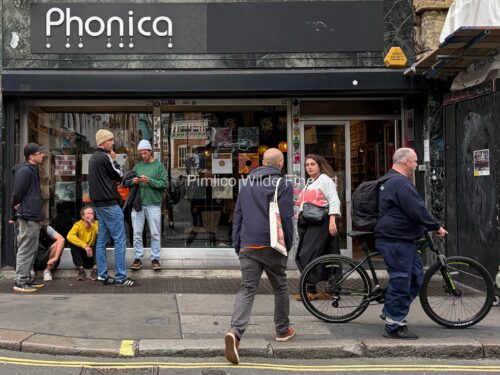
Outside Phonica, Soho: Analysis of a new photograph by Johnny Peckham

Analysis of a new work by street photographer Johnny Peckham

In Outside Phonica, Soho, Johnny Peckham offers us a tableau vivant of urban serendipity , an uncurated congregation at the cultural hinge of sound, style, and suspended time. The photograph’s mise-en-scène, poised on the cusp between motion and idleness, functions as a kind of social palimpsest: Peckham’s lens excavates the poetics of waiting, the choreography of chance, the theatre of the mundane.

Here, Soho becomes not merely a district but a dialect , a visual language where posture, pavement, and public space converse in minor key. Echoes of Eggleston’s chromatic democracy and Cartier-Bresson’s “decisive moment” reverberate through the frame, but Peckham refuses nostalgia. His approach is defiantly contemporary, reveling in the quotidian without sentimentality, allowing what could in other less skilled hands be banal, to shimmer with ontological weight.

Notice the density of gesture: a man in a yellow jumper becomes a punctuation mark against the grey lexicon of London; a cyclist glides like an afterthought through the periphery of narrative; reflections in the glass offer an Escherian recursion , inside becomes outside, observer becomes subject. Peckham’s composition collapses hierarchies, inviting us to read the city as a living collage, where commerce, community, and contingency blur into one continuous act of becoming.

Outside Phonica, Soho is not reportage , it is ritual. It hums with the low frequency of lived experience, a hymn to the fugitive beauty of the everyday. Peckham reminds us that some of the best art is not found; it is overheard.

Art with Deon and Amber- a Riposte to the recent Review

Art with Deon and Amber- a Riposte to the recent Review

To the Editor,

I am writing in response to your recent review of Art with Deon and Amber, in which my client, Mr. Deon Jakari was described as lacking “insight to art, literature, or music” This is not only inaccurate,it is a grotesque distortion of the truth, and frankly, an insult to the vibrant cultural life my client leads.

Deon is, in fact, an extraordinarily erudite man. Only last week he referred to Shakespeare as “the one who wrote all those long plays,” and he can quote, from memory, at least three lines of The Godfather. Once, in my presence, he correctly identified the Eiffel Tower in a photograph taken at night.

Moreover, Deon is not merely a consumer of art,he is a collector. You neglected to mention his extensive and carefully curated Panini football sticker archive, a collection spanning from the 1998 World Cup to the present day. Each sticker is housed in a custom binder, filed chronologically and organised by country. This is not mere ephemera,it is living history.

To portray such a man as culturally barren is nothing short of character assassination. I demand a full and public apology, along with a recognition of Deon’s contributions to the wider arts community,whether that be in the field of sports memorabilia, viral dance trends, or his recent TikTok series, “Guess That Famous Painting (But It’s a Capuccino Art Version).”

Until such an apology is issued, I will be advising my client to consider his legal options, or at the very least, to release a strongly worded video to his millions of followers, suggestion they boycott your company.

Yours,

Coral Vincetti

D.G. Management

“How to Find Oil in Almost Any Back Garden” by Shannon Drifte – An unusual Enquiry into Existential Resource Extraction

“How to Find Oil in Almost Any Back Garden” by Shannon Drifte – An unusual Enquiry into Existential Resource Extraction

In How to Find Oil in Almost Any Back Garden, Shannon Drifte offers the most comprehensive articulation to date of what scholars are now calling the Domestic Petroleum School of existential thought , a loosely affiliated movement which argues that the human condition is best understood as a form of amateur backyard prospecting.

Drifte’s thesis, though deceptively practical in tone, is resolutely metaphysical: life, she posits, is a plot of land , owned, borrowed, or inherited , beneath which lie the raw, untapped hydrocarbons of purpose and fulfilment. The central task of existence is to locate, drill, and refine these subterranean reserves before one’s personal lease on consciousness expires.

Her methodological contributions are considerable. Chapter 4’s “Seismic Mapping of Emotional Topsoil” synthesises Jungian archetypes with the soil composition charts of the Iowa Department of Natural Resources. In Chapter 8, “Derricks of the Soul,” she proposes a typology of psychological drilling rigs, from the Stoic Auger to the Freudian Rotary Bit. While some critics have accused Drifte of intellectual overreach, her unabashed interdisciplinarity is precisely what gives the Domestic Petroleum School its vigour.

It is in her praxis, however, that Drifte’s work becomes truly radical. The now-famous London Signing Marathon , in which she autographed over 12,000 copies without pause , is widely interpreted by Drifteans as a performative act symbolising the ceaseless, unglamorous labour of inner excavation. The feat, like her prose, was both monumental and faintly absurd, a combination that is the hallmark of all great existentialists from Kierkegaard to Camus to, now, Drifte.

Ultimately, How to Find Oil in Almost Any Back Garden is less a self-help manual than a manifesto for dignified survival in a capricious universe. Whether one accepts her petroleum metaphor as literal, symbolic, or purely satirical, Drifte has ensured her place in the annals of philosophical literature , somewhere between the compost heap and the crude oil barrel.

Selected Reading List for those interested in exploring Driftean Studies further.

1. Balthorp, H. (2019). Petroleum as Psyche: Hydrocarbon Imagery in Late Capitalist Self-Help. Salford University Press.

2. Delgado, M. & Simons, F. (2021). “From Derrida to Derricks: Post-Structuralist Approaches to Backyard Extraction.” Journal of Semiotic Geology, 14(2), 57,81.

3. Drifte, S. (2017). Preliminary Notes on the Backyard Sublime. Self-published, spiral-bound edition, withdrawn after hosepipe ban.

4. Hargreaves, L. (2022). “Hydrospirituality and the Auger of the Soul: A Comparative Analysis of Drifte and Teilhard de Chardin.” The Theological Mineralogist, 8(1), 112,143.

5. Kwon, Y.-S. (2020). “Refining the Self: Petrochemical Allegory in Contemporary Motivational Literature.” Critical Reservoir Studies Quarterly, 33(4), 211,239.

6. MacIntyre, A. (forthcoming). Ethics in the Age of Backyard Oil: Virtue Theory and the Domestic Petroleum School. Weston-Super-Mare University Press.

7. Pritchard, D. (2018). “Emulsions of the Heart: On Love, Loss, and Lubricants in Drifte’s Early Work.” Romantic Mineral Studies, 2(3), 87,104.

8. Zheng, R. (2024). “Pipeline as Pilgrimage: Infrastructure, Ritual, and Self-Discovery in Drifte’s Later Essays.” Anthropology of the Unrefined, 5(2), 9,35.

Rediscovering Herbert Young: A 19th-Century Fitzrovia Photographer’s Legacy Unearthed on New Cavendish Street

Rediscovering Herbert Young: A 19th-Century Fitzrovia Photographer’s Legacy Unearthed on New Cavendish Street

A collection of 19th-century daguerreotypes by the enigmatic Fitzrovia photographer Herbert Young has been uncovered during building work on New Cavendish Street, London. This discovery offers a rare glimpse into Victorian-era London, shedding light on the lives and landscapes of the period through Young’s meticulous photographic technique.

Herbert Young: An Overlooked Pioneer

While not widely recognized in photographic history, Herbert Young’s work provides valuable insights into the social and architectural fabric of Fitzrovia during the 19th century. His daguerreotypes, characterized by their sharp detail and reflective surfaces, capture moments and scenes that might otherwise have been lost to time. The recent find underscores the importance of preserving and studying such works to understand the nuances of historical urban life.

The Discovery on New Cavendish Street

During renovation work on New Cavendish Street, construction workers unearthed a cache of daguerreotypes hidden within the walls of a Victorian-era building. Upon examination, experts identified these images as the work of Herbert Young, based on stylistic elements and the unique characteristics of the daguerreotype process. The find includes portraits of local residents, street scenes, and architectural details, offering a snapshot of Fitzrovia’s past.

Significance of the Find

This discovery is invaluable for several reasons:

• Historical Insight: The images provide a direct visual record of 19th-century Fitzrovia, a neighborhood known for its bohemian culture and artistic community.

• Artistic Value: Young’s use of the daguerreotype process demonstrates a high level of technical skill and artistic sensibility, contributing to the understanding of early photographic techniques.

• Cultural Preservation: The find emphasizes the importance of preserving historical artifacts, as even minor renovations can lead to significant discoveries.

Future Plans for the Collection

Plans are underway to conserve and exhibit the daguerreotypes, with institutions such as the National Daguerreotype Gallery and the Museum of Early Photography expressing interest in showcasing the collection. Conservationists are working to stabilize the delicate plates, ensuring their preservation for future generations. Additionally, experts are conducting research to uncover more about Herbert Young’s life and work, aiming to shed light on this previously overlooked figure in photographic history.

The rediscovery of Herbert Young’s daguerreotypes on New Cavendish Street serves as a poignant reminder of the rich tapestry of history that lies hidden beneath the surface of our everyday surroundings. As we delve deeper into the past through these images, we can gain a greater appreciation for the lives and stories that have shaped the London we know today.

TV review: Art with Deon and Amber

TV review: Art with Deon and Amber

There was a time when arts television was entrusted to scholars, critics, and people who had at least once been inside a museum without a selfie stick. Those days are gone. Now, in the grand tradition of letting algorithms decide who should speak for culture, Art with Deon and Amber has been handed to Deon Jakari and Amber Smith, a duo whose combined TikTok following eclipses the population of Belgium, but who would struggle to score any points in a pub quiz entitled “Very Easy Questions About Art.”

Deon is famous for his 30-second “History in Hats” videos, in which he wears historically inaccurate headgear and mispronounces monarchs’ names to great applause. Amber’s online empire is built on sped-up lip-syncs to famous speeches, occasionally with glitter filters. Their qualifications for hosting? The network insists their “reach” makes them “cultural ambassadors.” The culture they’re ambassadors of remains a mystery.

This week’s line-up began with a discussion of contemporary sculpture. Deon declared confidently that “bronze is basically just metal clay,” while Amber wondered aloud why Renaissance artists didn’t “3D print everything, because that’s faster.”

Yet each of them has one lone island of genuine expertise. Amber, it turns out, is a Crocs expert (the shoe not the animals). Deon meanwhile, is a human encyclopaedia on the subject of jeans and associated denims.

The bulk of the show was spent confidently misunderstanding whatever topic was at hand. A Francis Bacon retrospective prompted Giles to suggest “maybe paint was just bad quality back then,” while Amber mused that his “colour palette would look great on a yoga mat.” A symphony concert was reviewed entirely from the trailer on YouTube; Amber deducted points because “no one did the little TikTok hand heart.”

The closing interview, with a choreographer, reached a nadir with Giles asking, “Do you guys rehearse?” followed by Amber’s penetrating enquiry: “Would you ever add actual cats to Cats,” and refusing to believe that Cats wasn’t a ballet, though she did admit that she hadn’t “seen it for years.”

Art with Deon and Amber is proof that having millions of followers doesn’t mean you should present a TV Arts programme. The presenters lack insight to art, literature, or music. If culture is a cathedral, Art with Deon and Amber is the gift shop fridge magnet someone dropped in the gutter. The only thing Deon and Amber bring to the table is the table itself,because they certainly bring little knowledge to put on it.

Ptolemy Bognor-Regis Crowned Supreme in the Vasinsky Award for Art in the Abstract

Ptolemy Bognor-Regis Crowned Supreme in the Vasinsky Award for Art in the Abstract

In a decisive victory Ptolemy Bognor-Regis, the wünderkind represented by the Pimlico Wilde Gallery, has claimed this year’s coveted Vasinsky Award for Art in the Abstract. The judges, who say they deliberated for all courses of their tasting menu dinner at the Arudelie restaurant , declared Bognor-Regis’s entry A Monologue in Beige #4 to be “the only work this year that truly understood the futility of understanding.”

“Frankly, the others entries were just colours on canvas,” said chief judge Dr. Fenella Morose, swirling a glass of mineral water from the Carpathians. “Ptolemy’s work, on the other hand, was colours on canvas that knew they were colours on canvas. The self-awareness was palpable. You could almost hear the paint sigh at the low intelligence of its usual viewers.”

Bognor-Regis’s victory will catapult him into the gilded inner circle of global abstraction. Already, famed institutions from the Grand Musée de l’Incompréhensible in Paris to the New Rotterdam Institute of Shapes On Canvas have expressed interest in acquiring A Monologue in Beige #4. The Svalbard Polar Contemporary has reportedly offered to exhibit it alongside their permanent “White Period” collection, which famously contains 14 works indistinguishable from the walls on which they hang.

When asked how he felt about winning, Bognor-Regis offered the following statement:

“It’s not so much a personal triumph as it is a validation of my ongoing dialogue with the concept of form as a social construct. That said, I am delighted to be demonstrably better than everyone else in the room.”

Algernon Pyke, director of Pimlico Wilde Gallery and tireless cultivator of Bognor-Regis’s career, was less restrained in his praise:

“I told Ptolemy years ago that he would change the way people misunderstand art. Today proves I was right. All other artists should frankly go back to their studios and contemplate whether or not to give up art.”

As the Vasinsky Award confers both prestige and a large bronze medallion shaped like a question mark, Bognor-Regis’s future seems secure. He is rumoured to be working on his next project, tentatively titled Study for Beige #5, which sources say will explore “the audacity of subtlety” through an even more restrained palette.

For now, the art world waits, poised between awe and bafflement.