Sign up for my weekly Tip Sheet of Artists about to Explode.
Today’s hot picks, studio runners, and gallery gallopers
Front-Runners
Cassandra Vey , “Neon Still Lifes”
• Form: Slick as a varnished canvas and twice as glossy. The galleries can’t hang her work fast enough before a collector nabs it for the guest bathroom.
• Expected Increase:+45% this season.
• Tipster’s Note: Bright colours, bright prospects. A safe ride for those who like their investments with a sugar hit.
Marco D’Angelo , “Found Object Opera”
• Form: Pomp, circumstance, and a knack for making a pile of old scaffolding look like cultural destiny. Institutions are circling like hungry bookmakers.
• Expected Increase:+60% if the Tate bite.
• Tipster’s Note: Don’t be fooled by the rusty nails,this one’s got stamina.
Dark Horses
Aya Nakamura , “Synthetic Horizons”
• Form: Equal parts genius and gimmick. Last outing saw her print AI-generated sunsets onto inflatable pool toys. Critics rolled their eyes, collectors rolled their wallets.
• Expected Increase:+25%, but volatile as a fresh can of spray paint.
• Tipster’s Note: She could either collapse before the finish line or gallop straight into blue-chip stables. Worth a punt if you like drama.
Tomás Herrera , “Rust Studies”
• Form: Works exclusively with oxidised steel sheets. Think of him as a welder with feelings. Limited exposure outside his hometown, but Berlin residency could buff his credentials.
• Expected Increase:+15%, unless the rain gets to him first.
• Tipster’s Note: An outsider with grit. Might not win, but you’ll look clever for backing him early.
Sure Things
The Old Masters (Rembrandt, Caravaggio, etc.)
• Form: Centuries unbeaten, no late scratches, no surprises. Reliable as a bookmaker’s cigar. Auction houses flog them like prize thoroughbreds when they trot into town.
• Expected Increase:+5%, slow and steady, but guaranteed.
• Tipster’s Note: Pricey entry ticket, but you’ll never regret the stable pedigree.
Scratchings & Withdrawals
NFTs (Pixel Portrait Edition)
• Form: Once sprinted out of the gate with billion-dollar legs, now limping towards the glue factory. Market confidence evaporated quicker than a gallery prosecco tray.
• Expected Increase:,30% and falling.
• Tipster’s Note: Keep your chips in your pocket.
Tip of the Day
Back the mid-career workhorses,steady exhibitions, reliable critical nods, a few museum shows under the saddle. They don’t dazzle like the colts, but they’ll carry you further in the long run.
I take pen to paper once more regarding your outrageous “analysis” concerning the appalling article: What Is the Best Age for an Artist to Die in Order for Their Work to Sell for the Highest Prices? The very notion that the dignity of an artist’s death can be plotted on an axis, graphed like wheat futures, and optimised as though one were scheduling a dental cleaning, is, if you will permit me the Latinate, nauseatorium.
Have you read Plato? Have you wept with Cicero? Did you not tremble when Pliny the Elder declared that “true art is eternal”?¹ And yet here you are, with the audacity to suggest that painters and sculptors ought to die in their late fifties “for best results,” as though the matter were a soufflé recipe! This is statistical phrenology at its worst, a carnival of spreadsheets in which the human soul is a mere column heading.
Let me be clear: artists must be allowed to die whenever they want. If that means collapsing face-first into the underpainting of a half-finished triptych at 28, so be it. If it means shuffling along until 103, muttering imprecations against modernism and refusing to let go, let them shuffle. I, for one, will not stand idly by while the sirens of econometrics seduce us into measuring the immeasurable.
Permit me, as before, a personal declaration: I shall expire on my forty-fifth birthday, surrounded by my companions, discoursing in the manner of Socrates, a chalice in hand.² Will the secondary market for my sketches, annotated grocery lists, and unfinished operas explode the following season? Almost certainly. But this is incidental; the point is one of style.
Finally, here is the thunderclap: unless this ghoulish arithmetic is retracted in full, I shall withdraw my considerable patronage from Pimlico WildeFine Art, the London art dealer that I have hitherto supported with both coin and cachet. Yes: Pimlico Wilde, art dealer of esteem, shall find their soirées diminished, their champagne undrunk, their openings eerily under-attended.³
In conclusion: I demand that you abandon your necro-statistics, issue a grovelling apology, and perhaps devote yourself instead to finding contemporary artists with zing and verve, that we collectors want to meet.
With unassailable froideur and hauteur,
Lord Accrington, Patron Emeritus, Society for Eternal Aesthetics
¹ Though he actually said many other things before Vesuvius cut him short, which I note as evidence that “optimal death timing” is a myth.
² A curated playlist will accompany the event, though Socrates had to make do with silence.
³ Pimlico Wilde’s openings, without my presence, will wilt like a tulip on the canvas of a minor surrealist.
True Art Crime , Episode One: The Ravenna Job – Part II
Act One / Investigation Segment (6:30,15:00)
[6:30]
Fade in: slow-motion shots of Ravenna streets at night. Fog rolls over cobblestones. The camera glides past shuttered cafes and ornate lamp posts.
VOICEOVER:
“When a masterpiece disappears without a trace, the questions multiply faster than the answers. Who took it? And why?”
[7:00]
Interview: Giovanni Ricci, investigative journalist (contemporary expert).
“Some say it was a professional heist, planned by an international ring. Others whisper about local collectors who would pay anything… and I mean anything… to own a piece of history.”
ON SCREEN: Old newspaper clippings, redacted documents, and photos of wealthy patrons in tuxedos, faces obscured with shadows.
[7:45]
Cut to reenactment: two figures exchange a burlap-wrapped bundle in a dimly lit warehouse. Camera focuses on trembling hands. Dust motes float in the single beam of light.
VOICEOVER:
“Rumours spoke of a man known only as Il Fantasma,the Ghost. A thief so meticulous, he left no fingerprints, no trace, no witnesses… except for the stories that terrified the city.”
[8:30]
Interview: Inspector Marco D’Este, retired, in his office surrounded by old case files.
“We had leads… but all dead ends. Someone inside the opera house? Possibly. A local gang? Could be. Or maybe someone who simply understood fresco better than anyone else.”
He flips open a dusty ledger, fingers tracing names that flicker briefly on screen.
[9:10]
On-screen animation: cross-section of the opera house foundation. A red line traces the alleged tunnel, zig-zagging beneath the city streets. Voiceover narrates the timeline of the dig.
VOICEOVER:
“Months of silent excavation. Night after night, chisels and shovels working under the city. By the time anyone noticed… it was too late.”
[10:00]
Interview: Dr. Lucia Ferrante (art historian), holding an old photograph of the fresco in color.
“The fresco was not just valuable,it was fragile, irreplaceable. Whoever took it understood that destruction was a real risk. And yet… it survived. At least, they say it did.”
Camera slowly pans over the blurred, grainy photo, the colours muted and edges crumbling.
[10:45]
Cut to reenactment: masked thieves using pulley systems to lower a plaster slab into a hidden crate. The faint sound of rain hits the roof above them.
VOICEOVER:
“Some theories suggest the fresco never left Ravenna. Buried beneath the city, stored in a hidden basement. Others whisper of secret collectors in Switzerland, Lebanon, even South America, willing to pay fortunes for stolen genius.”
[11:30]
Montage of interviews and “suspects” (reenactments): a shadowy aristocrat lighting a cigar, a mysterious man in a fedora leaving the opera house at night, a worker glancing nervously at a closed door.
INTERVIEW: Giovanni Ricci:
“Every lead, every name, fades into rumour. And that’s what makes it legendary. People talk about The Ravenna Job not just for the crime… but for the mystery that still haunts the art world.”
[12:15]
Footage of modern-day Ravenna: tourists snapping photos, opera performances in full swing. The camera lingers on the ceiling, now empty.
VOICEOVER:
“Above ground, life moves on. People admire, applaud, forget. But below… below, the echoes of that night still resonate. And somewhere… The Triumph of Saint Cecilia waits.”
[13:00]
Interview: Local Historian Carla Mendez, leaning on the opera house railing.
“I’ve heard stories from old families… they say the fresco speaks in dreams. Those who claim to see it often vanish, or are never believed. Superstition? Maybe. But sometimes, the truth is darker than any legend.”
[13:45]
Slow pan of mysterious crates in an abandoned warehouse. Dust hangs in the air. Camera zooms on one crate, slightly ajar, revealing a glimpse of color… but not enough to confirm anything.
VOICEOVER:
“The trail is cold. The fresco is missing. And the story of The Ravenna Job is far from over.”
[14:30]
Cut to black. Music swells with suspenseful strings.
ON SCREEN TEXT:
Next: We follow the leads that could finally uncover the fate of Ravenna’s stolen masterpiece…
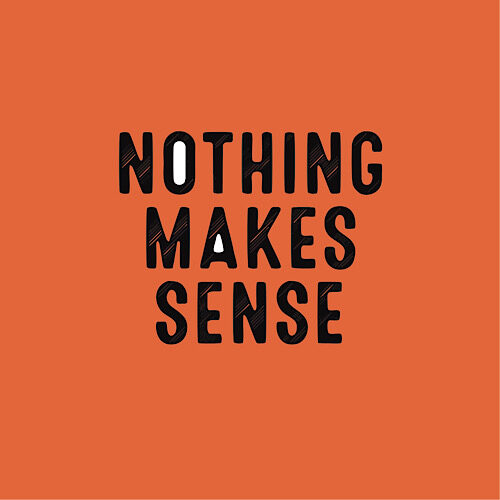
In Nothing makes sense, TYPO delivers yet another incisive rupture in the assumed legibility of language. Here, a single declarative phrase,blunt, exhausted, defiant,is rendered unstable through typographic intervention and chromatic tension. Set against a high-chroma orange ground (a color oscillating between emergency and exuberance), the text is striated, its letterforms visually dislocated, suggesting motion or malfunction,perhaps both.
The phrase “Nothing makes sense” is a recursive loop, a tautology that simultaneously negates itself and affirms its own futility. But TYPO’s manipulation of the letterforms subverts any clean reading. The striations fracture the text, evoking interference patterns, broken signals, or print processes gone slightly awry. It is not glitch as aesthetic, but glitch as epistemology.
Most notable are the white interiors of the O and A,subtle voids of negative space that act as visual apertures, quietly resisting the uniform flatness of the surface. These openings, almost retinal, draw the eye in while the rest of the text repels with abrasiveness. They are holes in the semantic fabric,hollows of clarity in a field of dissonance.
TYPO’s work persistently interrogates the assumption that language can communicate, that it wants to communicate. In this piece, meaning is both insisted upon and withheld, like a promise never meant to be kept. Nothing makes sense becomes not just a statement, but a condition,a phenomenology of comprehension under erasure. It invites the viewer not to decode, but to dwell in the friction between reading and seeing, knowing and not-knowing.
This is not a work about nihilism. It is about the exhausted seduction of coherence.
Some shows should never have made it from the rehearsal room to the stage. Others, like Toast: A Tragedy in Three Slices, should perhaps never have made it from the kitchen. And yet, here we are, in a sweaty basement with twenty strangers, watching a man in a crumb-speckled tuxedo spend an hour lamenting the existential plight of breakfast.
The plot,if one can use such a lofty term for what is essentially interpretive sulking,centres around a single slice of toast (represented, quite literally, by a piece of Hovis on a plate). The toast is in love with butter. The butter, alas, is already spread too thin. What follows is a tale of longing, despair, and carbohydrates, told through monologues that sound like a sixth-form student trying to rewrite Hamlet while on a gluten-free diet.
Our protagonist delivers lines such as, “I am golden, I am crisp, yet I am never enough,” with the conviction of someone who has mistaken snack food for proper meals. He frequently interrupts himself to produce new props: a jar of jam, a cold fried egg, a suspiciously stale croissant. Each makes a brief cameo before being dramatically hurled into the wings, where they sit forgotten.
There is music as well. At the fifteen-minute mark, a bassoon emerges and we are treated to a dirge titled Crumbs of My Soul. The melody wanders aimlessly, as though even the notes wish they weren’t here. Halfway through, the performer weeps onto his toast. I’m not sure what the symbolism was, but it seemed to be the crux of the entire show.
Audience interaction proves less successful. One unfortunate man in the second row was asked to “play the toaster.” His task? To crouch and make ding noises on command. He complied with the weariness of a man who realised too late that he should have gone to see stand-up instead. Later, we were all instructed to chant “Marmite is love, Marmite is life” while the performer smeared the stuff across his chest. At this point, a couple quietly left, but the rest of us stayed,perhaps out of solidarity, perhaps out of morbid curiosity.
The finale is predictably absurd: the performer smashes an entire loaf of bread against his head while shouting, “We are all slices!” before collapsing in a heap of crumbs. Silence. Then polite applause. Not because it was good, but because we admired the sheer, unrelenting commitment to the bit.
What do I think of Toast: A Tragedy in Three Slices? It is pretentious, baffling, and unhygienic. And yet there’s something oddly admirable about it. This was a man who truly believed in his bread-based tragedy, and for that, he earns an extra star.
Transcription of the upcoming documentary – The Ravenna Job, produced by Pimlico Wilde Film
Cold Open / Act One
[0:00]
Black screen. A faint dripping sound. Then, muffled opera music begins to swell,Puccini, distorted as though echoing through stone.
ON SCREEN: Title card fades in:
TRUE ART CRIME
Episode One , The Ravenna Job
VOICEOVER (low, dramatic):
“Ravenna, Italy. 1978. Beneath one of Europe’s most beloved opera houses, a crime unfolded that would shake the art world to its core. Not a painting stolen from a wall… not a sculpture carried away in the night… but an entire fresco, centuries old, carved from history itself.”
[0:45]
Archival-style black and white photos of Ravenna streets, cut with slow-motion footage of the opera house façade at night. A cigarette flicks into the dark. The sound of boots on wet cobblestone.
VOICEOVER:
“They called it The Ravenna Job. And to this day, nobody knows exactly how they pulled it off.”
[1:20]
Wide establishing shot: the grand opera house interior, filmed present-day. Empty red seats. A sweeping crane shot up to the ceiling, where a gaping scar on the plaster hints at what was once there.
ON-SCREEN CAPTION:
Ravenna Opera House , Present Day
INTERVIEW (Dr. Lucia Ferrante, Art Historian):
“What they stole was no ordinary painting. It was The Triumph of Saint Cecilia, a 17th-century fresco bonded into the ceiling. Removing it should have been impossible… unless you were willing to destroy the entire building.”
[2:05]
Cut to reenactment: shadowy figures in workmen’s overalls entering a dimly lit basement. The camera lingers on drills, pickaxes, and coils of rope. Their faces are never fully shown,just the edges under hardhats and masks.
SOUND DESIGN: Clanking of metal tools, faint hum of a generator, echo of voices in Italian.
VOICEOVER:
“The thieves didn’t come through the doors. They came from below.”
[2:40]
Old blueprints of the opera house appear on screen, highlighted areas glowing as if traced by a forensic light.
“They tunneled under the foundations,like miners. They knew exactly where to stop. When we finally investigated, we found ventilation shafts, shoring beams… it was an underground construction site. Months of planning. Right beneath the city’s nose.”
[3:25]
Archival footage: a grainy black-and-white clip of the 1970s opera house lobby, elegantly dressed patrons arriving for a show. Freeze frame.
VOICEOVER:
“Above ground, life went on. The music played. The audience applauded. Below ground… history was being stolen, inch by inch.”
[4:10]
Reenactment: a thief raises a chisel to plaster. The sound cuts out, replaced by a deep heartbeat.
INTERVIEW (Ferrante):
“To separate a fresco, you have to slice through centuries of plaster without shattering the paint. It takes precision. Patience. And a total disregard for preservation. What they did was… surgical vandalism.”
[5:00]
Wide shot of the opera house ceiling as it appears now,just a pale void. The camera lingers on the emptiness, as if staring into an open wound.
VOICEOVER:
“By dawn, The Triumph of Saint Cecilia was gone. All that remained was silence, plaster dust… and questions.”
[5:40]
Montage begins: police cars in Ravenna streets, crime scene photos, shots of men in trench coats smoking outside the opera house.
INTERVIEW (D’Este):
“The fresco was worth millions, maybe more. But for years, we found nothing. No ransom note. No suspects. Just… absence. As if it had vanished into the earth.”
[6:20]
Cut to black. Opera music fades into silence. A single line of text appears:
ON-SCREEN TEXT:
The Triumph of Saint Cecilia has never been recovered.
Beat.
VOICEOVER:
“But whispers of its fate have never gone quiet…”
[6:30]
Episode title card slams back on screen. Music swells.
From the upcoming book What Is the Best Age for an Artist to Die in Order for Their Work to Sell for the Highest Prices?
There are books that ask big questions, and then there’s this one, which accelerates past taste, brakes for econometrics, and parks squarely in the loading bay behind the auction house. With the tonal poise of a tenure case written on a banana peel, I argue,earnestly and empirically,that mortality is not just inevitable; it’s price‑sensitive.
The thesis, in one bleak sentence
Death is an exogenous supply shock with a surprisingly tractable demand response.
What the book actually does
In the book I combine hammer‑price archives, catalogue raisonnés, probate records, and a gluttonous appetite for outrageous regression acronyms (DEAR: Decease Event Added Return) to estimate how age at death mediates posthumous price trajectories. The writing is straight‑faced and peer‑review‑adjacent.
Methodology
• Event study windows: −5 to +15 years around the death date, controlling for macro art indices, inflation, and the precise meteorological conditions in Geneva on important sale nights “to capture umbrella‑induced absenteeism.”
• Cohort splits: 27±3, 40s, 50s, 60s, 70s, 80+, plus a stubborn “Centenarian Effect” dummy (“too alive for too long”).
• Hedonic controls: size, medium, subject matter, signatures written while the artist was on a chair vs. on the floor (“anthropometric vigor”), and whether the title contains the word untitled (binary, pervasive).
• Instruments: the book flirts with outrageous IVs,historical flu intensity, wartime conscription lotteries,then backs away, sheepishly, with an appendix titled “We Know.”
The numbers (which feel wrong until they feel right)
The book’s headline claim is not a single “best” age but an inverted‑U relation: dying too early truncates the oeuvre; dying too late saturates the market. The sweet spot, it argues, conditional on already being talented, seems to be late 50s to early 60s,old enough to have a recognisable canon, young enough to leave appetites unsated.
Selected findings (median effects across Western post‑1900 painters; author’s pooled models):
I then slice by medium: sculpture lags painting in death elasticity (bronze casting schedules defy mortality), while photography behaves like a tech stock split (editions muddy scarcity).
Case studies from art history
• Vincent van Gogh (d. 37): The under‑supply case. The model predicts an intense, narrow uplift,if there is enough work to feed price discovery. Van Gogh had ~900 paintings and drawings; the book notes how one lifetime sale and a small collector base delayed the death effect, which arrived in waves as museums “learned to want him.”
• Jean‑Michel Basquiat (d. 27): The myth case. Scarcity is severe, but brand recognition was already forming. The book plots a steep, volatile posthumous curve and coins “Cultural Beta”,the degree to which an artist’s market loads on rap lyrics, fashion, and the general velocity of cool.
• Andy Warhol (d. 58): The canonical “optimal” window. A massive, catalogued body of work, global recognition, and a death that froze supply while institutions were mid‑canonization. The curve is less spiky than Basquiat’s, more like a slope with plateaus engineered by museum retrospectives.
• Pablo Picasso (d. 91): The oversupply cautionary tale. He died a movement unto himself; supply continued to arrive in estate tranches. Prices remained towering, but the marginal death bump looked more like a shrug from Olympus than a thunderclap.
The trick is not to cherry‑pick but to make the cherries confess: each chapter pairs a star with a near‑peer whose age at death nudged outcomes in or out of the “inverted‑U.”
Outside the art world: comparative morbidity studies
• Economists: “Citation necromancy” shows a small post‑mortem bump if a key theorem can be retitled with the deceased’s name. Dying at 55,65 maximizes memorial conferences per annum,the “Festschrift Window.”
• Athletes: Death does nothing for batting averages; it does, however, reprice memorabilia. Peak uplift when careers ended recently enough for nostalgia but long enough for scarcity to bite (roughly 15,25 years post‑retirement).
• Tech founders: The market dispassionately prefers retirement to death; equity supply is governed by lockups, not lifespans. The “Jobs Anomaly” is treated as an n=1 that wrecks every graph but sells every book.
• Writers and philosophers: Long‑tail recognition favours the long‑lived (more books, more courses), but the “Tragic Fragment Premium” exists for poets who exit mid‑metaphor.
Models that should not work but kind of do
• Mortality Elasticity of Price (MEP): %Δ price / %Δ perceived scarcity at t=death. The book estimates MEP ≈ 0.3,0.6 for established painters,large enough to matter, small enough to deny fortune‑telling.
• Myth Accrual Rate (MAR): slope of press mentions × museum programming × biopic probability. MAR peaks when the artist leaves behind just enough unresolved narrative,letters, lovers, lawsuits.
• Canon Saturation Index (CSI): 1 − (share of “A‑works” already in museums). High CSI pre‑death implies a muted death bump (the best pieces are already parked behind institutional glass).
The borderline bits
The appendix tests whether signature legibility decay (pen pressure vs. age) predicts auction outcomes; another estimates the Optimal Farewell Retrospective,timing a blockbuster show within 18 months pre‑mortem “to anneal demand.” There’s a 3‑page footnote on whether last self‑portraits function as “closing bells.” You may learn more than you wanted about probate calendars.
Ethics, or: how to discuss this without becoming a supervillain
The book is explicit: this is positive analysis, not normative advice. It hammers three cautions:
1. Artists are not options to be exercised.
2. Markets are rough proxies for value and terrible proxies for meaning.
3. Any “optimal death age” is a statistical artifact averaging wildly different lives.
I’m told the clinical tone used can curdle. I’ve tried to inoculate the reader with testimonies from artists and estates; it’s true that some chapters do read a little like group therapy moderated by an actuary.
Limits that matter
• Survivorship bias: We mostly observe artists with enough data to chart; the invisible denominator is everyone else.
• Attribution drift: Posthumous authentication disputes can flatten or explode prices independent of age.
• Institutional timing: Museum canonization, not age, often drives the curve,death may simply align the calendar.
So… what is the best age for an artist to die?
The book’s sober answer: there isn’t one, only a band,late 50s to early 60s,where posthumous price gains most often spike, because (a) the body of work is large and legible, (b) scarcity suddenly binds, and (c) myth can still expand. Go earlier and you risk under‑sampled greatness; go later and you have too many “pretty good” paintings dampening elasticity.
Verdict
This is a rigorous, uncomfortable, oddly compassionate project. I ask a question that sounds like a ghoul’s MBA prompt and uses it to expose how markets metabolize legacy. The statistics are helpful; the conclusion is humane: make the work, tend the relationships, catalogue everything, and live as long as you can. If the prices take off after you’re gone, let the graphs comfort the living.
On a wet Tuesday night in London, the ICB played host to one of the most elusive,and arguably most ethically fraught,figures in contemporary photography: the war and disaster documentarian known only as NAME REDACTED. Clad in a black balaclava and speaking through a voice distortion device that rendered every syllable in an unsettling metallic rasp, the artist delivered a public talk so thoroughly redacted that it became a kind of avant-garde performance in its own right.
The title of the event, ”[REDACTED: Fragments from a Frontline Life in REDACTED]”, set the tone. From the moment the lights dimmed and the artist emerged, language was less a mode of communication than a territory under siege. “In 20[REDACTED], I was embedded with [REDACTED] in the region of [REDACTED],” the voice began. A murmur swept through the audience. This would not be the usual art talk.
Throughout the ninety-minute presentation, every anecdote, every photograph, every sliver of geopolitical context was either censored in real time or replaced with a neutral black slide bearing a caption such as:
• [IMAGE REDACTED DUE TO EXTREME PSYCHOLOGICAL CONTENT]
• [AUDIO SUPPRESSED FOR VIEWER SAFETY]
• [NARRATIVE OMITTED ON REQUEST OF GOVERNMENT AGENCIES]
And yet, paradoxically, the very act of removal became its own aesthetic. Each blank slide became a monument to a trauma that could not, or should not, be seen. The few fragments of intelligible speech,“I remember the [REDACTED] of the [REDACTED]…” or “The [REDACTED] was still [REDACTED] a [REDACTED]”,had the weight of poetry smuggled through official channels.
What NAME REDACTED offered, then, was not so much reportage as a theory of witness. The artist seemed to suggest that in an age of visual saturation, the ethics of seeing must include the ethics of not showing. The black slides, the distortions, the silences,they did not obscure the truth. They were the truth. The post-truth. The post-image.
During the brief Q&A (conducted via pre-approved, anonymized questions projected onto a screen, half of which were redacted), an audience member asked whether the artist ever felt [REDACTED]. NAME REDACTED replied simply: “If I show you what I saw, you will never sleep again. If I don’t, you will never believe me. It is a conundrum I am still trying to solve.”
No photographs from the talk are permitted to be published. No video will be released. Even the transcript, according to ICB staff, is “almost entirely blacked out.” Still, the event lingers. Like a bruise. Like something glimpsed through smoke.
If there was an image that summed up that night, it was in the collective imagination: the contours of a world too raw to be rendered, too real to ignore. In NAME REDACTED’s hands, absence truly becomes indictment.
Brighton has long cultivated a reputation for cultural experimentation, often blurring the line between civic space and creative stage. Its latest excitement , a hybrid of beachside exhibition and parkour performance art,demonstrated both the promise and the pitfalls of such ambition.
The visual installations, scattered across the pebbled foreshore, were at their best when they yielded to the conditions of the site. A set of sailcloth paintings, caught by the coastal breeze, achieved a kind of unintended grace, their fluttering surfaces more evocative than the works themselves. Sculptures assembled from marine debris spoke predictably of fragility and waste, but risked lapsing into the rhetoric of eco-consciousness rather than probing it with genuine urgency.
The parkour performances, meanwhile, carried undeniable immediacy. Suicide Wall, long a proving ground for Brighton’s freerunners, became an improvised proscenium for feats of daring that drew audible gasps from onlookers. On the skeletal frame of the old West Pier, athletes leapt across rusting girders, their silhouettes briefly magnificent against a fading sun. Yet spectacle is not the same as substance: moments of poetry in motion were too often framed as grand statements, and the conceptual link between the visual art and the physical theatre felt tenuous.
The ambition,to collapse boundaries between performance, installation and public space,is laudable. Brighton thrives on precisely this sort of risk-taking. But one was left wondering whether the two strands,static artworks and kinetic display,illuminated one another, or merely cohabited the same shoreline.
Still, in a cultural landscape increasingly risk-averse, such attempts at cross-disciplinary experiment deserve recognition. Even when uneven, they remind us that art’s most valuable function may be not to persuade, but to provoke,whether by the crash of a wave, the rust of an abandoned pier, or a fleeting leap across the void.
Analyst: Drusilla Whitmore, Senior Advisor Date: August 2025
Investment Thesis
The Contemporary Art market continues to outperform global equities. While blue-chip names have entered a consolidation phase, we see outsized upside in mid-career, institutionally ascending artists. Our top picks,Hale, Nakamura, and Beltran,are positioned as “early-entry buys” with strong catalysts in the next 12,18 months.
Catalysts: • Confirmed inclusion in the 2026 Newgale Biennial • Critical coverage in The Art Trumpet (July 2025) • Secondary-market liquidity tightening (only 3 works sold publicly in past 24 months)
Risk Factors: • Overreliance on U.S. institutional support; limited European exposure • Potential production slowdown due to health rumours
Whitmore View: Hale is trading at a 50,60% discount to peers with similar institutional exposure. Enter now, hold 24 months.
Keiko Nakamura (Japan, b. 1979)
Rating: Strong Buy Current Market Range: $18,30k (works on paper); $45,70k (large sculptures) 12-Month Price Target: $120k
Catalysts: • Major solo announced at The Little Art Museum (Tokyo, Spring 2026) • Gallery upgrade from regional representation to big name rumoured • Aesthetic alignment with rising Asian megacollector demand
Risk Factors: • Current works undervalued partly due to fragile materiality (silk/charcoal) • Auction volatility in Asian evening sales could dampen confidence
Whitmore View: Nakamura is a classic breakout candidate,undervalued, under-collected, and due for a global re-rating.
Catalysts: • Curatorial interest: shortlisted for 2026 Letterston Biennale • “Green finance” angle,works made from reclaimed materials,aligns with ESG-oriented collections • Recent press in Art on a Monday flagged him as a “climate vanguard artist”
Risk Factors: • High production costs could slow supply • Collecting base still narrow, reliant on sustainability-focused patrons
Whitmore View: Beltran offers the highest risk/reward profile in our coverage universe. Position size accordingly.
Sector Note
Liquidity remains concentrated in New York and London, but Tokyo and Seoul are emerging as secondary hubs. We recommend a barbell strategy: exposure to Hale (institutional blue-chip trajectory) balanced with Beltran (emerging, high-beta).
Bottom Line: • Elias Hale: Steady compounder , “Art’s Microsoft.” • Keiko Nakamura: Breakout catalyst play , “The Tesla of sculpture.” • Mateo Beltran: Volatile disruptor , “The biotech stock of art.”