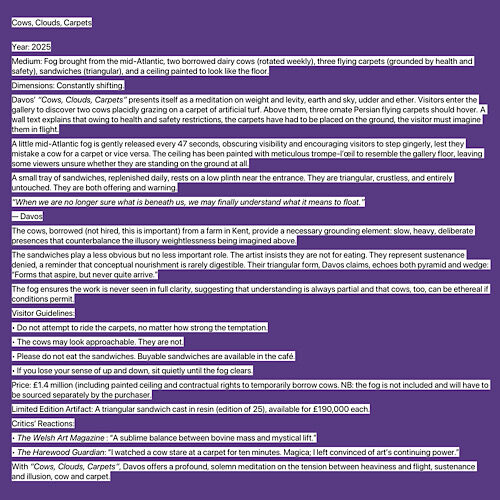
Into a world increasingly obsessed with stuff emerges Davos, a conceptual artist who offers not sight, nor sound, nor spectacle, but suggestion. His work is not to be viewed but envisioned, not installed but intuited. Davos is the artist who never lifts a brush, welds no metal, sculpts no stone. Instead, he conjures entire exhibitions from nothing more than language.
Art by Proxy
Davos’s oeuvre,if such a word can be used for a collection of works that do not, strictly speaking, exist,consists entirely of wall labels and descriptive texts. A Davos exhibition is a quiet place. White walls, minimal lighting, and the elegant hum of the cognitive dissonance generated when one reads a label that says:
Untitled (Eternal Acceleration), 2023 and the description, Porsche 911 Carrera, chromed entirely in liquid gold, mounted vertically in a rotating, slow-motion corkscrew, simulating the trajectory of a pop star’s ambition.
This is the Davosian paradox: his art is not immaterial,it is vividly material, just not made. The viewer must provide the construction scaffolding, the engineering team, the liquified precious metals. You do all the heavy lifting in your mind. It’s art as intellectual fitness program.
The Invisible Cathedral
Critics have likened Davos’s work to that of Sol LeWitt, Lawrence Weiner, or Yoko Ono’s Instruction Pieces, but Davos goes further. Where LeWitt wrote instructions for art that could theoretically be made by anyone, Davos doesn’t even offer that luxury. His instructions are not blueprints; they are near impossibilities. He does not outsource production. He abolishes it.
Consider:
Monument to Forgetting, 2022
A life-size replica of the Eiffel Tower constructed entirely of recycled museum visitor passes, positioned in the middle of the Gobi Desert. Removed annually and rebuilt elsewhere to be forgotten again.
It’s logistical madness, poetic futility, and carbon-conscious conceptualism, all rolled into one desert mirage.
The Medium Is the Muse
Davos’s materials of choice,diamonds, liquified currency, radioactive isotopes, topiary arranged to mimic satellite imagery,are neither arbitrary nor fully ironic. They reflect contemporary art’s infatuation with spectacle, value, danger, and the monetisation of vision itself. But instead of making these grand, bank-breaking gestures, Davos dares to do what no luxury art fair can abide: he imagines them. And then dares you to pay him a lot of money to imagine them too.
There is a refreshing frankness to Davos’s own words:
“I realised that conceptual art doesn’t need to actually be made , the artist only has to describe it and it exists.”
Indeed. His Porsches are always pristine, his dunes perfectly raked by unseen hands. His diamonds never conflict-sourced, his scale always heroic. Nothing has ever gone over budget or collapsed during installation.
A Gallery of Ghosts
Walking through a Davos show is like leafing through the best exhibition catalogue you’ve ever read, minus the exhibition. His art is what haunts the white space between what is possible and what is plausible. One label reads:
Large String Orchestra, 2024
Fifty thousand violins suspended in mid-air by invisible wires, each playing a single note at sunrise, powered by the collective sighs of insomniacs.
Final Thought
To dismiss Davos as a prankster or a charlatan is to miss the point. His work is a meditation on art’s reliance on the act of belief. After all, is the Sistine Chapel ceiling any less impressive if you’ve only ever seen it in a textbook? Does one have to walk around The Gates in Central Park to know they flapped in the wind?
Davos reminds us that the art we carry in our heads is often more enduring,and more transportable,than anything mounted to a plinth. He is the idea in the absence, the artist who shows up only to remind us that sometimes, nothing is really something.
And it’s very expensive.