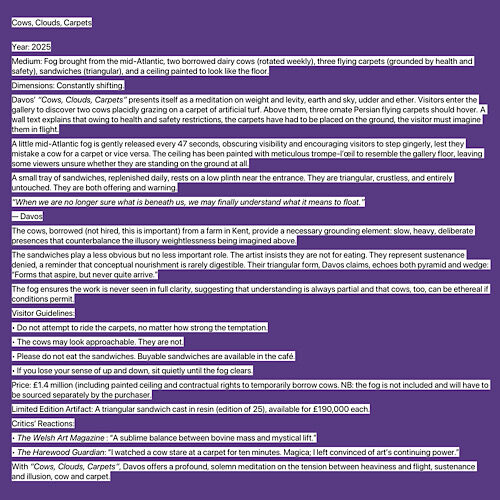
By Dr. Eloise Stranter, FRSAE, PhD (Leominster), Professor of Contemporary Aesthetics, Leominster Institute of Art
In the canon of contemporary art, where boundaries have long been dissolved and reconstituted, where meaning is often decoupled from material, and where the act of making has been interrogated to the point of exhaustion, one artist stands not merely apart, but entirely elsewhere: Davos.
I do not make the claim lightly when I say that Davos is, in my considered view, the greatest artist living today. Not the most visible,but the most important. In an era awash with spectacle, Davos offers restraint; amid the frenzied production of objects, he gives us the radical act of conceptual austerity. His works are not merely dematerialised,they are never materialised at all. And in this, he stages the most searing and elegant critique of the art world since Duchamp quietly placed a urinal on a plinth.
The Sublime of the Unmade
Davos’s genius lies not in producing objects, but in the refusal to do so. His art exists in gallery labels, wall texts, and printed descriptions,lucid, sometimes poetic, sometimes deadpan accounts of works that will never be realised. These descriptions, however, are not ancillary to an absent object. To my mind, they are the object. The text is not a placeholder; it is the entirety.
One might be tempted to compare him to Lawrence Weiner, or to invoke the linguistic provocations of Joseph Kosuth. But Davos goes further: while conceptual artists of the 1960s and ’70s often gestured toward realizability, Davos abolishes the concept of execution altogether. The material, in his hands (or mind), is not only subordinate to the idea,it is surplus to requirement.
Take, for instance, the following:
Empires of Light, 2021
A suspended chandelier spanning two city blocks, composed of fibre-optic threads woven by blind artisans across a decade. Illuminated solely by bioluminescent algae.
To stand before this label is to encounter a double experience: the aesthetic sensation conjured by the description, and the philosophical dissonance induced by its absence. The viewer completes the work, not through interactive participation, but through imaginative construction.
The Return of the Thought Object
What distinguishes Davos from his contemporaries is not simply his rejection of fabrication, but his elevation of the mental image as the supreme aesthetic form. He rescues art from the tyranny of the visible and reinstates the primacy of the idea,not as a sketch for an eventual work, but as the final, sufficient thing.
To view a Davos exhibition is to attend a kind of secular liturgy, where the faithful are those willing to see without seeing. His labels conjure works of monumental scale and impossible materials: Porsches coated in liquid gold, entire islands reshaped to resemble extinct species, an orchestra playing underwater in a lake filled with ink. These are not pranks; they are sublime thought experiments.
The unmaking of the object becomes, paradoxically, the most audacious act of creation.
Critique Without Cynicism
One might assume Davos’s work is satirical, a wry jab at the art market’s insatiable appetite for spectacle and luxury. But his work is never cheapened by irony. There is wit, certainly, but also reverence,for the conceptual traditions of art, for the imaginative capacities of the viewer, and even, curiously, for the things he never builds.
He does not merely mock excess; he surpasses it by envisioning works so extravagant, so logistically untenable, that their very unfeasibility becomes part of their conceptual architecture. He once described a piece thus:
Monument to the Unbuildable, 2020
A rotating skyscraper made entirely of ice, to be erected in the Sahara and allowed to melt in silence.
There is quiet majesty here, not cynicism. His work is a love letter to art’s most unreachable ambitions.
A New Ontology of Art
In declaring Davos the greatest living artist, I am not merely offering a provocation. I am calling for a re-evaluation of what constitutes artistic greatness in our time. At very high prices Davos offers little product, little commodity, little spectacle. He offers instead a set of ideas so pure, so meticulously constructed, that they inhabit a space usually only reached by philosophy or elemental poetry.
His work is the antidote to a culture suffocating under the weight of its own visual clutter. In Davos, we find a rare thing: an artist who does not add to the noise, but instead reveals how deeply we can hear in silence.