The Phantom deCollector: London’s Mystery Art Benefactor

London, a city of history, culture and generosity? For the past few weeks a mystery has been captivating both the art world and the public. Priceless artworks have been appearing in unexpected places across the capital,propped against a park bench, left in a quiet Tube station, even perched on the steps of the British Museum. Each piece has been accompanied by a handwritten note, usually saying something along the lines of: “Have this Monet on me.”

The identity of the benefactor remains entirely unknown. CCTV footage has been inconclusive, and no witnesses have come forward. The works themselves, however, are very real. Experts have authenticated several pieces as originals by the likes of Claude Monet, J.M.W. Turner, and even a small Degas sketch. Each could easily fetch millions at auction, and yet they are being given away as casually as a bouquet of flowers.

Some in the art world are skeptical. “It defies belief,” says Dr. Eleanor Hughes, curator at the Helena Strauss Gallery. “The act itself is almost as extraordinary as the art. If genuine, this person isn’t simply wealthy,they’re rewriting the relationship between value and ownership.”

Recipients of the artworks, ordinary Londoners who simply stumbled across them, describe the experience as surreal. One commuter who discovered a framed Monet at Charing Cross said, “At first I thought it was a prank. But then I saw the note,it was cheeky, almost playful. Whoever’s doing this has a sense of humour as well as deep pockets.”

Speculation about the mysterious donor has run rampant. Some suggest a billionaire art collector with eccentric philanthropic tendencies; others imagine an avant-garde artist staging the most audacious performance piece of the century. A few even whisper about a Robin Hood figure of the art world, redistributing cultural treasures to the public.

The police have urged finders to report the artworks, though in practice most of the lucky recipients have been allowed to keep them while provenance is confirmed. Meanwhile, social media is ablaze with reports of “sightings”,though many are hoaxes, with fake paintings left behind in an attempt to mimic the phenomenon.

Who is the Phantom Collector? And why London? Until the benefactor steps forward,or is caught,the city can only speculate. But one thing is certain: in a world where art is so often locked behind glass or hoarded in private collections, the sudden, whimsical generosity of an unknown hand has made Londoners look at their streets,and each other,with fresh eyes.

As one delighted recipient put it: “I’ve always loved London, but now I check every corner, every station, half-expecting to find another masterpiece waiting for me. It’s as if the city itself has turned into a gallery.”
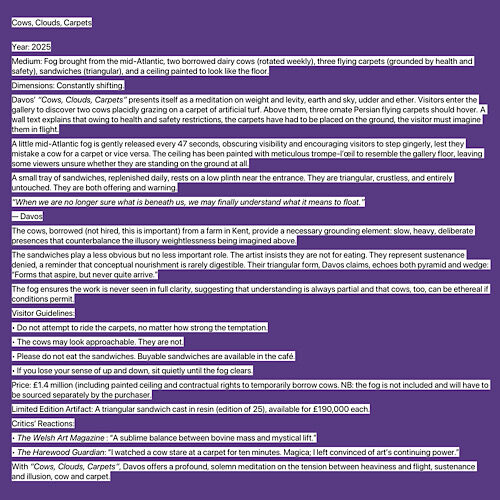
Davos: Cows, Clouds, Carpets

The greatest conceptual artist working today has made another masterpiece. Pimlico Wilde are pleased to present Cows, Clouds, Carpets to the market.

Year: 2025

Medium: Fog brought from the mid-Atlantic, two borrowed dairy cows (rotated weekly), three flying carpets (grounded by health and safety), sandwiches (triangular), and a ceiling painted to look like the floor.

Dimensions: Constantly shifting.

Davos’ “Cows, Clouds, Carpets” presents itself as a meditation on weight and levity, earth and sky, udder and ether. Visitors enter the gallery to discover two cows placidly grazing on a carpet of artificial turf. Above them, three ornate Persian flying carpets should hover. A wall text explains that owing to health and safety restrictions, the carpets have had to be placed on the ground, the visitor must imagine them in flight.

A little mid-Atlantic fog is gently released every 47 seconds, obscuring visibility and encouraging visitors to step gingerly, lest they mistake a cow for a carpet or vice versa. The ceiling has been painted with meticulous trompe-l’œil to resemble the gallery floor, leaving some viewers unsure whether they are standing on the ground at all.

A small tray of sandwiches, replenished daily, rests on a low plinth near the entrance. They are triangular, crustless, and entirely untouched. They are both offering and warning.

“When we are no longer sure what is beneath us, we may finally understand what it means to float.”

, Davos

The cows, borrowed (not hired, this is important) from a farm in Kent, provide a necessary grounding element: slow, heavy, deliberate presences that counterbalance the illusory weightlessness being imagined above.

The sandwiches play a less obvious but no less important role. The artist insists they are not for eating. They represent sustenance denied, a reminder that conceptual nourishment is rarely digestible. Their triangular form, Davos claims, echoes both pyramid and wedge: “Forms that aspire, but never quite arrive.”

The fog ensures the work is never seen in full clarity, suggesting that understanding is always partial and that cows, too, can be ethereal if conditions permit.

Visitor Guidelines:

• Do not attempt to ride the carpets, no matter how strong the temptation.

• The cows may look approachable. They are not.

• Please do not eat the sandwiches. Buyable sandwiches are available in the café.

• If you lose your sense of up and down, sit quietly until the fog clears.

Price: £1.4 million (including painted ceiling and contractual rights to temporarily borrow cows. NB: the fog is not included and will have to be sourced separately by the purchaser.

Limited Edition Artifact: A triangular sandwich cast in resin (edition of 25), available for £190,000 each.

Critics’ Reactions:

The Welsh Art Magazine : “A sublime balance between bovine mass and mystical lift.”

The Harewood Guardian: “I watched a cow stare at a carpet for ten minutes. Magica; I left convinced of art’s continuing power.”

With “Cows, Clouds, Carpets”, Davos offers a profound, solemn meditation on the tension between heaviness and flight, sustenance and illusion, cow and carpet.

Credit Cards in the Heat: How London’s Art Market is Booming in the Heatwave

As London swelters under its third record-breaking heatwave of the summer, an unexpected cultural phenomenon has emerged: the city’s fine art market is not merely surviving,it’s positively scorching. While most industries wilt under the relentless sun, London’s galleries are enjoying a sizzling renaissance, with art sales curiously tracking the mercury.

The trend first came to light when the Pimlico Wilde Gallery,a chic haven known for its devotion to everything from emotionally tormented surrealists to conceptual Invisibilists,reported a 63% increase in sales during last month’s 34°C scorcher. “We assumed people would stay home,” said co-director Imogen Saffron-Blaire, “but instead they came in droves, sweating into our parquet floors and walking out with six-, seven-, or even in some cases, eight-figure works by some of our top artists.”

The Pimlico Wilde Gallery is not alone. The Hoxton Vortex2, an avant-garde container-turned-gallery currently exhibiting “Post-Apathy: Art After Motivation,” saw record footfall during July’s most oppressive days. Curator Bastien K. Larkspur noted: “Our patrons seem to be drawn by the promise of air conditioning and existential abstraction. They arrive hot and disoriented, and leave £400,000 lighter with a taxidermied mackerel dipped in resin or one of Cecilia Norton’s sculptural snow domes.”

Art meteorologists,yes, they exist,have taken note. According to an internal report leaked from the new British Association of Climate-Responsive Galleries (BACRG), every one-degree Celsius rise above 27°C corresponds to an estimated 12% increase in spontaneous art purchases across the capital. The effect is more pronounced in emerging collectors, who BACRG describes as “emotionally vulnerable to both sunlight and suggestion.”

But why the heat-induced buying spree? Theories abound. Some say extreme weather triggers a latent aesthetic yearning,a subconscious craving to “cool” oneself with beauty. Others suggest that the city’s wealthier patrons, abandoning their usual haunts in Provence or Umbria, are trapped in London and looking for ways to justify staying indoors. A more philosophical explanation posits that melting ice creams and perspiring pedestrians stir deeply buried anxieties about mortality, which art,preferably oil on canvas,helps to temporarily alleviate.

Even the most cynical dealers are leaning into the meteorological muse. Mayfair’s new Galerie Ébouillanté Rouge , helmed by the irrepressibly Andréus-Harlem Knox-Burleigh, now offers “temperature-tiered pricing,” with discounts inversely proportional to how hydrated you are upon entry.

Thanks to the British Association of Climate-Responsive Galleries, more is understood about the links between sunshine and art purchase. A new financial instrument, the Fine Art Sun Index will soon be tracking movement in this newly discovered relationship. In a controversial draft white paper leaked to The Biggen Hill Literary Supplement, the BACRG has proposed a radical new strategy for “cultural climate sales enhancement.” The plan? Raise UK temperatures year-round using an ambitious network of underground thermal ducts beneath art districts like Shoreditch, Fitzrovia, and Hampstead. “If more heat equals more art sales,” reads the summary, “then let there be sun.”